When Power Begins to Fear the Pen: The FBI’s Knock on a Journalist’s Door !
By Raja Zahid Akhtar Khanzada
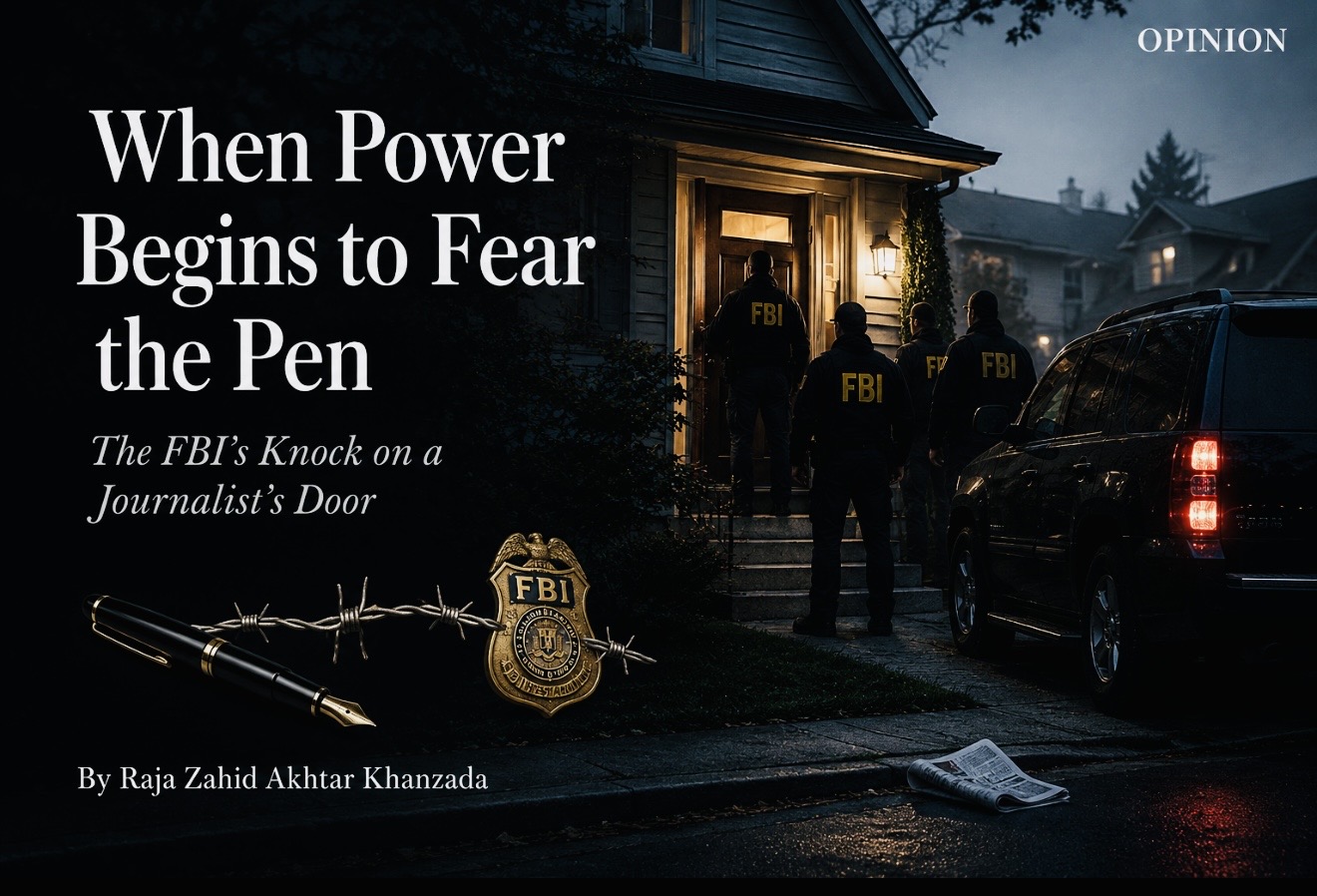
Six in the morning is that hour when the world has not yet woken from its sleep, when silence stands sentinel over the streets and the leaves of the trees remain still beneath the weight of their own dew. In an unremarkable house in the American state of Virginia, the silence of that very hour was broken by a knock at the door, the knock of the federal investigative agency known as the FBI. Inside the house a young woman of twenty-nine, a journalist, was sleeping. Her name was Hannah Natanson, and her only crime was that she had spoken with more than a thousand officials of her own country and told the American people the truth that their own government had been hiding from them. The agents took her phone, they took her laptop, they took her recorder, they even took the Garmin watch from her wrist. They were, in effect, gathering up the labor of her entire life and carrying it away with them, and the astonishing thing is that no charge of any crime had been brought against her, no charge of espionage, no charge of treason, no charge of any conspiracy whatsoever. She was simply a journalist who had done the work for which journalism exists.
This is not some country of the third world. This is the America where it is said that the freedom of speech and the freedom of the press belong to every citizen, and that this freedom was granted to its people by the Constitution of this land, a Constitution whose dignity every person is bound to honor.
Three months later, on the morning of the fourth of May, in an institution in New York, the highest honor of American journalism was bestowed upon that very reporting. The Pulitzer Prize Board awarded The Washington Post the Gold Medal for Public Service and declared that the newspaper had pierced the veil of secrecy around the Trump administration’s chaotic overhaul of the federal agencies. The distance between these two moments is not merely a distance of four months. It is the journey of an entire civilization. In January the state had decided that the tongue which speaks the truth must be silenced, and in May the most respected pulpit of journalism declared that no, this is precisely the voice we are duty-bound to protect. The distance between these two moments is the truest mirror of the present condition of American democracy.
There is a serious argument here that compels us to take ourselves by the collar, because the real test of power is not the moment when it confronts an enemy. The real test is the moment when it stands before its own citizens and chooses to become a wall rather than a doorway. Every government has the right, indeed the responsibility, to do its work better, but the distance between reform and ruin is the distance between earth and sky. Reform is undertaken with people, not against them. And the work that the Trump administration began in the name of the Department of Government Efficiency, known as DOGE, appeared on paper as reform and revealed itself in practice as an institutional earthquake.
In the single year of two thousand twenty-five alone, more than two hundred and sixty thousand federal employees walked away from their jobs. The IRS, Social Security, and all the agencies upon which tens of millions of American citizens depend, were hollowed out from within. Then, at the beginning of two thousand twenty-six, that same government was quietly compelled to rehire some twenty-five thousand of those very workers, because at last the realization arrived that the business of the state requires trained hands. Even Elon Musk, who had led this experiment, conceded in December that his efforts had succeeded only in some limited measure and that he would not repeat the experiment again. This was not reform. This was chaos dressed in the becoming garment of efficiency. And this was precisely the story that Hannah Natanson had laid before the world.
For months she walked among those federal employees whose careers had been brought to a sudden halt, in whose homes the cooking fires were close to being extinguished, whose children’s school fees were drifting into debt. She built her bonds with one thousand one hundred and sixty-nine human beings, each one of them the breadwinner of a family, who placed their trust in her that she would carry their stories to the world. This was no ordinary trust. This was the trust that a career civil servant places in the hands of a journalist by putting his job, his pension, the very roof above his family at risk, in the hope that perhaps somewhere a single ray of truth might still survive, and that perhaps somewhere justice might still be possible.
Then came that morning of the fourteenth of January, two thousand twenty-six, when the FBI stood at the door of that house in Virginia. On paper the raid was being carried out in connection with the investigation of a Pentagon contractor named Aurelio Perez-Lugones, who had been accused of mishandling classified material. The government announced that Natanson herself was not its target. But there was a serious problem which the administration chose to ignore. When the Department of Justice applied for the search warrant, it did not so much as mention the Privacy Protection Act of nineteen-eighty, that law which had been crafted for the express purpose of shielding the work of journalists from the hands of the state, a law whose violation requires extraordinary circumstances and the personal authorization of the Attorney General himself. The state trampled, with its own feet, the very protective wall it had once built with its own hands.
And there was a further bitter irony. The current Attorney General, Pam Bondi, had just last year rescinded the policies her predecessor had crafted to protect journalists from Department of Justice subpoenas, except in matters of national security. The road, in other words, had already been cleared so that in the days to come, knocks at journalists’ doors might become possible.
Then Magistrate Judge William Porter delivered his ruling. He granted The Washington Post’s request that the government preserve, but not review, the seized devices until the court authorized otherwise. Later, U.S. District Judge Anthony Trenga maintained the same position and, for a second time, blocked the Justice Department from sifting through those devices. Bruce Brown, the president of the Reporters’ Committee for Freedom of the Press, observed that physical searches of reporters’ devices, homes and belongings are among the most invasive investigative steps law enforcement can take, and that specific federal laws and Department of Justice policies exist precisely to limit such searches to the most extreme cases, because they endanger confidential sources far beyond a single investigation and impair public-interest reporting in general.
It is here that the story turns at a new bend, and that bend revolves around Kash Patel. Patel is at present the Director of the FBI. This is among the most sensitive positions in American democracy, an office about which the long American tradition has held that it requires patience, it requires credibility, and it requires the understanding that one serves the Constitution, not one’s personal reputation. But in the conduct of Director Patel something very different has come into view. In April, The Atlantic published a report based on the investigation of its journalist Sarah Fitzpatrick, in which more than two dozen sources spoke of his alleged irregular drinking and his unexplained absences.
Patel’s response was the response of a man who had begun to imagine himself to stand above the law. He filed a defamation suit against The Atlantic for two hundred and fifty million dollars. This is not the language that can ever belong to the head of a law-enforcement agency. This is the language of those who have begun to mistake an institution for their personal estate. And the prevailing opinion of legal scholars is that this lawsuit will not survive the courtroom, because the standard of defamation for public figures in American law is extraordinarily strict. A public official must prove that the publisher knew the story was false and published it anyway, the legal standard known as actual malice. This is precisely the point at which the one who issues threats may find himself caught in his own net, because if the case advances, Patel himself will have to answer, under oath, the very questions he filed this lawsuit to escape.
There is a meaning here that it is essential to grasp. The raid at six in the morning at Hannah Natanson’s door was not merely a raid on the home of a single woman. It was a message addressed to those one thousand one hundred and sixty-nine informants who had not yet opened their mouths, a warning to those young journalists who are only now setting foot in this profession, a reminder to those editors who sit down to approve sensitive stories. This is precisely what is called, in American legal terminology, the chilling effect, that cold wave which has not yet taken the form of any law but which whispers into the ear of every conscience that silence alone is safe. When a government begins to view the press as an enemy, it does not first attack the press. It first poisons the very air in which truth must breathe.
And all of this was unfolding at a moment when the American government was already operating in the shadow of an unusual secrecy. The decisions of DOGE were being made behind closed doors. The lives of millions of Americans were being affected and those millions did not even know what was being done to them. Natanson’s reporting was the only window through which any light was entering. If that window too were to be sealed, then transparency would not remain, oversight would not remain, only power moving in the dark would remain. And the next step of power that moves in the dark has always, throughout history, been a step toward cruelty.
The argument may, on its surface, be made that all of this finally backfired. Natanson received the Pulitzer. The courts shamed the government. Institutions like the Committee to Protect Journalists and the Reporters’ Committee for Freedom of the Press raised their voices openly. All of this is true, but inside this truth there hides a dangerous innocence. The strategy of intimidation does not require a legal victory. It requires only a single silence. A lawsuit lost in court still consumes years of a newspaper’s time and money. A raid declared unlawful still leaves a trembling hesitation in the heart of the next journalist. The objective is not always to win. Sometimes the objective is only that the next human being should think a hundred times before deciding.
And there is a further bitter truth from which one cannot turn away. The Pulitzer Prize, which was once regarded as the badge of a shared American value, has now itself fallen prey to political division. Half the country called it a victory for the freedom of the press, and the other half dismissed it as a political statement. When the freedom of the press becomes a partisan dispute rather than a common American value, a society enters a territory from which the road back is not found for many generations. Because the First Amendment is the property neither of Democrats nor of Republicans. It is the right of the American people, and when it is forged into a weapon of the cultural war, in the end everyone bears the loss, the attacker as much as the defender.
The question now is what road lies ahead. The actual case against Perez-Lugones still sits in the courts. Natanson’s devices remain locked in a legal limbo whose duration no one can name. What the government extracted from those documents, what it learned about her sources, all of this still hides behind a curtain that the public has not been permitted to draw aside. Kash Patel’s lawsuit against The Atlantic may not survive the courtroom, but the very existence of this lawsuit is itself a message, a reminder that power wishes to answer criticism with cash.
But the largest question is not what becomes of Patel, or of The Atlantic, or of when Hannah Natanson’s equipment is finally returned to her. The largest question is whether this chill will break after the Pulitzer, or whether the government will tighten its grip and call the tightening discipline. Whether Congress will at last fulfill its constitutional duty, or whether this episode too will pass before our eyes the way so much has passed in recent years, dissolving into the ordinary rhythm of headlines, swallowed by the next news cycle and the one after that. Whether American citizens, regardless of what political tribe they have made their home in, can agree on this much at least: that the FBI standing at a journalist’s door at six in the morning is a thing alien to the spirit of the very democracy that was built two and a half centuries ago upon the explicit refusal of such mornings.
History has a way of teaching the same lesson again and again, and the lesson is that democracy has never been a spectator’s game and was never meant to be one. It is a tree that must be watered by the sweat of every generation that hopes to sit in its shade, and the generation that begins to think of it as a thing already given, already secured, already beyond the reach of ruin, that generation will one day find itself standing in a clearing where there is no shade left, wondering how the sun became so cruel. The relationship between a free press and a functioning government is not meant to be a relationship of enemies. It is, in fact, the oldest understanding of the republic, that the press holds the government to account and the government serves the people, and when this balance holds, everyone is the richer for it, even those who sit in power, because public trust is the only capital that no treasury can print and no law can manufacture.
And let it not be forgotten that the leaking of classified information is a serious matter and must be investigated. There is no doubt about that. But the avenues for such investigations already exist, shaped by the long patience of legal tradition. There is the Privacy Protection Act. There is the system of subpoena. There are the established methods of negotiating through counsel, methods that have, for decades, allowed the state to pursue its legitimate interests without breaking down a journalist’s door before sunrise. These protective walls were not raised by accident, and they were not raised out of sentimentality. They were built from the hard lessons of history, from the memory of what happens when governments begin to imagine the press as an enemy. What happens is this: fear takes up residence in the society, and where fear has made its home, freedom always finds its bags packed by morning.
And yet, even in the darkest scene, a single lamp continues to burn. The courts performed their role. Judge Porter and Judge Trenga discharged their duty with a clarity that should make the rest of the judiciary lift its head a little higher. The Pulitzer Board took an unambiguous stand at a moment when ambiguity would have been the easier path. The long procession of American journalists did not halt, did not turn back, did not whisper among themselves that the cost was now too high. A twenty-nine-year-old woman stood firm in her mission while the most powerful law-enforcement agency on earth stood at her door before the sun had risen. This was not merely courage, although it was certainly courage. It was the announcement of a faith older than any republic, the faith that truth carries within it a power which no warrant has yet learned how to seize. But these victories are fragile. They will endure only so long as the conscience of the citizens remains awake. They will endure only so long as we refuse to accept intimidation as the new shape of normal life. They will endure only so long as we remember, and teach our children to remember, that the freedoms we today inhale as effortlessly as the air itself reached us through the sacrifices of generations who paid for them in coin we never had to count.
And in the end there is a question that now moves through the American air, a question every citizen must ask of himself. Do you wish to live in a country where the government decides which stories are told, or in a country where the truth is granted, at the very least, a fighting chance? The question does not belong to Americans alone. It never did. It belongs to every society where the long rope-pulling between power and truth continues, whether that society sits in Washington, or in Islamabad, or in Delhi, or in any of the countless other places where journalists go to bed each night wondering whether morning will bring the sound of boots on their stairs. When power begins to fear the pen, understand then that the society in question is standing at the edge of some great transformation. That transformation can move toward light, and it can move toward darkness, and the direction it takes will be decided by no senator, no judge, no editor, no president. It will be decided by where the citizens of that society are standing in that moment, as silent spectators on the far side of the field, or as the company of a conscience that has chosen at last to wake.
The raid on Hannah Natanson was one piece of news. The Pulitzer was another. But the silent argument that runs between those two pieces of news, the argument that no headline has yet been wide enough to contain, that is the real story. And that story is not yet finished.