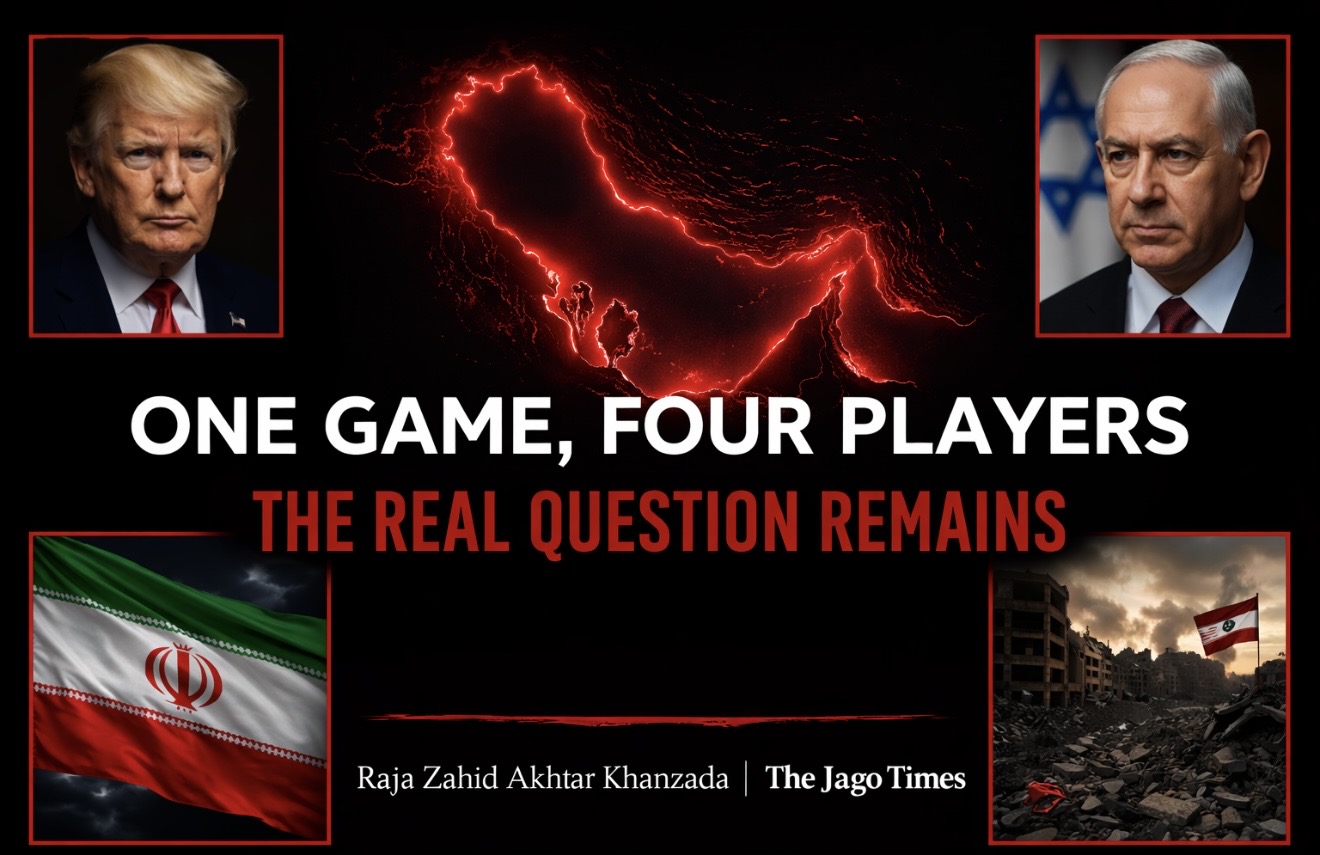
Peace or Strategy? Trump’s Contradictions, Global Skepticism, and the Game of the Strait of Hormuz
By : Raja Zahid Akhtar Khanzada
I want to say something to you, and I am not saying it because it will be easy to hear. I have spent considerable time — writing columns, reading the statements of world leaders, studying the analyses of independent thinkers here in America and abroad — and what I have come to understand about this moment, about these negotiations, about this so-called peace, is something that cannot be left unsaid. Because if we do not understand it today, we may not have the opportunity to understand it tomorrow. What is happening right now on the waters of the Strait of Hormuz, and on the screens of the world, is not peace. It is the image of peace. And there is a difference between an image and a reality — the same difference that exists between a face seen in a mirror and the face itself. A reflection, yes. But reversed.
The world does not believe powerful nations because those nations tell the truth. The world believes them because it has no other choice. And that is precisely where I want to take you — into that silence, beneath the announcements and the press releases and the carefully worded statements, where the real story is being written.
The Strait of Hormuz has opened. That is a fact. That is a headline. But at the very same moment, the naval blockade against Iran continues in full force. That is also a fact. That is also a headline. And both of these facts emerged from the same mouth, on the same day, spoken with the same unshakeable confidence. President Donald Trump declared that the Strait of Hormuz was open for business. He also declared that the naval blockade would remain. In one breath he spoke of a completed deal; in the next, of B-2 bombers and nuclear dust. On one side, peace. On the other, the language of annihilation.
I ask you plainly: when a man speaks of war and peace in the same sentence, which word do you believe? And why?
This contradiction is not accidental. Accidents are not this consistent. This is strategy — old, practiced, and deliberate. It keeps the adversary off balance. It moves markets up and down, and there are those who will quietly profit from that movement. It tells the domestic audience that their leader is simultaneously a lion and a peacemaker. Three objectives, achieved at once. Trump understands this art, and he deploys it fluently.
But there is something even more revealing than the contradictions themselves. At one point, Trump referred to the waterway as the “Strait of Iran” — and then, almost immediately, corrected it to the “Strait of Hormuz.” Some will call this a slip of the tongue. I call it something else. When the leader of the world’s most powerful nation cannot, in the heat of the moment, recall the correct name of the most consequential waterway in the region — or when his narrative is moving so quickly that geography itself becomes negotiable — it tells us something important: what is being said has not been fully thought through. And a peace built on words that have not been fully thought through is not a peace at all. It is a performance.
Now let me bring you to a reality that receives very little attention on Pakistani television screens.
John Mearsheimer. Jeffrey Sachs. Douglas Macgregor. Scott Ritter. These are not government spokesmen. They are not servants of any single nation’s interests. These are men who have studied power at close range, who have watched history move and recognize the shape of what is happening now. And they are saying, collectively and clearly, that this is not peace. This is a strategic pause. A moment in which every party is quietly repositioning itself.
They argue that two games are being played simultaneously. The first is short-term: bring oil prices down, calm the markets, create the political impression of a victory. The second is long-term, and it is the one that never appears in the headlines — the management of global power. Containing China’s expanding influence. Limiting Iran’s emergence as a major regional force. Protecting the primacy of the petrodollar in an era when its dominance is being quietly challenged. Serving Israel’s strategic demands. Securing new long-term revenue streams for American interests. This is the game that does not run on screens. It runs in results — years from now, when we look back and say, quietly, to ourselves: ah. So that is what was happening.
And this is precisely the moment where I want you to stop and think.
Look at Iran’s position. In the days following the ceasefire, as Israel moved against Lebanon, Tehran opened the Strait — then closed it — then opened it again as a gesture of goodwill. It spoke of peace. But in the same breath it made its conditions unmistakably clear: if sanctions remain, if frozen assets are not returned, if the embargo on Iranian oil exports continues, then that gesture of goodwill can be reversed. Iran has not offered peace. Iran has offered a conditional pause. And a conditional pause is not peace — it is an open door with a hand still on the handle.
Then look at Israel. Look carefully, because this is where the story becomes most transparent.
Israel has refused, without ambiguity, to accept this process as genuine peace. Its position is stated plainly: this is a ten-day temporary ceasefire with the Lebanese government — not with Hezbollah — and nothing more. Israeli forces are not merely present in southern Lebanon; they have established a security zone extending ten kilometers into Lebanese territory. Hundreds of civilians have been killed. Nearly a million people have been displaced. And Israel has made its intention clear: it will not stop until Hezbollah is destroyed. It will maintain its positions. It will continue operations if it deems them necessary.
I ask you: is this a defensive measure? No. This is territorial control. This is the language armies use when they do not intend to leave. What Iran reads as a broad peace framework, Israel reads as the preparation time for the next phase of war. Both exist in the same moment, on the same geography, within the same conflict — and yet they inhabit entirely different realities.
And in the middle of all of this — Lebanon.
I will not call Lebanon a character in this story, because Lebanon is not a character. Lebanon is a nation. A nation that breathes, and loves, and dreams, and is today paying the full price of everyone else’s strategy. More than a million people displaced. More than two thousand lives lost. Thousands of homes reduced to rubble. A vast portion of the country emptied. And still, on the screens of the world, the announcements of peace continue to scroll. This is the moment when I understand something with absolute clarity: history does not lie to us. We lie to history.
Now we must speak about Pakistan, because this is our own matter, and we cannot look away from it.
There is a particular kind of hope in the Pakistani media these days. A momentum. A declaration that Pakistan has made history — that Islamabad served as the bridge between Washington and Tehran, that the engagements of Prime Minister Shehbaz Sharif and Field Marshal Asim Munir signal something historic approaching, that a possible visit by the American president will seal this achievement permanently.
I do not dismiss this hope. I do not call it a lie. I believe that a genuine and positive diplomatic role has emerged, and that it is being acknowledged at the international level. But I also believe that hope and reality are not the same thing. Great historical agreements are not reached in one or two meetings. They require months, sometimes years, of patient and unrelenting negotiation. The question is whether Pakistan’s role will translate into something lasting — or whether it, too, is simply a piece of a larger game, significant for a moment and then quietly moved aside.
I raise this question not to diminish Pakistan. I raise it because if we inflate our success beyond what the evidence supports, the disillusionment, when reality arrives, will be as deep as the hope was high.
I have observed, across many years and many crises, that the people who speak most loudly of peace are often the very ones who are most quietly preparing for war. This is not conspiracy. This is the logic of power — ancient, consistent, and indifferent to our preferences. It operated in the decline of Rome. It operates today. It will operate tomorrow.
Two narratives now run in parallel across the world. The first says that a breakthrough is near, that diplomacy is succeeding, that peace is arriving. The second says that this is nothing more than a positioning exercise — the silence before a larger move, with the real game still ahead. Iran says the war is ending. Israel says the war is not over. America speaks both languages simultaneously — sometimes in the same sentence — and Lebanon pays the price of all of it, quietly, without being asked.
I want to say something to you now, and it may be difficult to read. The world we inhabit is not divided between good and evil. It is divided between interests. And every nation, every leader, every party that makes the loudest declaration of peace is serving some interest in that declaration. That is not cynicism. That is the record of history, and the record of history does not flatter us.
Perhaps the most honest sentence that can be written about this entire moment is this:
The greatest announcements of peace are most often made precisely where the war has not yet ended — where it is simply entering its next phase. And we, who listen to those announcements, choose to believe them, because believing is easier than questioning, and questioning costs something that comfort is not willing to pay.
But this is the moment for questions. Pakistan’s leadership is working with genuine commitment toward peace, and that effort is not nothing. Yet the contradictions pouring from Washington and Tel Aviv leave us standing before a question we cannot avoid: Is this truly a journey toward peace — or is Israel, through a carefully constructed long-term strategy, using American power to advance its own objectives, drawing all of us, Pakistan included, into a game whose rules we did not write and whose ending we cannot yet see?
That question is painful.
But the questions that cause the most pain are almost always the ones most necessary to ask.