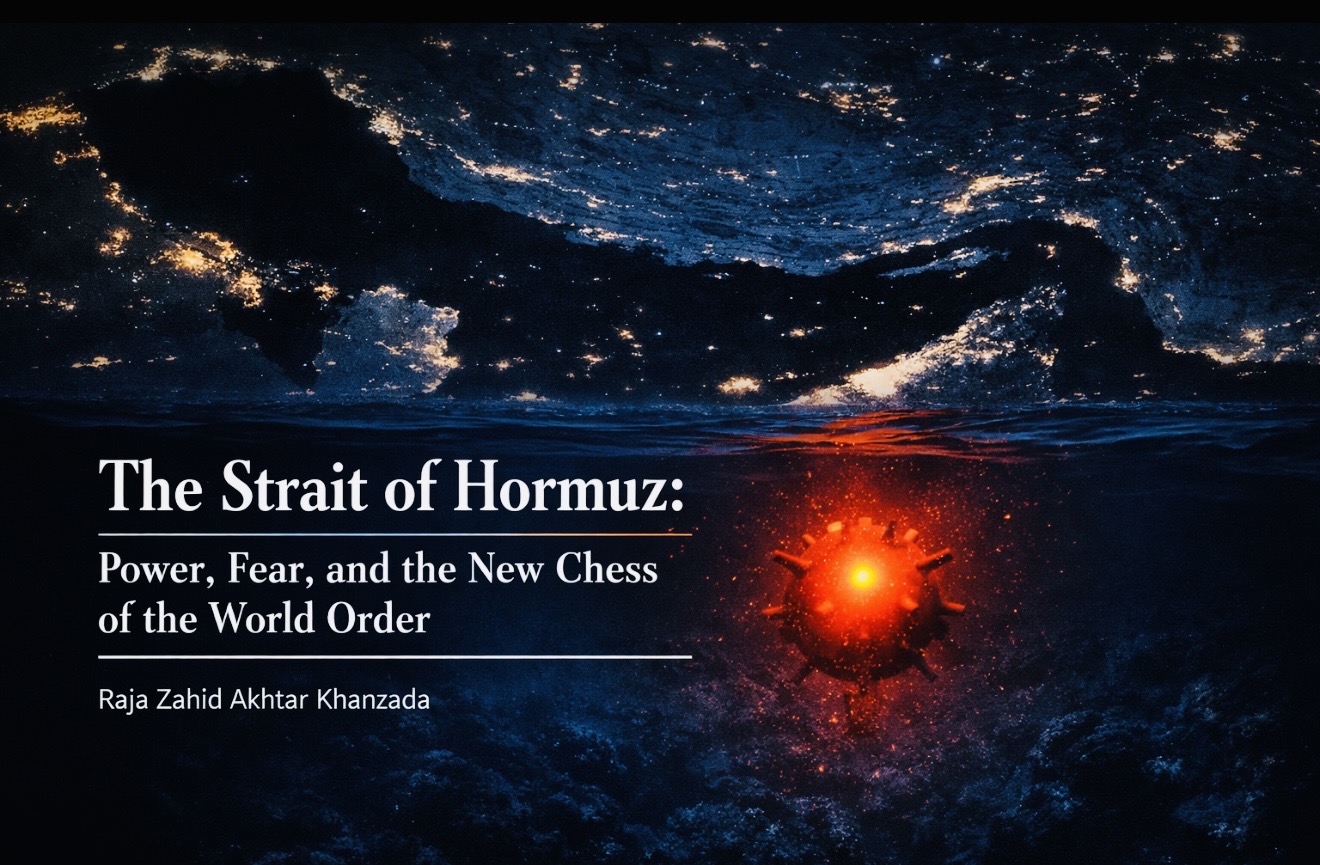
The Strait of Hormuz: Power, Fear, and the New Chess of the World Order
By: Raja Zahid Akhtar Khanzada
Imagine a scene. It is the dead of night. The sea, from above, appears perfectly still. But beneath its surface, fear and power, commerce and war and politics, are all moving together. The Strait of Hormuz is the name of that stillness — quiet, but lethal. On a map, it is merely a narrow channel between the Persian Gulf and the Gulf of Oman. In reality, it is the jugular vein of the world. The ships that pass through it carry more than oil. They carry the liquidity of the global economy, the confidence of markets, the domestic politics of nations, and the credibility of great powers. If one must know the conclusion now, it is this: the world has neither entered a complete war nor returned to a complete peace. The real crisis is that a passage whose openness has been a foundational principle of American strategy has become, today, a proving ground — tested between American power and Iranian patience, European hesitation and Russian opportunism, Chinese interest and the fear of the global market.
This is not the first time the Strait has reminded the world of its true importance. The events of April 1988 are still studied in American naval and military history as a decisive example. The USS Samuel B. Roberts struck an Iranian mine. That moment was not merely a maritime accident. It was a warning — one that showed Washington that the balance of power at sea is not maintained by aircraft carriers, missiles, and declarations alone. America responded with Operation Praying Mantis, targeting Iranian naval installations, platforms, and military assets, delivering the message that challenging American power in the waters of the Gulf is not a simple undertaking. But 1988 gave another lesson — perhaps a deeper one: that a mine is not merely a piece of steel and explosives. It is an instrument of fear, capable of paralyzing global commerce at the psychological level. Whether there is one mine in the water or ten, whether there is only a rumor of mines — ships change course, insurance premiums rise, markets shudder, and the confidence of the world fractures. The question worth asking now is whether Washington, having once learned that lesson, has walked back into the same trap.
Since the Carter Doctrine, American policy has held that keeping the Strait of Hormuz open is a non-negotiable component of American national interest. The reason is not merely that oil passes through it. It is that the power which controls the opening or closing of that passage holds its hand upon the nerve endings of the global economy. This is why the question of the Strait is not simply naval or military — it is an entire strategic philosophy. But today the question must be asked: if this principle was the foundational pillar of American strategy, why did America so readily enter a state of tension — or something close to war — whose first and most obvious consequence was to make that very passage unsafe, choked with fear and obstruction? Was the full picture of the outcome considered at the moment the first step was taken? Had Washington thought through what the next move would be if Iran turned its geography into a weapon? Or was force applied first, with strategy to be determined afterward?
The gravity of the present crisis lies precisely here — not only in the military dimension but as a profound strategic revelation. The American Navy is today preparing to contend with the threat of mines in this very region, but at a moment when it has drawn down its proven Avenger-class mine countermeasures capability and shifted reliance to the relatively newer and less battle-tested Littoral Combat Ship. On paper, this was called modernization. Unmanned systems, remote sensors, drones, modular packages — all of it sounds impressive, even elegant. But the sea does not open itself to PowerPoint presentations. The question that must be asked is whether being modern is always the same thing as being more effective. Whether, in large-scale combat situations, it is the theoretically beautiful systems that succeed — or those that have passed through years of experience, continuous training, operational endurance, and proven performance. This is precisely the point on which American experts have warned for years: mine warfare is not a domain where technology alone is sufficient. It demands patience. It demands trust. It demands sustained large-scale operations. It demands a capacity that can eliminate not just the mine — but the fear of the mine.
In this context, the statements and operational signals coming from CENTCOM carry extraordinary weight. American military command has always projected the image that it possesses the capacity to take whatever steps are necessary to defend freedom of navigation and regional stability. But the distance between that claim and ground reality becomes visible when the problem is not merely stopping a single attack — but restoring confidence across an entire maritime environment. If CENTCOM says the passage can be made safe, the question is: to what extent, for how long, and at what cost? Can a few warships, a limited corridor, a handful of mine-clearing operations dissolve the psychological crisis that has already taken up residence in the minds of ship owners, insurance companies, purchasing states, and global markets? If the answer is no, then the Strait may be open on paper while remaining closed in reality.
This is precisely why the reference to 1988 is not merely a historical memory but a key to understanding the present crisis. Even then, America demonstrated military superiority — and yet eliminating the fear at sea proved a far more complex undertaking than any military response. Today the situation is still more precarious, because the world’s energy markets are far more deeply interconnected, insurance far more sensitive, supply chains far more fragile, and fear travels far more quickly into global prices than it did before. When the head of the International Energy Agency warns that the present crisis could prove more severe than the energy shocks of 1973, 1979, and 2022 combined, that is not an ordinary statement. It means that this time the problem is not merely a supply shock — it is the uncertainty of the passage itself. The question is no longer where the oil will come from. The question is whether it can pass through safely at all.
America’s position is its own, and it is completely clear. Washington says Iran is holding global commerce hostage, refusing flexibility on the nuclear question, and converting the Strait of Hormuz into a weapon. In the American view, naval blockades, mine clearance, demonstrations of force, and firm responses are necessary precisely so that freedom of navigation is preserved and a regional power cannot hold the global economy as ransom. But Iran’s position is equally unequivocal. From Tehran’s perspective, it is defending its geography, its sovereignty, and its strategic interests. Iran argues that America uses the language of negotiations to impose its own conditions, shifts the framework at will, and then seeks to extract results through military pressure. The truth stands between these two narratives — on one side, America, which considers itself the guardian of the global order; on the other, Iran, which has converted its geography into its greatest bargaining power.
And this is precisely where the real complexity begins — because a war fought on water is never only a naval war. The mine here is not merely a military weapon. It is a psychological instrument. A single mine’s detonation damages one ship, but its news travels through the world’s markets, insurance rates, shipping routes, and governmental decisions like an electric current. So when America says it will open the passage, the real question is not whether it can push a few ships through. The real question is whether it can convince every ship owner, every insurance company, every purchasing state that next week, next month, or tomorrow night, no new mine, no new threat, no new warning will surface. If it cannot, then the victory will be partial, not complete.
This is why many analysts are raising the question of whether America looked at this conflict from the point of entry rather than the point of outcome. Airstrikes, blockades, naval power — all of these can generate pressure, but did they reckon with the foundational reality that Iran’s most effective response is perhaps not its air force or its missiles, but its geography? Iran has the Strait. It has time. It has endurance. And now, as the balance of power among great powers shifts, it may find itself with even more political room to maneuver. America has power — but does it have the same patience? Does it have the same diplomatic flexibility? Does it have the kind of alliance-building that, in situations like this, leaves a more enduring impression than military force alone?
Here the role of Britain and Europe becomes critically important. The British Prime Minister’s current posture has become a kind of emblem of this entire crisis. He is neither aligning fully with America nor maintaining complete distance from it. The apparent effort to convene forty nations, or to move toward a broader diplomatic framework, signals that Europe does not wish to leave this crisis entirely to American or Iranian logic. This is why the question being raised again and again among global analysts is whether this represents a coordinated strategy — America applying pressure while Europe extends olive branches — or whether a genuine fracture has opened within the Western alliance. Some circles read it as a good cop, bad cop arrangement. Others call it real disagreement. And a third view — perhaps the most realistic — is that the crisis is being managed at just enough of a distance that a way back remains possible.
Russia’s role is no less significant. Moscow has neither opposed American action in terms that would constitute direct confrontation, nor offered support that would place it in America’s column. Most global analysts read this as an opportunistic posture. In their view, Moscow wants America further entangled in the Middle East — under pressure on both the energy and security fronts — while Russia consolidates relatively stronger positions in its other strategic theaters. China’s situation is still more sensitive. For Beijing, the Strait of Hormuz is not merely a regional dispute but the passage through which its energy, its industry, and the future momentum of its economy must flow. If Beijing senses that Washington intends to establish long-term dominance over this chokepoint, it will not remain silent. This is why the crisis is no longer being read merely as American-Iranian tension, but as a broader global chess match in which every power maintains its own separate account.
The scene along the southern Lebanese border adds another bitter truth to this entire picture. The doors of empty houses swing in the wind. Streets are deserted. Villages have fallen silent. Nearly a million people have been displaced from their homes. International condemnation followed. Concern was expressed. Human rights organizations spoke. But the ground reality did not change. This reminds us that modern crises never unfold on a single front. When the world’s gaze is fixed on Hormuz, on oil, on the great game of power — at that very moment, on the ground, human geography is being quietly, irrevocably altered. Where populations cease to exist, control shifts of its own accord. This is the silent strategy that the world sees but rarely manages to stop in time.
If one must give this entire crisis a single defining description, it is a struggle unfolding on three levels. On the first level, America and Iran face each other directly. On the second, Russia, China, and the other great powers are calculating their own interests. On the third, Europe and other middle actors are attempting to keep the fire from becoming a full-scale war. And at the center of it all, the most powerful element of all is fear. Fear in the sea. Fear in the market. Fear in the voter. Fear in leadership itself.
For America, the political cost at home may also be rising. Gasoline prices climb, inflation bears down, the voter grows restless, and every foreign crisis eventually enters domestic politics. This is the precise moment at which the real definition of power reveals itself. Real success is not measured in how much damage you have inflicted on your adversary. It is measured in whether you have opened the passage, restored confidence, contained the threat, and left your credibility intact and believable. If the Strait is still gripped by fear — if Iran still holds its fundamental bargaining power — if China is still present in the picture — if the allies are not unified — if oil remains expensive — if the navy is mired in the slow and complex challenge of mine warfare — then what remains of the definition of victory?
The realistic scenario for the future is not that the Strait of Hormuz will be completely sealed shut, nor that it will return immediately to normal. The more probable outcome is that it becomes an expensive, limited, fearful corridor that opens intermittently. Ships will pass, but at greater cost. Insurance will rise. Security will be heightened. Political risk will be embedded in every transaction. If America holds to its current hard line, the danger of limited naval conflict may increase. If diplomacy is revived, a transitional accommodation is possible — but it will not come through the force of arms alone. It will require trust, mediation, and a genuinely multilateral framework in which Europe, the Gulf states, perhaps Oman, perhaps Pakistan, and possibly other behind-the-scenes actors each contribute their part.
This is the essence of the entire story. The Strait of Hormuz is no longer merely a waterway. It has become a mirror — reflecting American strategic calculation, Iranian endurance, European arithmetic, Russian opportunism, Chinese interest, naval power, the psychological weight of mines, the fragility of global commerce, and a crisis of political credibility. The question now is not only how many mines are there. The question is how much fear is there. How much diplomacy remains. How much leadership remains. And perhaps the largest question of all: does America still believe that every crisis can be opened with military force — or is it entering a moment in which it must acknowledge that some wars become a strategic trap at the very instant they begin?
If one last question could be put to any honest analyst today, it would perhaps be this: will it truly be naval power that opens the Strait of Hormuz — or will what is ultimately required to open it be the very thing America has called its greatest strength for decades? That is to say: credibility.