Peace or Pause? Islamabad, Hormuz, and a World Suspended Between Power and Promise
By: Raja Zahid Akhtar Khanzada
There are moments when the news stops being information and becomes something else entirely — becomes, in fact, a story being written in real time, with consequences that none of the authors fully understand and none of the characters can escape. I am writing these words at eleven o’clock on a Sunday night in America, which means it is nine o’clock on a Monday morning in Pakistan. For the past several hours I have been reading — American media, Trump’s statements on Truth Social, diplomatic signals, field reports — trying to assemble these fragments into a coherent picture. And the more carefully I look, the more clearly I see that the world is not moving in a straight line right now. It is moving in a circle, and with every step the direction changes, and no one standing inside the circle can quite agree on which way is forward.
This is not confusion. This is, I have come to believe, the point.
Not long ago, the impression being carefully cultivated was that the United States and Iran were approaching some kind of agreement — that diplomacy was doing its slow, difficult work, that Islamabad was preparing to serve as the bridge across which the two sides might finally meet. That impression has now given way to something considerably more complicated, a condition in which certainty and doubt exist simultaneously, and neither is strong enough to displace the other. What we are watching is not the approach of peace. What we are watching is the performance of its approach — and those two things are not the same, and the difference between them is not small.
President Trump’s statements have become, in their contradictions, the most revealing element of this entire crisis. In one moment he says a deal could come in a day or two, that his representatives are going to Islamabad, that he hopes Iran will accept what is being offered. In the next moment, in the same breath, he warns that if it does not happen, the consequences will be catastrophic. And beneath these words, the naval blockade continues. The tension over the Strait of Hormuz does not diminish — it intensifies. An Iranian cargo vessel has been seized by American forces after its engine room was damaged for violating the blockade in the Gulf. Iran has called this action armed piracy, a violation of the ceasefire, and has promised a swift response. Negotiations on one side. Seizure of vessels on the other. Both happening at once, both presented as consistent with a single policy.
This contradiction is not accidental. Accidents do not sustain themselves with this kind of consistency. What we are seeing is a strategy — the deliberate use of diplomacy and pressure simultaneously, designed to keep the opposing party in a state of uncertainty, unable to calculate the cost of resistance or the reward of compliance. It is an old technique. It has been used before, by other powers, in other crises. It does not always lead where its architects intend.
Islamabad has become the central stage of this drama, but the significance of the stage lies less in what is being said upon it than in the impression its existence is meant to create. Extraordinary security arrangements, restricted zones in parts of the city, an unusual density of diplomatic activity — all of this signals that something important is happening, or at least that the world is meant to believe something important is happening. The American delegation was initially described one way, then another. First it was said that Vice President J.D. Vance would not attend, that Jared Kushner and Steve Witkoff would represent the American side. Then it was said that Vance would come after all. This back and forth — this readjustment of names and titles and levels of representation — is where the line between genuine negotiation and political theater begins to blur. And once that line blurs, the question becomes not what is being negotiated but what is being staged, and for whose benefit.
Inside Iran, two narratives are running simultaneously, and it is these two narratives — not the statements of American officials, not the security arrangements in Islamabad — that will ultimately determine the direction of this crisis. The first narrative says that all of this is a trap, that America is buying time through the language of negotiation while strengthening its military position and giving Israel the opportunity to consolidate its gains. The second narrative says that diplomacy cannot be entirely dismissed, that if there is any path out, it must be tested — but not this time without guarantees, not this time on faith alone. This is why Tehran has made its position clear: lift the naval blockade first, and then the conversation can continue. Without that, any negotiation is understood not as a genuine process but as a form of pressure by other means. And this is where the crisis of trust becomes most visible, most acute, most dangerous.
From Iran’s perspective, what is happening now is not simply another round of negotiations. It is a test. A test of whether what has happened before will happen again — whether the pattern of talking on one side and tightening the grip on the other will repeat itself indefinitely. When an Iranian cargo vessel is seized while diplomats are exchanging proposals, the question is no longer merely one of intention. The question becomes one of credibility. And credibility, once lost, is not recovered by statements. In Tehran right now, the question being asked is whether the meeting in Islamabad — if it happens — represents a genuine step, or whether it is another moment in which the world will be shown that an effort was made, and that the failure, when it comes, can be attributed to the other side.
Pakistan stands in this process at a position that demands extraordinary care. Prime Minister Shehbaz Sharif and Field Marshal Asim Munir have worked to present their country as a responsible diplomatic bridge — a nation with the relationships, the geography, and the credibility to stand between two parties who cannot easily stand near each other. And this is not a small thing. In a crisis of this magnitude, the ability to hold a space where conversation remains possible is genuinely valuable. But Pakistan must also ensure that it does not become part of a process that is merely symbolic — that it does not spend its credibility on a performance of diplomacy rather than its substance. If Iran is persuaded to come to the table, and the table produces nothing, the cost is not borne only by the process. It is borne by Pakistan’s standing as well. This is the narrow line on which the difference between success and failure is decided.
There is another dimension to this crisis that does not appear in the headlines but which shapes everything beneath them — the language of power, the language that is rarely spoken aloud but which determines, in the end, every significant decision. The most serious analysts watching this situation from outside its immediate pressures are all, in their different ways, trying to read this language. John Mearsheimer has argued that treating Iran as the weaker party is a fundamental error — that its control over the Strait of Hormuz gives it a form of leverage capable of affecting the global economy in ways that make simple capitulation, under immediate pressure, essentially impossible. Jeffrey Sachs sees the crisis within a larger context of global economic fragility and warns that if it is not managed through genuine diplomacy, its effects could ripple outward through systems far beyond the region. Douglas Macgregor reads the situation as a geopolitical miscalculation in which American entanglement creates strategic openings for China and Russia that serve neither American nor regional interests. Scott Ritter has said plainly that if the tensions escalate further, what follows will be a long, expensive conflict in which quick victory will belong to no one.
These analysts disagree with one another on significant questions. But they point, collectively, toward a single underlying reality: this conflict is no longer moving toward any rapid resolution. It has entered a phase in which every party is purchasing time, consolidating its position, and waiting for the accumulation of pressure and response to determine what becomes possible. The actual decision will not come from a single meeting or a single announcement. It will come from the sustained weight of days — from what each side is willing to absorb and what each side is no longer willing to endure.
What is happening right now is not, at its core, a negotiation. It is a simultaneous performance on multiple levels. On the first level, there are the public statements — the declarations of hope, the warnings of consequence, the carefully managed signals of flexibility and firmness. On the second level, there is the show of force in the field — the seized vessel, the gunboats, the blockade that remains in place while the diplomats exchange proposals. On the third level, there is the politics of global markets and energy supply, where the closure of the Strait has already produced the largest oil supply disruption in recorded history and where every shift in the diplomatic weather moves prices and shapes decisions in boardrooms and finance ministries around the world. And on the fourth level — the quietest, the most consequential — there is the silent strategy of each party working to improve its position before the moment of actual decision arrives.
It is within this context that the potential meeting in Islamabad must be understood. If it happens, it is not simply a diplomatic event. It is a signal that the world still believes conversation can contain what force has so far failed to resolve. If Iran participates, there is an opportunity — narrow, uncertain, but real. If Iran withdraws, it signals that the line of trust it extended has been crossed, and that returning to the position of engagement will require something more than another invitation. And if America shows flexibility — if the language of power that has been Trump’s consistent register gives way, even briefly, to the language of compromise — then a path may exist. But Trump has consistently chosen the register of dominance. He wants to transform what has become a complicated, costly engagement into something that can be called a victory. And that desire, more than any single policy decision, is what makes the next escalation not merely possible but likely.
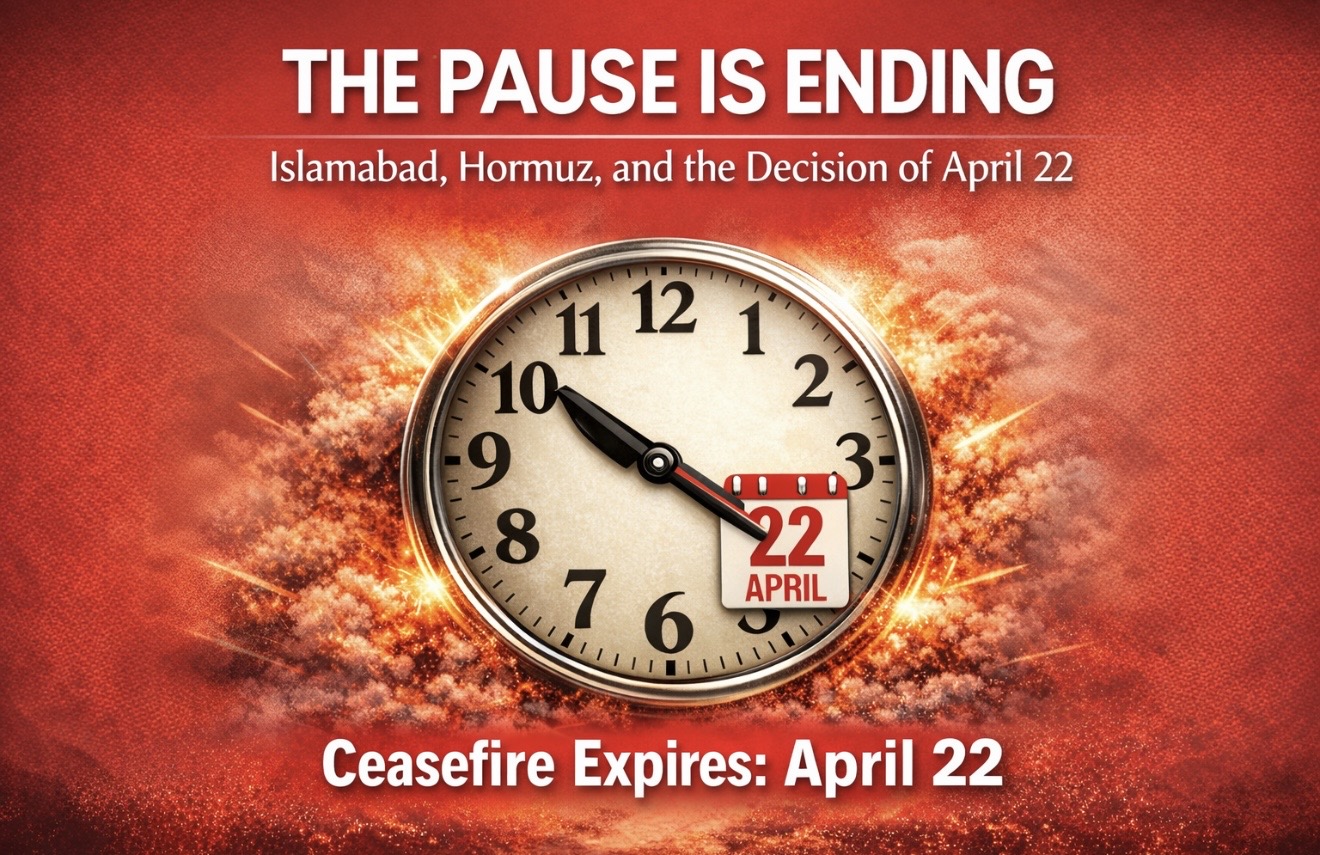
And perhaps the most important and most difficult question this entire situation asks — the question beneath all the other questions — is this: Is what we are watching genuinely a journey toward peace, or is it a pause? A breath. A moment in which the players adjust their positions before the game resumes with the same intensity, or greater.
Because history teaches us, with a patience and a consistency that should by now be impossible to ignore, that the greatest announcements of peace are most often made precisely where the war has not yet ended — where it is simply taking on its next form, learning its next shape, preparing for what it has not yet become.
The pause is real. The question is what it is a pause before.