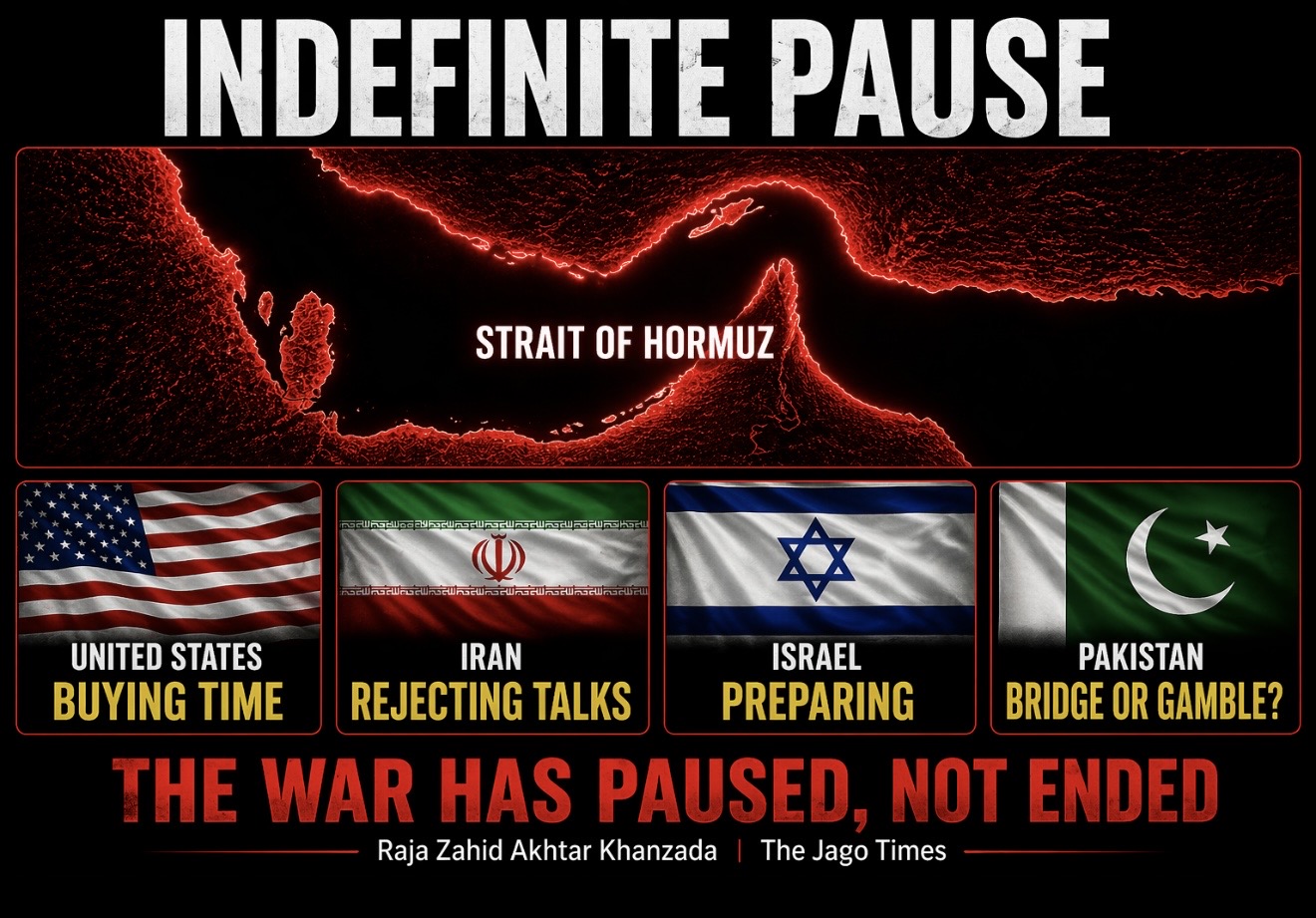
The Ceasefire That Isn’t: Trump’s Indefinite Pause, Iran’s Refusal, and the War That Never Ended
By:Raja Zahid Akhtar Khanzada
History has a habit of returning — not as repetition, but as variation. The characters change, the methods shift, and what is at stake grows larger with each iteration. President Donald Trump has announced an indefinite extension of the ceasefire with Iran, and on the surface this looks like a pause, a breath, a signal of possibility. But those who read history carefully know that announcements of this kind tend to conceal as much as they reveal. And at the very same moment that this ceasefire was declared, Iran refused to come to the negotiating table. On one side, the guns have fallen temporarily silent. On the other, the door to conversation has closed. This contradiction is the real story of everything happening now — and without understanding it, the world as it exists today cannot be understood at all.
A historical parallel arrives almost unbidden. In 1983, Ronald Reagan found himself trapped in the Lebanese crisis. After the bombing of the Marine barracks, he made a decisive choice and withdrew American forces. He extracted the United States from the conflict, halted the escalation, and averted a larger catastrophe. Some analysts today invoke that precedent and argue that America should do the same now. But the difference between then and now is the difference between an exit and a hold. Reagan chose to leave. Trump has chosen to pause — while keeping the naval blockade intact, while maintaining military positioning, while continuing to supply Israel with weapons. This is not Reagan’s withdrawal. This is Trump’s suspension. And the distance between those two things is precisely the distance between peace and the management of war.
To understand Iran’s position, you must first understand its memory. Tehran has said plainly that as long as America maintains its naval blockade, any negotiations will take place under coercion rather than on equal terms. This is not merely a diplomatic stance. It is an experience. It is a history that Iran carries into every room where an agreement might be discussed. Iran has sat at tables before and watched what it received when it arrived from a position of weakness. This is why Mohammad Bagher Qalibaf, Speaker of the Iranian Parliament, withdrew from the proposed Islamabad meeting. He said, in words that were precise and deliberate, that Trump wants to turn the negotiating table into a table of surrender. Those words are harsh. They are not baseless. And it is at exactly this point — where the language of one side and the experience of the other meet and refuse to reconcile — that the crisis of trust becomes most visible, most acute, and most dangerous.
The question of who benefits from this ceasefire is one on which serious analysts are sharply divided, and their disagreement is itself illuminating. From America’s perspective, this pause serves multiple purposes simultaneously. Stopping the fighting, even temporarily, relieves domestic political pressure. It stabilizes global markets — oil prices in particular — which is not a small thing for an administration that reads economic indicators as closely as battlefield reports. It gives the military time to reposition. And it gives Israel time to prepare for whatever comes next. Several analysts have called this pressure diplomacy — the simultaneous maintenance of negotiating language and coercive force. One American commentator put it simply: Trump is buying time, not peace.
For Iran, the ceasefire offers something considerably more limited. The immediate fighting has stopped. The scale of destruction has been temporarily interrupted. There is an opportunity to reorganize. But the economic blockade continues. The oil trade remains disrupted. The international pressure has not diminished. For Iran, this is not relief. It is a brief moment to breathe — and even that breath is conditional. For Israel, the pause is most advantageous of all: time for military preparation, an opportunity to strengthen supply lines, a reduction in diplomatic pressure. This is why people like Joe Kent — a significant figure in the Trump administration who resigned over his disagreement with the direction of this war — have said plainly that this is not America’s war. It is a war being driven by Israeli priorities. Iran, Kent argued, was not an immediate threat to the United States. This conflict was built on foundations that cannot hold the weight of what has been placed upon them.
That voice does not stand alone. Inside America, a transformation is underway that constitutes one of the most consequential chapters of this entire story. There was a time — and it was not long ago — when support for Israel in American politics was not a position but an assumption, something so settled it required no defense. That time has passed. Within the Democratic Party, open criticism of Israel has moved from the margins to the mainstream. A significant number of senators have supported halting arms sales. Among younger Americans and within the party’s internal factions, the narrative has shifted in ways that would have been unimaginable a decade ago. And this is not confined to Democrats. The Republican Party is showing fractures of its own, and Joe Kent’s resignation is the most visible evidence of those fractures. There was a period when funding for systems like Iron Dome passed through Congress without debate. Today, that funding is being questioned. What was once unthinkable has become thinkable. And that is a change of a different order entirely.
This transformation is not merely political. It is strategic. And it cannot be separated from what is happening on the ground, because when a nation’s foreign policy becomes entangled in its domestic divisions, decisions are no longer made only in the field. They are made in the court of public opinion and in the arithmetic of electoral politics. The divisions within the Republican Party, the growing dissent among Democrats, the ongoing disputes over judicial appointments, the approaching midterm elections — all of these forces combine to create a context in which the ceasefire announcement is not purely a foreign policy decision. It is also an attempt to manage pressure from within.
Nor is this transformation confined to American shores. In the major cities of Europe, voices are rising against Israel’s conduct. Protests in European capitals, disagreements at the policy level, open criticism from governments that were once reliably aligned — all of this signals that global public opinion is shifting, and that shift makes the long-term political consequences of this war considerably more complicated than they appeared at the outset.
The analysts who have spent their careers understanding power at close range are reading all of this with a clarity that official statements rarely achieve. John Mearsheimer has argued that treating Iran as the weaker party in this equation is a fundamental strategic error — that the Strait of Hormuz in Iranian hands is a weapon that requires no ammunition and yet can bring the world’s economy to a standstill. Jeffrey Sachs places the crisis within a larger framework of global economic fragility and warns that if diplomacy fails to contain it, the consequences will extend far beyond the region into systems that the world depends on for its basic functioning. Douglas Macgregor reads the entire situation as a geopolitical miscalculation whose primary beneficiaries are China and Russia, who are watching American entanglement with the patient satisfaction of players who understand that their adversary is spending resources they cannot afford. And Scott Ritter has said clearly that the current trajectory does not lead toward resolution. It leads toward a long, costly, exhausting conflict in which decisive victory belongs to no one.
These voices, coming from different places and different traditions of analysis, converge on a single underlying reality: this ceasefire is no one’s complete victory and no one’s complete defeat. America has gained a strategic pause. Iran has gained time. Israel has gained preparation. The world has gained the temporary comfort of reduced immediate threat. But beneath that comfort, the uncertainty is as deep as it was before — perhaps deeper — because Iran’s refusal to negotiate and America’s insistence on maintaining the blockade tell us that the foundation of trust upon which any lasting agreement must be built has not yet been laid.
Pakistan’s role in this story deserves honest examination. Islamabad was being positioned as a neutral space — a place where the two sides might find ground that neither could create on their own. Iran’s refusal has suspended that possibility, at least for now. The question is whether Pakistan can find a way to bring both parties back to a table, or whether this moment will join the long list of diplomatic efforts that arrived at the threshold of something significant and found the door closed. This is not only a question about Pakistan’s credibility as a diplomatic actor. It is a question about whether the region has any path forward that does not run through another phase of armed conflict.
Joe Kent and others have called this a manufactured conflict — a war constructed on premises that do not withstand scrutiny, that serves interests other than those of the American people, and that threatens to draw the United States into a position from which extraction will be far more difficult than entry. When the people inside a nation’s own government begin to ask why they are fighting a particular war, that question has ceased to be merely moral. It has become strategic. And strategic questions, once asked seriously, do not go away simply because the leadership would prefer they remain unasked.
What is happening now can be stated simply, even if its implications are anything but simple. This ceasefire is not peace. It is an indefinite pause — a condition in which the war has not ended and the conversation has not begun, but both are being prepared simultaneously. The language of diplomacy is being maintained on one side of the room while the instruments of force are being kept ready on the other. This is not a contradiction in the conventional sense. It is a strategy. And it is a strategy that serves some parties better than others, at costs that are not being distributed equally.
This war is not being fought only on the battlefield. It is being fought in the narrative. It is being fought in the domestic politics of the most powerful nation on earth. It is being fought in the slow, patient repositioning of global power that China and Russia are conducting while America is otherwise occupied.
Guns can fall silent. They often do. But silence is not the same as peace, and a pause is not the same as an ending. Reagan understood that distinction. He acted on it. What we are watching now is something different — a controlled hold, a managed suspension, a moment in which every party is using the quiet to prepare for what comes next.
History teaches us, with a consistency that should by now be impossible to ignore, that the loudest announcements of peace are most often made precisely where the war has not ended — where it is simply changing its form, learning its next shape, becoming something it has not yet been. And the world, at this moment, is standing inside exactly that transformation: neither fully at peace, nor fully at war, but suspended between the two, waiting for the moment that will determine which way it falls.
The pause is real. What it is a pause before — that is the question that everything else is waiting to answer.