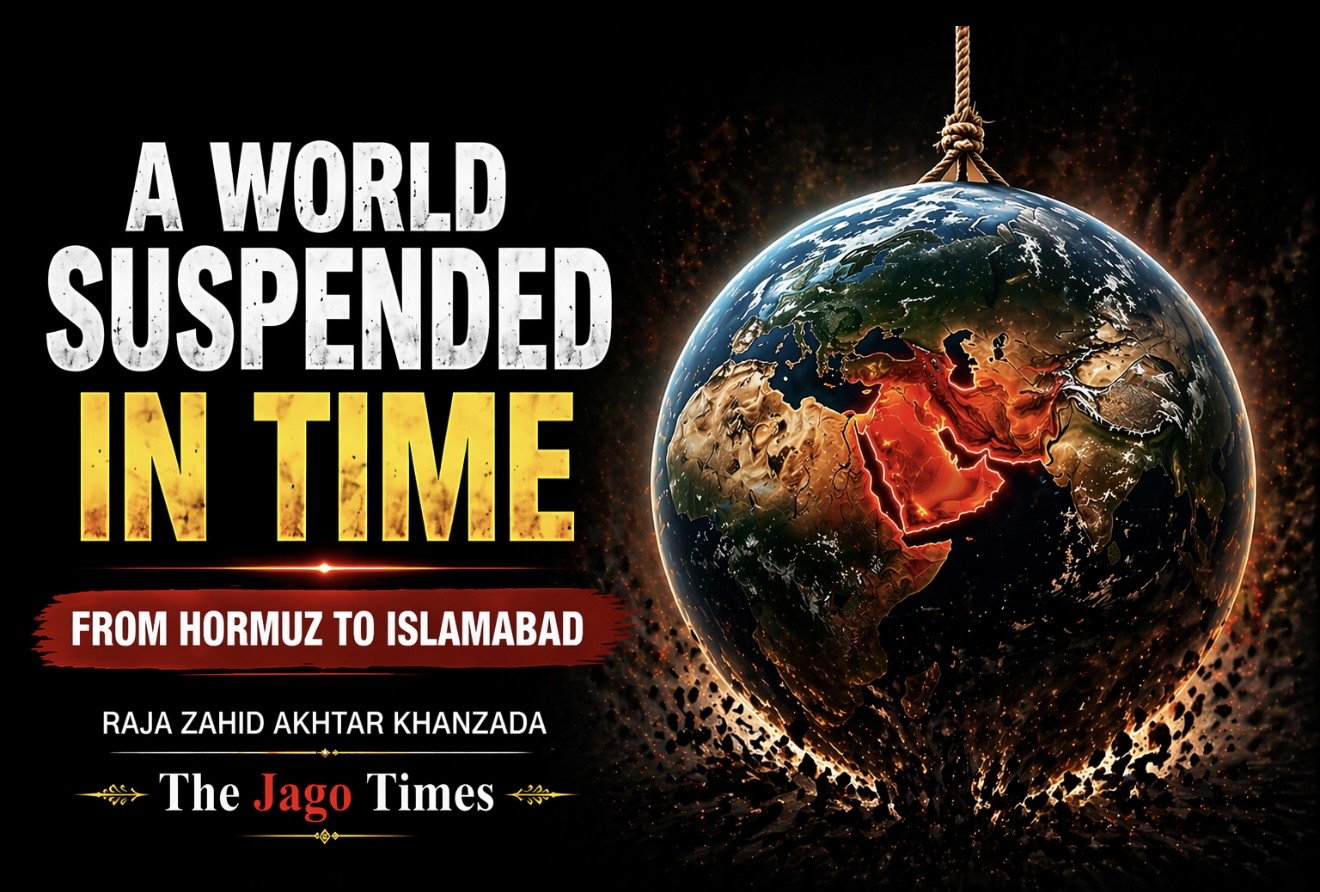
The Table of Negotiations or the Shadow of Power? Hormuz, Islamabad, and a World Suspended Between Force and Promise
By: Raja Zahid Akhtar Khanzada
There are moments when the world arrives at a crossroads where the news stops being merely information and becomes something else entirely — becomes, in its own right, a condition. A condition in which truth and impression dissolve into each other, and where understanding reality requires not just listening but feeling. This is one of those moments. On one side, we are being told that negotiations are close, that the door is open, that Islamabad is about to become a bridge. On the other side, the waters of the sea are restless, the paths of ships are uncertain, and the language of official statements carries a hardness that could, at any moment, transform words into something far more destructive.
President Donald Trump’s words carry the loudest echo in this entire story. In a single breath he offers hope and generates fear. He says a deal is one or two days away, that his representatives are arriving in Islamabad, that a path forward exists. And then, in that same moment, he says that if it does not happen, bridges will fall, power stations will go silent, and a nation’s breath will be cut off. These are not two sentences. These are two worlds — and both are emerging from the same mouth. This is precisely the point where diplomacy and coercion become indistinguishable from each other, where it becomes genuinely difficult to determine what the actual objective is: peace, or dominance.
In response to this, Tehran’s voice arrives — cautious, but clear. Iran’s Parliament Speaker Mohammad Bagher Qalibaf says that negotiations conducted under threat are not negotiations Iran will accept. He gives a different name to the table that the world is calling a peace table — he calls it a table of surrender. This is not merely a statement. It is an experience, a history, a memory that stands behind every Iranian decision. Tehran says that if a path is to be opened, the pressure must first be reduced. If there is to be conversation, trust must first be built. Otherwise, words do not remain merely words — they become a mirror of intention.
But the reality on the ground diverges from the language being spoken above it. The naval blockade remains in place. The Strait of Hormuz — the jugular vein of the world’s economy — has once again become a symbol of escalating tension. An Iranian cargo vessel was stopped, damaged, and seized. Iran has called this action an act of piracy and a violation of the ceasefire, and has signaled that a swift response is coming. Negotiations on one side. The seizure of vessels on the other. Both happening simultaneously, both presented as part of a coherent policy. This contradiction is not accidental. It is the signature of a strategy in which diplomacy is being used as an instrument of pressure — a way of keeping the adversary off balance while the underlying posture of force remains unchanged.
At the global level, independent journalists and analysts affiliated with serious think tanks are reading this situation through an entirely different lens. Their argument is that the talk of negotiations is, in fact, a strategic curtain — a way of temporarily controlling oil prices, giving global markets the impression of stability, and simultaneously strengthening military positioning. They also argue that Israel is being continuously supplied with weapons and military equipment in preparation for a larger confrontation. The central claim of this analysis is that the American establishment, Israeli leadership, and the relevant lobbying networks are aligned on a single objective — not merely to apply pressure on Iran but to weaken it to the point where it cannot emerge as a stable and sovereign regional power. Because if Iran were to consolidate itself as such a power, it would not only affect Israel’s strategic goals but would fundamentally alter the balance of power across the entire region.
The American delegation sent to the negotiations has itself become a subject of serious questioning. It has been noted that career diplomats were not included — that the delegation was composed instead of individuals whose roles were primarily political or strategic in nature. Former President Bill Clinton raised this very point, questioning what kind of diplomacy could realistically emerge from such a delegation. Beyond the composition of the team, the behavior of American leadership in the immediate aftermath of the talks — certain sudden contacts, abrupt shifts in tone — has deepened the suspicion in Tehran that what was presented as a genuine diplomatic effort may have been something considerably more calculated.
Inside Iran, two narratives are running simultaneously, and it is these two narratives — not the statements of foreign governments — that will determine the actual direction of this crisis. The first says that all of this is a game — a game of buying time, a game of preparation, a game of pressure — and that participating in it is to walk voluntarily into a trap. The second says that the door should not be closed entirely, that if any path toward resolution exists it must be tested, but this time with open eyes and without the surrender of judgment. This internal tension — neither complete refusal nor complete trust — is the most honest picture of where Iran actually stands.
Islamabad has emerged in this story as a quiet but consequential presence. The streets of the city may look the same as they always have, but beneath them something else is moving. The security cordons, the diplomatic traffic, the invisible quality of waiting — all of it suggests that something is about to happen, or at the very least that the world is being shown that something is about to happen. The American delegation was first described one way, then another — first Vance would not come, then it was said he would. This back and forth generates a question that cannot be dismissed: will whoever arrives be coming to genuinely negotiate, or simply to demonstrate the fact of their presence?
Pakistan stands at a delicate position in this entire story. Under the leadership of Prime Minister Shehbaz Sharif and Field Marshal Asim Munir, Pakistan has presented itself as a responsible diplomatic bridge — a nation with the relationships and the standing to hold a space between two parties who cannot easily hold it themselves. But in doing so, it has also placed its own credibility, its own position, and its own diplomatic standing at risk. If this process succeeds, it will represent a historic achievement of the first order. But if it proves to be nothing more than a stage — a setting for a performance rather than a negotiation — the consequences will extend far beyond this single moment.
The serious global analysts who are watching this situation are making its contours even clearer. John Mearsheimer has argued that treating Iran as the weaker party is a fundamental error — that the Strait of Hormuz in Iranian hands is a weapon that fires no bullets but has the power to stop the world. Jeffrey Sachs sees this moment as part of a larger global crisis in which the politics of power is destabilizing the delicate balance of the world economy. Douglas Macgregor observes that China and Russia are quietly benefiting from American entanglement in this conflict, watching from a distance as their strategic position strengthens. And Scott Ritter warns that the current trajectory does not lead toward any rapid resolution — it leads toward a long, exhausting escalation in which no party achieves a decisive outcome.
The relationship between economics and politics in this crisis is also too significant to set aside. The connection between fluctuations in oil prices, movements in stock markets, and the management of political narratives represents a thread that runs through everything happening now. It has been suggested that this crisis is generating substantial financial benefit for certain circles — that the volatility in commodity prices is creating profit opportunities at a scale that makes the continuation of uncertainty, in some quarters, quietly preferable to resolution. It has also been argued that America’s approaching midterm elections form an important part of the strategic calculus behind the current approach.
There is also a broader geopolitical dimension that cannot be separated from this picture. The competition between America, China, Russia, Japan, and the major European powers has entered a new phase. Iran’s cooperation with China on energy matters, and its desire to sell oil in currencies other than the dollar, represents a direct challenge to the global system that rests on the foundation of the petrodollar. This is why containing Iran has ceased to be merely a question of regional politics — it has become a question of protecting the architecture of the global financial order itself.
And on the ground, the military dimension continues to deepen. American military presence in and around the Strait of Hormuz is expanding. Thousands of additional personnel are being deployed to the region. This buildup reinforces the impression — difficult to dismiss — that what is unfolding is not only a diplomatic process but a simultaneous strategic preparation, with both tracks running in parallel, each serving the purposes of the other.
All of these factors combine to produce a picture that is not simple, not linear, and not one-sided. This is a layered reality in which every party appears, from its own perspective, to have a legitimate position — and in which every perspective generates a new and deeper complexity. On one side stands America, determined to maintain the impression of its own power but aware of the weight that a prolonged war would place on it. On the other side stands Iran, unwilling to submit but equally unwilling to invite an endless escalation. This is the point at which both parties may, in fact, want the same thing — and yet find themselves unable to trust each other enough to reach it.
And this is the most honest and most difficult truth this entire story contains.
Because in the end, the question is not simply whether negotiations will happen or not. The real question — the one that everything else is pointing toward — is whether these negotiations, if they occur, will lead anywhere genuine. Or whether they are simply a pause. A breath. A moment in which the players adjust their positions before the game resumes with the same intensity, or greater.
History teaches us, with a patience that should by now be impossible to ignore, that the greatest announcements of peace are most often made precisely where the war has not ended — where it is simply changing its shape, learning its next form, preparing for what it has not yet become. And perhaps the world, at this moment, is standing inside exactly that transformation — neither fully at peace nor fully at war, but suspended between the two, in a moment where every decision will determine the direction of what comes next.
The pause is real. The question is what it is a pause before.