

By Raja Zahid Akhtar Khanzada
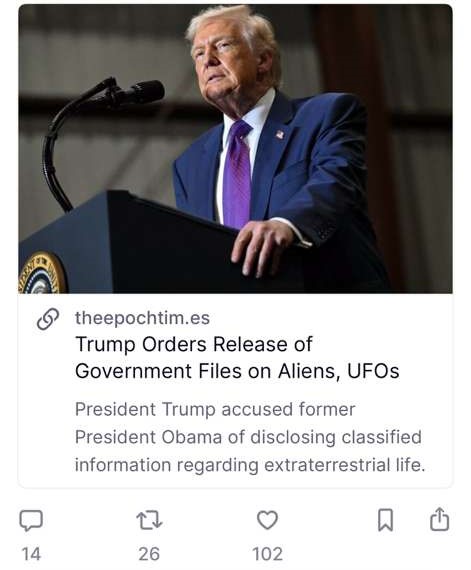
DALLAS : A long simmering American fascination with unidentified flying objects, extraterrestrial life and the mysteries of Area 51 has once again surged into the national spotlight after President Donald Trump directed the Pentagon and other federal agencies to begin identifying and releasing files related to U.F.O.s and what he described as “alien and extraterrestrial life.”
In a post on his social media platform, Truth Social, Mr. Trump instructed Defense Secretary Pete Hegseth and other agency heads to initiate the process of reviewing and making public any relevant materials connected to what he called “highly complex, but extremely interesting and important, matters.” The announcement, while sweeping in tone, did not specify which documents might be released or what information they could contain.
The Pentagon has, for decades, cataloged reports of what it terms Unidentified Aerial Phenomena, or U.A.P.s. In a March 2024 report, the Defense Department stated that it had found no evidence that any of the investigated incidents involved extraterrestrial technology or contact with alien life. The report further noted that investigators had uncovered no indication that the unexplained sightings were attributable to foreign adversaries.
Mr. Trump’s directive comes at a moment when the subject has already been stirred by comments from former President Barack Obama. During a rapid-fire exchange on a podcast hosted by Brian Tyler Cohen, Mr. Obama was asked whether aliens are real. “They’re real,” he replied, adding, “But I haven’t seen them. And they’re not being kept in Area 51.”
The remark ricocheted across social media, prompting the former president to clarify his comments in a statement posted on Instagram. He explained that he had been responding in the spirit of a speed round, but elaborated that, statistically speaking, the vastness of the universe makes the existence of life elsewhere plausible. At the same time, he emphasized that the immense distances between solar systems make the likelihood of alien visitation to Earth low. Mr. Obama said he saw no evidence during his presidency that extraterrestrials had made contact with humanity.
Area 51, the secretive Cold War era military installation in the Nevada desert, has long occupied a central place in conspiracy lore. In 2013, the Central Intelligence Agency formally acknowledged the site’s existence, while dismissing claims involving crashed spacecraft, extraterrestrial beings or staged lunar landings.
Public curiosity has at times taken theatrical form. A few years ago, a loosely organized online campaign dubbed “Storm Area 51” drew dozens of people to the perimeter of the base, declaring their intention to “see them aliens.” Online forums and social media groups remain active, with some users insisting that the federal government knows far more than it has disclosed.
In recent years, military pilots and service members have reported hundreds of unexplained objects in restricted airspace, prompting some lawmakers to press the Pentagon for greater transparency and a clearer assessment of whether such phenomena pose a risk to aviation safety or national security.
Though official reports to date have not substantiated claims of alien life or advanced extraterrestrial technology, Mr. Trump’s call for the release of additional files, coupled with Mr. Obama’s widely discussed remarks, has thrust the enduring mystery back into the center of public discourse. Whether new disclosures will fundamentally reshape the debate remains uncertain, but the question of what lies beyond Earth continues to captivate both policymakers and the public alike
