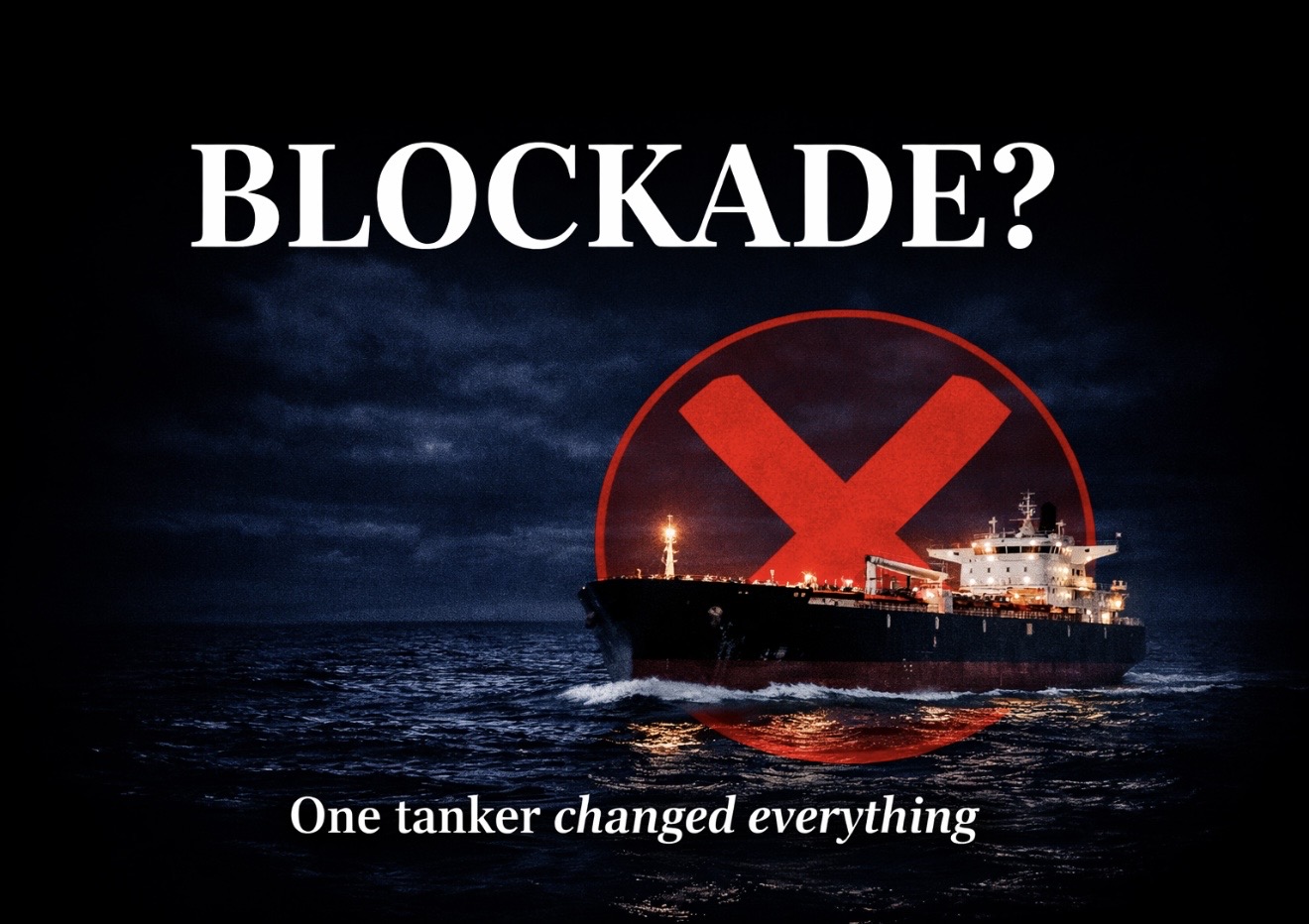
Trump’s Blockade and America’s Credibility: One Chinese Tanker Exposed Everything
By: Raja Zahid Akhtar Khanzada
There is an old line from an Indian film — crude on its surface, as folk wisdom often is — that translates, roughly, to this: a single mosquito can unman the mightiest of men. I have been turning that line over in my mind for days now, because it contains something true about power that power itself refuses to acknowledge. The mosquito is not strong. It has no army, no arsenal, no territory to defend. What it has is precision — the ability to find, in the vast armor of its adversary, the one place where the skin is thin.
That is what happened in the Strait of Hormuz. And if we are honest with ourselves — if we are willing to look at what actually occurred rather than what was announced — we will understand that what was exposed there was not merely a gap in a naval blockade. It was a gap between a nation’s words and its deeds. And in the long, unforgiving accounting of history, that is the gap that matters most.
The night sea, as it always does, looked calm from a distance. It has a way of doing that — presenting a surface of stillness while everything beneath it moves with terrible purpose. The Strait of Hormuz, that narrow passage between the Persian Gulf and the Gulf of Oman, through which roughly twenty percent of the world’s seaborne oil must travel, had become once again what it periodically becomes: the place where the grammar of global power is written and rewritten, where the distance between a declaration and a reality is measured not in miles but in consequences.
On April 14, 2026, at ten o’clock in the morning, the blockade announced by President Trump went formally into effect. The language of the announcement had been unambiguous, the kind of language that American power has historically deployed when it wishes the world to understand that it is serious: every vessel would be stopped. This was not a suggestion. It was not a negotiating position. It was, in the words of the announcement, a fait accompli — the Strait, America declared, would be cleared.
And then the ships began to move.
The first name that matters here is the Rich Story — a mid-sized chemical tanker, Chinese-owned, operating under a Malawian flag, though Malawi itself maintains it has no active ship registry. Since 2023, the vessel had been under American sanctions for its role in helping Iran evade oil restrictions. It had loaded approximately 250,000 barrels of methanol in Sharjah, in the United Arab Emirates. And on the morning of the blockade, it passed through the Strait of Hormuz — without incident, without interception, without so much as a radio challenge — and continued toward its destination in China.
I want you to sit with that for a moment. Not with the outrage of it, not with the politics of it, but with the simple, human reality of what it means when a nation says every vessel will be stopped and then does not stop the first vessel.
The Rich Story was not alone. Reuters and other international outlets confirmed that at least eight ships transited the strait that same day. Among them: the Merlakishon, flagged to Madagascar, bound for Iraq, sailing in the opposite direction — into the Gulf — despite being under sanctions for its Iranian connections. And the Alps, already sanctioned under a 2018 American package, which had departed Iran’s Bushehr port on March 30th and crossed the strait on April 13th, a day before the blockade, suggesting that the movement of these vessels was not improvised but coordinated, part of a network that had been watching and calculating and waiting.
American military sources, to their credit, did acknowledge that approximately six vessels were turned back. But the acknowledgment itself revealed the architecture of what was actually happening: this was not a blockade in any total sense. It was a selective intervention — a pressure campaign dressed in the language of absolute authority.
I have lived long enough to know that the distance between what power announces and what power does is rarely accidental. Empires do not make mistakes of this magnitude by oversight. They make them by miscalculation — by believing that the announcement is itself a form of action, that the declaration creates its own reality simply by virtue of being declared.
The official American clarification, when it came, was revealing in its precision. The blockade, it turned out, applied specifically to vessels connected to Iranian ports and coastal areas. Ships traveling between non-Iranian ports would not be impeded. Which meant, of course, that the Rich Story — having loaded its cargo in the UAE — fell entirely outside the blockade’s stated scope.
This is a perfectly coherent policy. It is, in fact, a reasonable and limited one. What it is not — what it cannot be, by any honest measure — is what the President of the United States announced to the world.
And this is where I must speak plainly, because the comfortable evasions of diplomatic language are of no use to anyone here. When a nation’s commander-in-chief says every vessel will be stopped and the policy that follows stops only some vessels, and only under specific conditions, the world does not hear a correction. The world hears a contradiction. And contradictions, in the vocabulary of geopolitical credibility, are not footnotes. They are the story itself.
China understood this. China has always been patient in its understanding of these things — it does not need to announce its perceptions because it acts upon them. A Chinese-owned tanker, already under American sanctions, transited an American-declared blockade and was not stopped. No statement was issued from Beijing. None was necessary. The ship’s passage was the statement. The ship’s safe arrival was the punctuation.
This is what strategic patience looks like when it has learned to read its adversary. You do not challenge the declaration. You test it. You send a ship. You watch what happens. And when nothing happens, you have learned something that no intelligence briefing could have told you as clearly: the words and the will are not in alignment.
Europe, for its part, responded with the careful ambiguity that has become its signature in moments like this. France called for multilateral dialogue. Germany offered conditional support. Italy softened its defensive posture. These are not the responses of allies who believe, in their bones, that the declaration they are being asked to support is fully credible. These are the responses of governments buying time, waiting to see whether the reality will eventually match the rhetoric.
I grew up understanding something about the relationship between words and deeds that formal education tends to obscure. Words are not neutral. They carry weight. They make promises. And when the promises are not kept — not because of force majeure, not because of circumstance, but because the words were more expansive than the intention behind them — something is lost that is very difficult to recover.
America’s power has never rested solely on its military capacity. Every serious student of its history understands this. From Harry Truman to Dwight Eisenhower, from John Kennedy to Ronald Reagan, from the elder Bush to Barack Obama — whatever one thinks of their individual decisions, and there is much to think, much to argue about — these were men who understood that the credibility of American power was a form of currency. You spent it carefully. You did not make announcements you could not enforce, because an unenforced announcement was worse than silence. Silence leaves the question open. A failed announcement answers it in the wrong direction.
Donald Trump has said, on more than one occasion, that if a thing can be achieved through threat, there is no need to actually do it. This is, in a certain light, a pragmatic philosophy. It has its logic. But it rests entirely on the willingness of the adversary to believe the threat — and belief, once tested and found to be misplaced, does not restore itself. It calculates. It remembers. It adjusts.
The people of Iran are not abstractions. They are a civilization of enormous depth and complexity, living under a government that has, whatever its many failures, managed to survive decades of sanctions, isolation, military pressure and external interference. They have learned to read American power the way the poor learn to read the powerful everywhere — by watching not what is said, but what is done, and what is not done when it was promised it would be.
I want to return, for a moment, to the question I raised in an earlier column: in this reckoning, who pays the price — Donald Trump, or America itself?
The answer, as the current evidence suggests, is both. But they are paying different kinds of prices. Trump’s approval rating has entered a territory that should alarm anyone paying attention — not because of partisan politics, but because a leader whose credibility is compromised domestically is also, by extension, a leader whose credibility is compromised abroad, and the two cannot be separated as cleanly as Washington sometimes pretends.
But the price America is paying is of a different, and in some ways more serious, character. There is a peculiar kind of damage that occurs when the gap between a nation’s self-image and its actual behavior becomes visible to the world. America has always carried a mythology about itself — the indispensable nation, the last best hope, the power that, whatever its flaws, could be counted on to mean what it said. That mythology has been contested before, sometimes rightly so, sometimes unfairly. But it has been the foundation upon which alliances were built, upon which adversaries calculated, upon which the entire architecture of the post-war international order was constructed.
When that foundation cracks — not through defeat in battle, not through economic collapse, but through the simpler and more corrosive process of saying one thing and doing another — the damage does not announce itself dramatically. It accumulates. Allies grow cautious. Adversaries grow bold. Neutral nations recalibrate. And the world, which has organized itself around certain assumptions about American power, begins quietly, without fanfare, to reorganize itself around different assumptions.
Make America Great Again. I have thought about those words a great deal. They contain, as all effective political slogans do, a genuine longing — a real feeling, held by real people, that something has been lost, that a restoration is possible, that the distance between what America is and what America could be is not fixed. I do not dismiss that longing. I have seen enough of this country to know that it runs deep.
But greatness, as I understand it — as history has always understood it — is not announced. It is demonstrated. It is demonstrated in the alignment between commitment and action, between declaration and deed, between the promise made to the world and the behavior that follows. A mosquito cannot unman a great nation. But a great nation that cannot keep its own word — that is something the mosquito has nothing to do with. That is a wound self-inflicted, and those are always the hardest to heal.
The questions that remain are not rhetorical. They are urgent and they are real.
Can America recover its credibility in this theater, in this moment, before the calculations of its adversaries and the doubts of its allies harden into permanent positions? Can the gap between the declaration and the reality be closed — not through another announcement, but through the slow, patient, unglamorous work of consistent, coherent action over time?
Will the price of this moment be borne by one man, one administration, one political season? Or has something shifted that goes beyond any individual, that will require a deeper reckoning — a national conversation about what kind of power America wishes to be, and what it is willing to do to deserve that designation?
And the question beneath all the questions: what does it mean to be the world’s indispensable nation in an age when the world is watching your every move on satellite tracking systems in real time — when a sanctioned Chinese tanker can pass through your declared blockade and every ship-watcher on the internet can watch it happen?
The Rich Story has reached its destination. The cargo has been delivered. The Strait of Hormuz remains open.
And somewhere in the long memory of history, which does not forget these things even when we would prefer it to, a ledger is being updated.
The questions remain open. The answers are being written — not in press releases or Truth Social posts, but in the movement of ships across dark water, in the quiet recalculations of governments that have learned not to take announcements at face value, and in the slow, inexorable adjustment of a world that is deciding, one incident at a time, what American power actually means.