

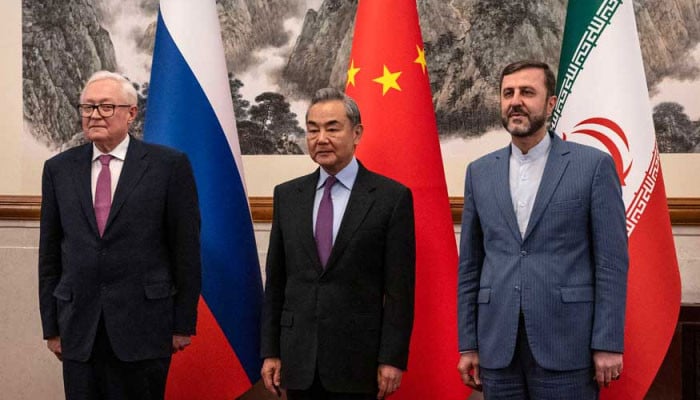
As global tensions escalate following US and Israeli airstrikes on Iran, the country’s closest diplomatic allies, Russia and China, have taken a cautious approach. Despite stern statements, both nations have avoided direct military intervention, according to recent developments.
Russian President Vladimir Putin has condemned the assassination attempt on Iranian Supreme Leader Ayatollah Ali Khamenei as a grave violation of human rights and international law. Meanwhile, Chinese Foreign Minister Wang Yi emphasized in a conversation with his Israeli counterpart, Gideon Saar, that the use of force does not resolve issues and urged all parties to avoid further escalation. Russia and China jointly requested an emergency meeting of the United Nations Security Council, but despite this, neither country has hinted at direct military action in support of Iran.
In January 2025, Russia and Iran signed a comprehensive strategic cooperation agreement, covering trade, defense cooperation, science, culture, and education. However, the agreement does not include a mutual defense clause, which means that if one country is attacked, the other is not obligated to come to its defense. Russian foreign policy expert Andrei Kortunov noted that Russia’s agreement with North Korea in 2024 is more robust, with a commitment to provide military support in the event of a conflict.
China and Iran have a 25-year cooperation agreement, signed in 2021, which includes cooperation in energy, investment, and China’s Belt and Road Initiative. Chinese experts say that the two countries have strong political and economic ties, but China has historically avoided direct military intervention in other countries’ conflicts. Chinese analyst Judy Chen believes that China is unlikely to provide arms to Iran or engage in military action, preferring instead to focus on diplomacy and conflict resolution.
Iran’s nearly 87% of crude oil exports go to China, making the country a significant economic partner for Iran. However, China’s share of global trade is relatively small. Experts say that while Russia and China may continue to provide diplomatic support to Iran, they will likely avoid direct military intervention to avoid a broader conflict between major powers.
Following US and Israeli airstrikes on Iran, some Indian TV channels have broadcast fake videos and old footage, while Indonesia has offered to mediate in the conflict, with the support of Pakistan and the United Arab Emirates. A Lebanese media outlet reported that Israeli warplanes targeted a three-story building in the al-Aqaba neighborhood, which was the residence of a retired Lebanese army officer, Youssef Reda Rimel. The building was completely destroyed.
Iran has claimed that it targeted the Israeli embassy in Bahrain’s capital, Manama. In Kuwait, a fire broke out at an American military base following a drone attack. The global oil market responded to the failure of the US to open the Strait of Hormuz, with prices rising 9% in a single day. Israel has announced that it will resume flights for foreign nationals from March 19.
The UK has offered to pay a large sum for 150 families to leave the country voluntarily, amid criticism of the scheme and allegations of mistreatment of British taxpayers.
