

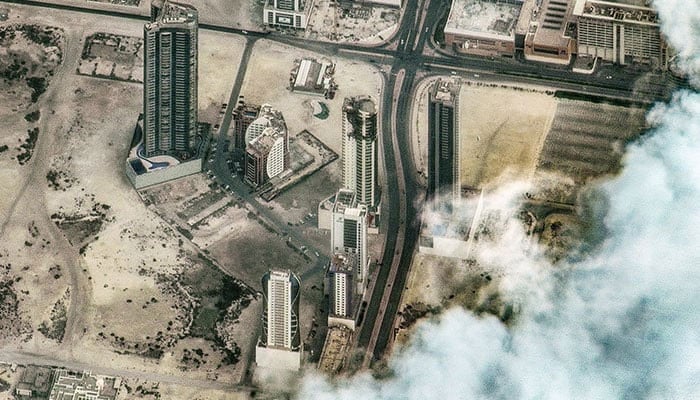
The ongoing conflict between Iran, the US, and Israel has raised serious questions about the security, economy, and diplomatic balance in the Gulf region. Analysts believe that the recent attacks have severely shaken the perception that Gulf states are safe havens despite regional instability. According to reports, Iran’s drone and missile attacks have created a state of fear and anxiety in several cities in the region, with residents forced to take shelter in homes equipped with missile defense systems. The closure of airspace has also significantly affected travel.
Major economic centers such as Abu Dhabi, Dubai, and Riyadh, which have long presented themselves as safe and stable business hubs, are now directly facing threats. Iran’s Shahed 129 drone, a tactical unmanned aerial vehicle with a wingspan of approximately 11 feet, has been used in the attacks. The Iranian strikes have targeted airports, ports, and critical infrastructure, severely impacting tourism and business activities, with some financial markets temporarily closed and citizens stockpiling essential items. The region’s economy has been hit hardest by disruptions in oil supply, with the closure of the Strait of Hormuz and Qatar’s LNG operations causing chaos in the global energy market. Iraq has reduced oil production, while Saudi Arabia is forced to reroute its crude oil shipments, with hundreds of oil tankers waiting for safe passage near the Faw Terminal.
Analysts say that the conflict has severely damaged trust between Gulf states and Iran, with the region’s countries having made efforts to improve relations with Iran over the past few years, but the recent attacks have effectively ended this process. Even if the conflict ends, the security policies of Gulf states may become more cautious and rigid, potentially leading to a shift where economic growth takes a backseat to security concerns. The crisis has cast uncertainty over the region’s economic model, energy security, and regional diplomacy, potentially affecting the politics and economy of the region for years to come.
In the aftermath of the US and Israeli attacks on Iran, some Indian TV channels have broadcast fake videos and old footage, while Indonesia has offered mediation in the Iran-Israel-US conflict, with Pakistan and the UAE announcing their support. Lebanese media reported that Israeli warplanes had targeted a three-story building in the Akkar district, which belonged to a retired Lebanese army officer, causing the building to be completely destroyed. Iran has claimed to have targeted the Israeli embassy in Manama, the capital of Bahrain.
In Kuwait, a fire broke out after a missile attack on a US military base, while the failure of the US to open the Strait of Hormuz led to a 9% surge in global crude oil prices. Israel has announced the resumption of flights for foreign nationals from March 8. The ongoing crisis has put pressure on the budgets and economies of Gulf states, with Saudi Arabia, the UAE, Kuwait, and Qatar potentially withdrawing their investment promises worth billions of dollars in the US.
Russia has reportedly provided Iran with the locations of US warships and aircraft, with Iranian officials claiming that 112 drones were detected, 109 of which were shot down in the air, and three of which landed in the UAE. Israel has announced the resumption of flights for foreign nationals from March 8.
