

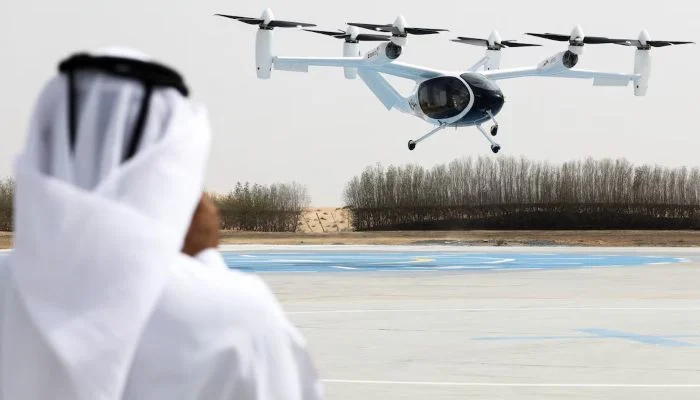
Dubai commuters may soon experience a new way to bypass traffic congestion: air taxis. This week, Joby Aviation successfully conducted the first test flight of its fully-electric air taxi in the emirate. This marks a significant milestone in Dubai’s ambitious efforts to integrate airborne transport into its existing mobility networks as early as next year, 2026.
Joby anticipates that its air taxis will alleviate pressure on current ground transportation systems and provide travelers with a significantly faster alternative as Dubai continues to grapple with increasing congestion. “We want to change the way people commute,” stated Anthony Khoury, Joby’s UAE General Manager. The company predicts that a journey from Dubai’s main airport, DXB, to Palm Jumeirah aboard the Joby Aerial Taxi will take approximately twelve minutes, a stark contrast to the 45 minutes typically required by car.
While Joby’s long-term vision is to make its aerial taxis “affordable for everybody to use,” Khoury acknowledges that early pricing will likely cater to higher-income travelers. “As with any novel technology, early days might be a bit more premium,” he explained. The demonstration flight, held on Monday, July 1, 2025, took place at an isolated desert site southeast of Dubai’s downtown area. Joby Aviation officials stated that the flight was designed to simulate a typical aerial taxi journey. During a ceremony attended by senior government officials, transport executives, and company representatives, the experimental aircraft executed a vertical takeoff, flew for several miles, and then returned for a precise vertical landing.
The Joby Aerial Taxi, the flagship electric vertical take-off and landing (eVTOL) aircraft developed by the California-based company, boasts an impressive range of up to 160 kilometers (100 miles) and can reach speeds of 320 km/hr (200 mph). Being fully electric with zero operating emissions, Joby’s air taxi is designed to be both environmentally friendly and quiet enough for commercial operation in densely populated urban environments. “It will be flying in the city, next to residential areas, and hopefully people will barely notice it,” Khoury noted.
Despite the excitement surrounding eVTOLs as the future of urban air mobility, the industry still faces substantial hurdles. These include securing comprehensive regulatory approval and developing sufficient vertiport infrastructure. In April, Morgan Stanley downgraded Joby’s stock price target from $10 to $7, citing near-term execution risks and broader aerospace industry concerns such as tariffs and supply-chain issues. Joby is currently trading at $10.55.
In early 2024, Joby secured a contract with Dubai’s Roads and Transit Authority, granting the company exclusive rights to operate aerial taxis in the city for the next six years. The company intends to inaugurate the emirate’s commercial air-taxi service in 2026, with four initial vertiports planned at strategic locations: Dubai International Airport (DXB), Palm Jumeirah, Dubai Downtown, and Dubai Marina.
Didier Papadopoulos, Joby’s President of Original Equipment Manufacturing, expressed profound enthusiasm: “In aviation, you don’t see transformations like this. Every once in a while, you have this propulsive move into the future. What you’re witnessing here is really exciting, and I’m excited for you to be riding this one point in the future.”
