

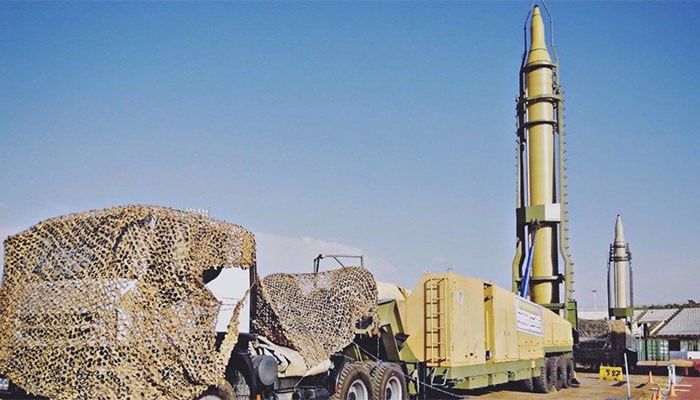
Iran has successfully maintained 50% of its missile capacity despite ongoing US and Israeli strikes over the past month, according to a recent report by a US broadcasting agency. The report, based on intelligence sources, claims that Iran possesses nearly half of its missile launchers and hundreds of drones, while also having a significant number of cruise missiles for coastal defense.
The US intelligence agency’s report contradicts the claims made by Iran’s military leaders, who have repeatedly asserted that Iran’s military capabilities have been severely damaged by the recent airstrikes. According to the report, Iran’s military capabilities remain intact, with nearly 50% of its missile launchers and hundreds of drones remaining operational.
The report also highlights the challenges faced by the US military in targeting Iran’s missile launchers, with Iran’s military having successfully hidden many of its launchers underground in tunnels and caves. The report also notes that Iran’s coastal cruise missiles, which could potentially pose a threat to shipping in the Strait of Hormuz, remain largely intact.
The US and Israel have launched a series of airstrikes against Iran in recent weeks, targeting the country’s military capabilities and infrastructure. However, Iran has maintained that its military capabilities remain intact, and has vowed to retaliate against any further attacks.
The situation has sparked concerns among regional leaders, with many calling for a peaceful resolution to the conflict. Iranian Supreme Leader Ayatollah Ali Khamenei has warned that any further aggression against Iran will be met with a “crushing response.”
The US and Israel have maintained that their airstrikes are aimed at countering Iran’s military capabilities and preventing the country from developing nuclear weapons. However, Iran has denied any plans to develop nuclear weapons, and has accused the US and Israel of attempting to undermine its sovereignty.
The conflict has also had a significant impact on regional trade and commerce, with many countries in the region expressing concerns about the potential for further escalation. The situation remains fluid, with both sides maintaining a hardline stance.
In related news, Russia’s state nuclear company has removed 198 staff members from Iran’s Bushehr nuclear power plant following a recent US and Israeli strike. The plant has been the target of several strikes in recent weeks, with both the US and Israel claiming to have damaged Iran’s nuclear capabilities.
The situation has also sparked concerns about the safety of regional shipping, with many countries in the region expressing concerns about the potential for further attacks. The Strait of Hormuz, which connects the Gulf to the Arabian Sea, is a critical shipping route, and any closure of the strait could have significant economic implications.
The conflict has also had a significant impact on regional politics, with many countries in the region expressing concerns about the potential for further escalation. The situation remains fluid, with both sides maintaining a hardline stance.
In a related development, the US has removed several high-ranking military officials from their positions, including General Qasem Soleimani and his daughter. The move is seen as a significant escalation of the conflict, and has sparked concerns among regional leaders.
The situation has also sparked a heated debate about the role of Pakistan in the conflict, with many accusing the country of siding with Iran. Pakistan has maintained that it is neutral in the conflict, but has expressed concerns about the potential for further escalation.
The conflict has also had a significant impact on regional trade and commerce, with many countries in the region expressing concerns about the potential for further escalation. The situation remains fluid, with both sides maintaining a hardline stance.
In a statement, Iranian President Mohammad Baqer Qalibaf has said that Iran has targeted only US and Israeli military bases and interests in the region, and has emphasized the need for regional countries to prioritize their own security and sovereignty.
The situation remains volatile, with both sides maintaining a hardline stance. However, many regional leaders are calling for a peaceful resolution to the conflict, and are urging both sides to engage in diplomatic efforts to find a solution.
The conflict has also sparked concerns about the safety of regional civilians, particularly children, who have been caught in the crossfire. Many have called for a thorough investigation into the recent airstrikes, and for both sides to take steps to minimize civilian casualties.
The situation remains fluid, with both sides maintaining a hardline stance. However, many regional leaders are calling for a peaceful resolution to the conflict, and are urging both sides to engage in diplomatic efforts to find a solution.
