

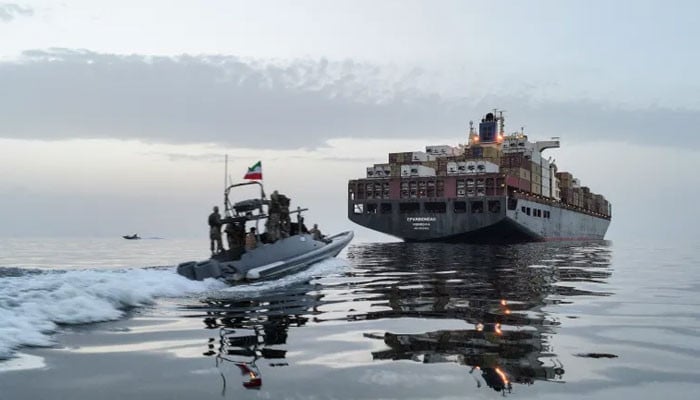
The Strait of Hormuz, a crucial waterway located in the Persian Gulf, has become a major challenge for the global economy due to the ongoing conflict between the United States and Iran. The strait, through which approximately 20% of the world’s oil and natural gas is transported, has not been fully secured despite the recent tensions. Reports suggest that the heightened tensions between the US and Iran have severely impacted maritime trade in the strait, resulting in nearly 2,000 ships being stranded in the Gulf.
Experts warn that even if the route is re-opened, the risks may not be completely eliminated. According to US officials, it may take at least six months to clear the sea mines laid by Iran, while some analysts believe that completely eliminating the threat may be impossible. A confidential briefing was held at the Pentagon, where senior officials discussed the situation in the Strait of Hormuz. Meanwhile, insurance companies have suspended or increased premiums for war-related risks, citing the high uncertainty in the situation.
Insurance costs for ships passing through the strait have skyrocketed, from 0.25% of the ship’s value to 1-5% or even higher. Experts stress that for the strait to be considered safe again, a permanent ceasefire, clear security guarantees, effective mine clearance, and unimpeded control over maritime routes are essential. A temporary ceasefire may not be sufficient, and uninterrupted maritime traffic for an extended period is necessary to restore trust among insurance companies.
The International Energy Agency has termed this situation the most significant obstacle to oil supply in the world, surpassing the 1970s oil crisis. In other news, the UAE has detained 13 individuals suspected of being involved in an international narcotics smuggling network. The company’s revenue increased by 16% last year, reaching $11 billion, while its profit surged by 6.5%, making it the company’s highest profit in history.
The UAE’s decision to leave OPEC was made on both political and economic grounds, with the primary reason being to increase oil supply to Japan. The “Global Pride” flotilla has arrived off the coast of Greece in an effort to break the Gaza blockade. A US journalist has shared a video on social media showing protesters confronting US Congresswoman Pat Higginbotham.
The European Parliament has defined the concept of “gender” in a new resolution, stating that any social relationship will be considered a sexual relationship if consent is given freely, information is shared, and it can be withdrawn at any time. Without consent, any relationship will be considered a form of exploitation or rape. The US Defense Department is considering a $1.5 trillion defense budget for the next year.
A special passport will be available for US citizens this summer, which will not require an additional fee. The refinery, which was shut down after the US-Iran conflict, has been reopened. German Chancellor Angela Merkel has stated that relations with the US remain good. Merkel’s comments come after criticism from US President Donald Trump.
In a shocking incident in London, a Jewish man was stabbed and two Jewish women were injured in a separate attack. A suspect has been arrested in connection with the attack. The Iranian government has been criticized for a controversial tweet, which has led to the Iranian ambassador in London being summoned to the Foreign Office. The Iranian rial has hit a record low against the US dollar, making it the weakest currency in the world.
The US Defense Department has acknowledged that the US is vulnerable to modern missile threats, which could put the country’s defense systems at risk. The White House has confirmed that the US will not provide Iran with nuclear capabilities.
