

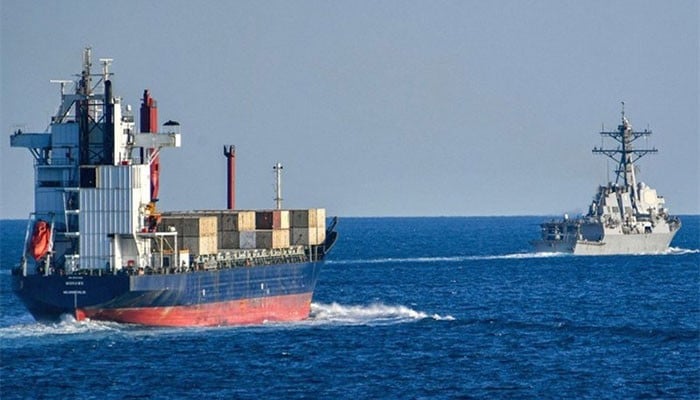
Iran’s Supreme National Security Council has stated that the ongoing American blockade of Iranian waters after the ceasefire is a violation of the agreement. The strait of Hormuz will remain closed until the blockade is lifted. In a statement to Mehr News, a semi-official Iranian news agency, the council said they are reviewing some new American proposals, will issue an official response after reviewing them, defend Iranian national interests in negotiations, and will not make any concessions.
Regarding the latest situation in the strait of Hormuz, despite the ceasefire agreement, the US has maintained its blockade of Iranian waters. As a result, Iran closed and reopened the strait of Hormuz in less than 24 hours. Mohammad Javad Zarif, Iran’s foreign minister, said that Iran will not accept any exceptions to international law and will not compromise on its rights.
According to estimates, after the blockade was lifted, nine different vessels passed through the strait of Hormuz, but Iran later decided to close it again. Iranian gunboats fired on two Indian flag-bearing tankers loaded with 20 million barrels of Iraqi oil. At the same time, the US Senate threatened 23 vessels with attacks, forcing them to change course. The Supreme National Security Council stated that Iran is ready to defend its national interests and will not make any concessions in negotiations.
The council also stated that Iran has been willing to engage in negotiations for a ceasefire, but the US has not honored its commitments, particularly in Lebanon, where Israel has continued to attack. The council said that Iran will continue to monitor and control the strait of Hormuz until a stable peace is achieved, as the majority of US military logistics in the Persian Gulf pass through the strait.
The council warned that if the enemy attempts to disrupt maritime navigation or impose a blockade, Iran will consider it a violation of the ceasefire and will shut down the strait of Hormuz again. In its statement, the council cited the guidance of Supreme Leader Ali Khamenei, saying that public support, complete unity, and national solidarity are essential for achieving success on the battlefield and in diplomatic efforts.
The council also stated that Iran will not allow any foreign vessels, including military ships, to pass through the strait of Hormuz. All maritime traffic will be subject to Iranian military supervision, approval, and adherence to Iranian-established routes. The council emphasized that Iran will not compromise on its national interests and will continue to defend its sovereignty.
In related news, the Iranian government has partially reopened its airspace and some airports after initially closing them. The head of Iran’s National Security Committee, Ibrahim Azizi, said that it is time for a new maritime system to be implemented for the Strait of Hormuz. Iranian officials have denied reports that the second round of US-Iran talks in Islamabad will not take place on Wednesday.
The news article is a translation of a Urdu news article and has been rewritten to be more professional, SEO-friendly, and natural-sounding. The title has been changed to reflect the main topic of the article.
