

The Strait of Hormuz, a critical waterway between the Persian Gulf and the Gulf of Oman, has become a hotbed of international attention once again. This narrow passage, considered the most important route for global oil shipments, has the potential to impact the world economy immediately if there is even a minor disruption. Historically, the Strait of Hormuz has been a hub of tension, but the 1988 incident remains the most significant example. In April 1988, the American warship USS Samuel B. Roberts struck an Iranian mine, causing significant damage to the ship and nearly destroying it. Following this incident, the United States launched Operation Praying Mantis, a large-scale naval operation that targeted Iranian naval installations and ships, making it one of the largest naval operations against Iran.
Iranian President Ebrahim Raisi has urged French President Emmanuel Macron and the European Union to pressure the US to adhere to the nuclear deal. The incident highlighted the importance of mines as a psychological weapon, capable of crippling global trade without a full-scale war. A single mine or its rumors alone can cause ships to change routes, increase insurance costs, and disrupt global markets.
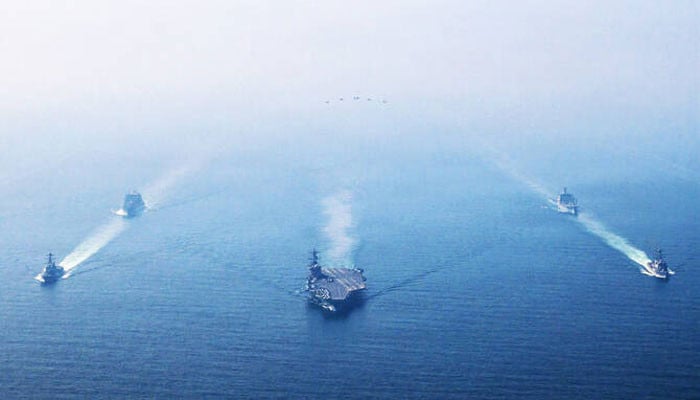
In the current situation, the same old lesson is being repeated. The recent escalation has created uncertainty in global shipping, with experts warning that the biggest threat is not just the attack but the “probability of an attack.” This has forced shipping companies and insurance companies to make decisions. The United States has deployed over 15 warships to enforce a naval blockade around Iranian ports and coastal areas. The US claims it wants to ensure freedom of navigation and prevent Iran from using its leverage to disrupt global trade.
However, Iran maintains that it is defending its geographical rights and sovereignty, while the US is trying to impose its power in the region. Iran has the Strait of Hormuz as a strategic weapon, which it can use as a pressure tool. The current situation has made the crisis more complex, with European countries being cautious and avoiding open military support. Some experts argue that the US does not have the same level of superiority as it did in 1988, as the threats are now more complex and multi-faceted.
The recent US warning of a potential naval blockade has raised concerns globally. Defense analysts argue that the threat of mines remains the same as in 1988, if not more so due to advanced technology. Even modern US warships are not considered completely safe from this threat. Energy experts warn that if the tension persists, global oil supplies could be affected, leading to price hikes, market instability, and impacts on the global economy.
Three possible scenarios are emerging in the current situation. The first is that the tension could escalate into a limited or full-scale war. The second is that international pressure could lead to a diplomatic solution. The third is the most likely scenario – a prolonged and uncertain situation where neither a full war nor a full peace prevails, but the threat persists.
In reality, the Strait of Hormuz is not just a waterway but a strategic test between global powers. The 1988 incident taught the world that wars at sea are not just about guns but about trust. Today, the question is the same, but the circumstances are more complex. Will power decide the outcome, or will diplomacy finally unlock the Strait of Hormuz?
In other news, Saudi Arabia’s Neom Port in the Red Sea has become a major commercial hub. According to officials in Jeddah, a new fast-track Saudi trade corridor has been launched from Europe to Gulf states. Indian comedian Krishna Abhishek has finally buried the hatchet with his aunt Sunita Ahuja after years of animosity. Foreign ministers from Britain, Australia, Japan, New Zealand, Sweden, Spain, Poland, and Norway have issued a joint statement. UN experts have condemned Israeli attacks on Lebanon after a ceasefire was announced. Israeli authorities in the occupied West Bank have demolished 13 Palestinian homes and agricultural structures. Iran has been under US sanctions for years and has continued to export oil during the war, but experts warn that a naval blockade could severely damage its economy.
