

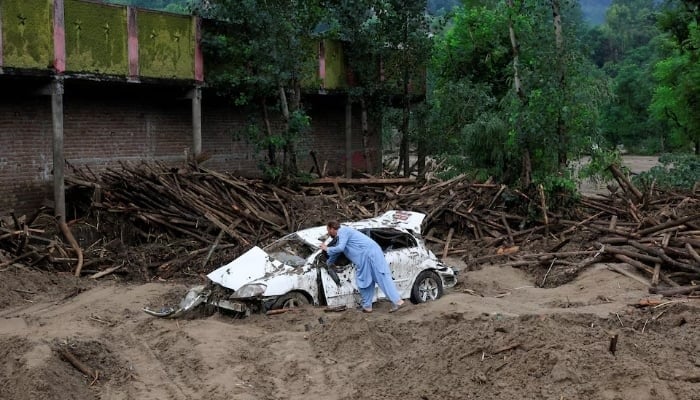
Rescuers and residents resumed the search for survivors on Tuesday after five days of relentless torrential rain raised the death toll to almost 400. Authorities have warned that the monsoon downpours are expected to continue until the weekend.
Torrential rains across northern Pakistan have triggered widespread flooding and landslides, which have swept away entire villages, leaving many residents buried under rubble and scores of people missing.
The National Disaster Management Authority (NDMA) reported that 356 people have been killed in Khyber Pakhtunkhwa since Thursday evening. Dozens more casualties in surrounding regions have brought the total death toll over the last five days to almost 400.
In the hard-hit village of Dalori in Khyber Pakhtunkhwa, rescuers dug through mud and stone in the hope of finding survivors and recovering the bodies of the missing. Villagers watched and prayed as the rescue efforts continued, a day after the search was temporarily halted by intense rain.
Umar Islam, a 31-year-old labourer, struggled to hold back tears while talking about his father, who was killed on Monday. “Our misery is beyond explanation,” Islam told AFP as neighbours tried to console him. “In a matter of minutes, we lost everything we had. Our lives are ruined.”
Fazal Akbar, 37, another villager, described the aftermath of the floods as “terrifying.” He said, “It happened so suddenly that no one even had a minute to react. Announcements were made from the mosque, and villagers rushed to begin the rescue themselves. In less than 20 minutes, our village was reduced to ruins.”
The Aga Khan Development Network’s Relief Efforts
Amid the widespread devastation, the Aga Khan Development Network (AKDN) has mobilized relief operations across Gilgit-Baltistan, Chitral, and other vulnerable mountain communities.
Its primary disaster agency, the Aga Khan Agency for Habitat (AKAH), activated emergency centers in Chitral, Gilgit, Karachi, and Islamabad at the onset of the flooding.
Community Emergency Response Teams have evacuated over 3,000 people and are now distributing food, tents, and other shelter supplies. Stockpiles in Gilgit-Baltistan and Chitral have been used to provide emergency aid, while nine Disaster Assessment Response Teams are conducting rapid surveys in the northern regions.
Community volunteers are continuing to repair crucial water supply lines, roads, and irrigation channels under harsh conditions. In Diamer, Village Emergency Response Teams have rescued stranded residents and tourists, and the Aga Khan Rural Support Programme (AKRSP) has been repairing roads and water infrastructure in Ghizer and Baltistan.
Healthcare workers from the Aga Khan Health Service, Pakistan, remain on 24-hour duty. A three-day medical camp in Punial treated more than 380 patients, while mobile teams are visiting homes in vulnerable areas to ensure safe deliveries and provide hygiene counseling.
Following an appeal by the GB Chief Minister Haji Gulbar Khan, the AKDN has also committed to longer-term support, including the rehabilitation of schools and health facilities, solar retrofitting, protection infrastructure, and the distribution of medical equipment and livestock inputs to vulnerable farmers.
The NDMA stated that over 700 people have been killed by the monsoon rains since June 26, with nearly 1,000 injured. The monsoon season is expected to last until mid-September.
Landslides and flash floods are common during the monsoon season, which typically begins in June and lasts until the end of September. Pakistan is among the world’s most vulnerable countries to the effects of climate change and is increasingly experiencing extreme weather events. In 2022, monsoon floods submerged one-third of the country, resulting in approximately 1,700 deaths.
