

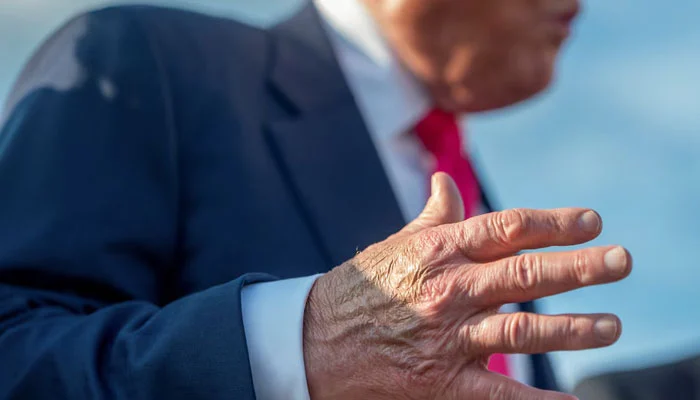
The White House has clarified that President Donald Trump’s leg swelling and bruising on his right hand are not causes for concern, following the circulation of photographs showing him with swollen ankles and makeup covering a bruised area on his hand.
Officials explained that the swelling is attributed to a common vein condition, while the bruising is a result of frequent handshaking.
During a press briefing, White House spokesperson Karoline Leavitt, reading from a letter by Trump’s doctor, stated that both issues were benign. She informed reporters that his leg swelling is due to a “common” vein condition, and the bruising on his hand is from shaking many hands.
Doctors have ruled out any serious health problems and asserted that the US President enjoys “excellent health.”
This statement aimed to quash a flurry of online speculation suggesting the 79-year-old president might be suffering from a more serious health issue based on the images.
Following the briefing, the White House released the letter from a US Navy officer and Trump’s physician, Sean Barbabella, confirming that Trump had undergone a series of tests regarding these concerns.
Barbabella stated that an ultrasound on the president’s legs “revealed chronic venous insufficiency, a benign and common condition, particularly in individuals over the age of 70.” He noted there was no evidence of deep vein thrombosis or arterial disease.
Further examinations, Barbabella added, found no signs of heart failure, kidney impairment, or any systemic illness. Leavitt also confirmed that Trump was experiencing no discomfort from the condition.
Barbabella explained that the bruising on Trump’s right hand was “consistent with minor soft tissue irritation from frequent handshaking and the use of aspirin, which is taken as part of a standard cardiovascular prevention regimen.”
He concluded, “President Trump remains in excellent health.”
Kwame Amankwah, chief of vascular surgery at the University of Connecticut in Hartford, explained that chronic venous insufficiency typically affects the lower legs, where veins struggle to return blood to the heart.
He noted that it is generally treated with compression stockings and elevating the legs. Amankwah cautioned, “Even without heart disease, the condition needs to be managed. If it isn’t controlled with compression and elevation, it can lead to severe swelling and ulcers, requiring more significant treatment.”
Todd Berland, director of outpatient vascular interventions at NYU Langone Health, clarified that chronic venous insufficiency “has no overall impact on life expectancy. It’s a quality-of-life issue, not a quantity-of-life issue.”
Trump underwent a full physical examination on April 11 at Walter Reed National Military Medical Center near Washington. Doctors reported he had a normal heart rhythm and no major health concerns.
