

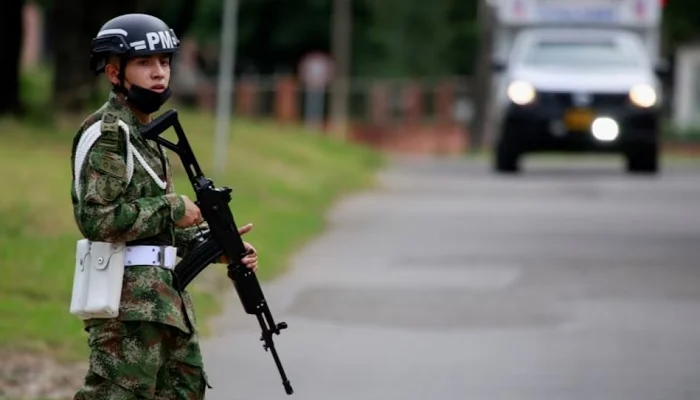
A vehicle bomb exploded on a busy street in the Colombian city of Cali on Thursday, killing five people and injuring dozens, local authorities confirmed. Police said the target of the bomb was the Marco Fidel Suarez Military Aviation School in the northern part of the city. This attack represents a new challenge to the country’s fragile peace process ahead of the 2026 elections.
Hector Fabio Bolanos, a 65-year-old eyewitness, told AFP, “There was a thunderous sound of something exploding near the air base.” He added, “There were so many injured people,” and that “many houses were damaged in front of the base.” Following the explosion, several buildings and a school were evacuated.
Cali Mayor Alejandro Eder stated that preliminary reports indicated at least five people had been killed and 36 injured. Fearing more explosions, he announced a ban on large trucks entering the city and a $10,000 reward for information leading to those responsible. Eyewitness Alexis Atizabal, 40, suggested that civilians were among the casualties, noting, “There were fatalities among people passing by on the avenue.”
The identity of those responsible was not immediately clear, but regional governor Dilian Francisca Toro called it a “terrorist attack,” declaring, “Terrorism will not defeat us.” In June, the leftist guerrilla group known as the Central General Staff (EMC) claimed responsibility for a wave of bomb and gun attacks in and around Cali that killed seven people. This group rejected the 2016 peace deal and has escalated its operations ahead of the 2026 elections.
Surge in Violence
While guerrilla, paramilitary, and cartel groups still control parts of Colombia, the country had enjoyed a decade or more of relative calm. However, there has been a recent surge in violence in the lead-up to the 2026 presidential elections. In a seemingly unrelated attack on Thursday, eight people were killed in clashes between guerrillas and police in the country’s northwest. The police officers were in the process of eradicating coca crops near the city of Medellin. Many of Colombia’s armed groups, once defined by leftist or right-wing ideologies, now fund themselves through the lucrative cocaine trade. These attacks are putting pressure on the government of President Gustavo Petro, whose conciliatory approach to armed groups has been blamed for the uptick in violence.
