

The United States has issued a warning that China appears to be preparing for the use of military force in Asia. A senior US official stated that China’s recent actions—including military drills conducted near Taiwan and in the South China Sea—suggest a potential plan to alter the balance of power in the region.
This warning emerges amid escalating tensions between the two global powers over issues of trade, technology, and security.
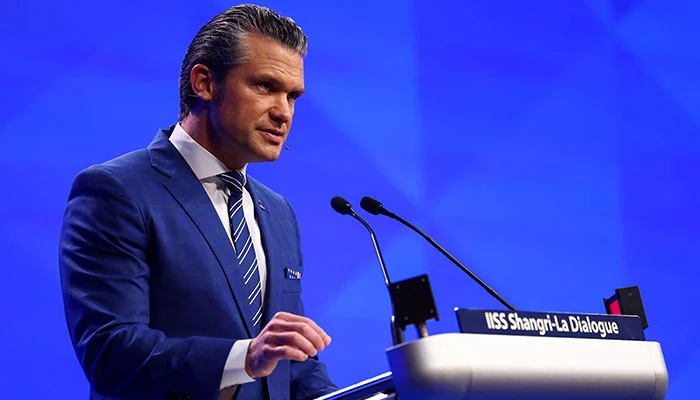
US Secretary of Defense Pete Hegseth conveyed this on Saturday while addressing the annual Shangri-La Dialogue, a prominent security forum held in Singapore. His remarks coincide with the administration of US President Donald Trump’s ongoing disputes with Beijing concerning trade, technology, and influence over strategic areas worldwide.
China’s foreign ministry sharply criticized the speech, announcing that it had “lodged solemn representations with the US side” regarding Hegseth’s comments, particularly taking exception to his remarks concerning Taiwan.
Since taking office in January, President Trump has initiated a trade war with China, sought to restrict its access to crucial AI technologies, and deepened security ties with allies such as the Philippines, which is engaged in intensifying territorial disputes with Beijing.
“The threat China poses is real and it could be imminent,” Hegseth stated at the Shangri-La Dialogue, an event attended by defense officials from across the globe.
He asserted that Beijing is “credibly preparing to potentially use military force to alter the balance of power in the Indo-Pacific.”
Hegseth further cautioned that the Chinese military is developing capabilities to invade Taiwan and is actively “rehearsing for the real deal.”
China has significantly escalated military pressure on Taiwan, conducting large-scale exercises around the self-governed democratic island that are frequently interpreted as preparations for a blockade or invasion.
Hegseth affirmed that the United States was “reorienting toward deterring aggression by communist China,” and urged US allies and partners in Asia to swiftly bolster their defenses in response to mounting threats.
In Beijing, the foreign ministry responded: “The US should not try to use the Taiwan issue as a bargaining chip to contain China and must not play with fire.”
‘Stirring up trouble’
Hegseth characterized China’s conduct as a “wake-up call,” accusing Beijing of endangering lives through cyber attacks, harassing its neighbors, and “illegally seizing and militarizing lands” in the disputed South China Sea.
Beijing claims nearly the entire waterway, a critical route for over 60 percent of global maritime trade, despite an international ruling that its assertion lacks legal merit.
In recent months, China has repeatedly clashed with the Philippines in these strategic waters, a flashpoint expected to dominate discussions at the Singapore forum, according to US officials.
As Hegseth spoke in Singapore, China’s military announced that its navy and air force were conducting routine “combat readiness patrols” around the Scarborough Shoal, a chain of reefs and rocks that Beijing disputes with the Philippines.
Beijing did not send any top defense ministry officials to the summit, instead dispatching a delegation from the People’s Liberation Army National Defense University led by Rear Admiral Hu Gangfeng.
Without directly naming Hegseth, Hu remarked about his speech that “these actions are essentially about stirring up trouble, creating division, inciting confrontation, and destabilizing the Asia-Pacific.”
Hegseth’s comments followed new trade tensions stoked by Trump, who argued that Beijing had “violated” a deal to de-escalate tariffs as both sides appeared deadlocked in negotiations.
The world’s two largest economies had previously agreed to temporarily lower significant tariffs they had imposed on each other, pausing them for 90 days.
‘Cannot dominate’
Reassuring US allies on Saturday, Hegseth declared that the Asia-Pacific region was “America’s priority theatre,” pledging to ensure that “China cannot dominate us — or our allies and partners.”
He stated that the United States had enhanced cooperation with allies including the Philippines and Japan, and reiterated Trump’s vow that “China will not invade (Taiwan) on his watch.”
However, he called on US partners in the region to increase their military spending and “quickly upgrade their own defenses.”
“Asian allies should look to countries in Europe for a newfound example,” Hegseth suggested, citing pledges by NATO members, including Germany, to move towards Trump’s defense spending target of five percent of GDP.
“Deterrence doesn’t come on the cheap.”
