

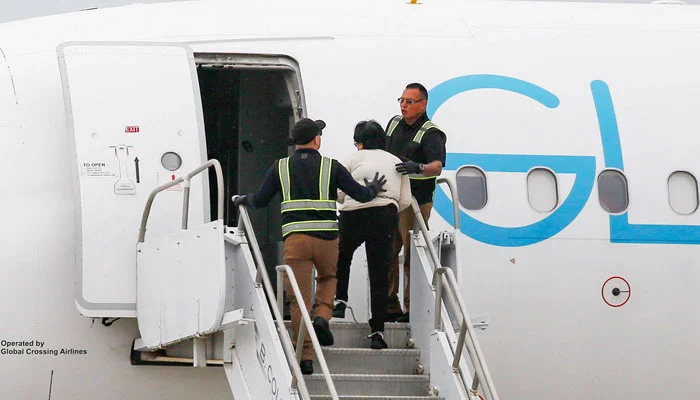
The United States Supreme Court on Monday cleared the path for President Donald Trump’s administration to resume deporting migrants to countries other than their own, without first offering them an opportunity to demonstrate the harms they could face. This decision marks another victory for the president in his aggressive pursuit of widespread deportations.
In a move that drew sharp dissent from its three liberal justices, the court granted the administration’s request to lift a prior judicial order. That order had mandated that migrants slated for deportation to so-called “third countries” be given a “meaningful opportunity” to inform US officials of their risk of torture at their new destination, while a broader legal challenge to the policy unfolds.
US District Judge Brian Murphy, based in Boston, had initially issued the order on April 18.
The Supreme Court’s brief order was unsigned and provided no specific reasoning, which is a common practice when it decides on emergency requests. The court currently holds a 6-3 conservative majority.
Justice Sonia Sotomayor, joined by the two other liberal justices, strongly condemned the decision, labeling it a “gross abuse” of the court’s power.
“Apparently, the court finds the idea that thousands will suffer violence in far-flung locales more palatable than the remote possibility that a district court exceeded its remedial powers when it ordered the government to provide notice and process to which the plaintiffs are constitutionally and statutorily entitled,” Sotomayor wrote in her dissent.
Sotomayor further described the court’s action as “as incomprehensible as it is inexcusable.”
Judge Murphy had previously determined that the administration’s policy of “executing third-country removals without providing notice and a meaningful opportunity to present fear-based claims” likely violates the due process protections guaranteed by the US Constitution. Due process typically requires the government to provide notice and an opportunity for a hearing before implementing certain adverse actions.
Legal Battles and Broader Implications
After the Department of Homeland Security moved in February to accelerate rapid deportations to third countries, immigrant rights groups filed a class-action lawsuit. This lawsuit was brought on behalf of a group of migrants seeking to prevent their removal to such destinations without proper notice and to gain a chance to assert the potential harms they could face.
On May 21, Judge Murphy found that the Trump administration had violated his order by attempting to send a group of migrants to politically unstable South Sudan. The US State Department has explicitly urged Americans to avoid South Sudan “due to crime, kidnapping and armed conflict.” The judge’s intervention led the US government to keep these migrants at a military base in Djibouti.
Following the US Supreme Court’s ruling, Judge Murphy, in a subsequent court order, clarified that his decision preventing the rapid deportation of eight men to South Sudan “remains in full force and effect.”
Trina Realmuto, executive director of the National Immigration Litigation Alliance, which helps represent the plaintiffs, called the ramifications of the court’s action “horrifying.” She stated it strips away “critical due process protections that have been protecting our class members from torture and death.”
The administration argued before the Supreme Court that its third-country policy already complies with due process and is crucial for removing migrants who have committed crimes, as their countries of origin are often unwilling to take them back. It asserted that all the migrants slated for South Sudan had committed “heinous crimes” in the United States, including murder, arson, and armed robbery.
“The Supreme Court’s stay of a left-wing district judge’s injunction reaffirms the president’s authority to remove criminal illegal aliens from our country and Make America Safe Again,” White House spokesperson Abigail Jackson said after Monday’s decision.
“Fire up the deportation planes,” added Department of Homeland Security Assistant Secretary Tricia McLaughlin.
This dispute is one of many legal challenges to Trump’s policies that have reached the nation’s highest judicial body since he returned to office in January. In May, the Supreme Court allowed Trump to terminate humanitarian programs that permitted hundreds of thousands of migrants to live and work temporarily in the United States.
However, the justices did criticize the administration’s treatment of some migrants whom Trump targeted for removal under the Alien Enemies Act—a 1798 law historically employed only in wartime—as inadequate under constitutional due process protections.
Justice Sotomayor noted that in sending migrants to South Sudan, and in another instance, four others to the US naval base at Guantanamo Bay, Cuba, and then on to El Salvador, the administration “openly flouted two court orders” issued by Judge Murphy. Sotomayor also referenced separate Alien Enemies Act litigation where questions were raised about the administration’s compliance with an order from a judge in that case.
“This is not the first time the court closes its eyes to noncompliance, nor, I fear, will it be the last,” Sotomayor wrote. “Yet each time this court rewards noncompliance with discretionary relief, it further erodes respect for courts and for the rule of law.”
The administration had sought the Supreme Court’s intervention after the Boston-based 1st US Circuit Court of Appeals on May 16 declined to put Judge Murphy’s decision on hold. Reuters has also reported that US officials were considering sending migrants to Libya, another politically unstable country, despite previous US condemnation of Libya’s harsh treatment of detainees.
