

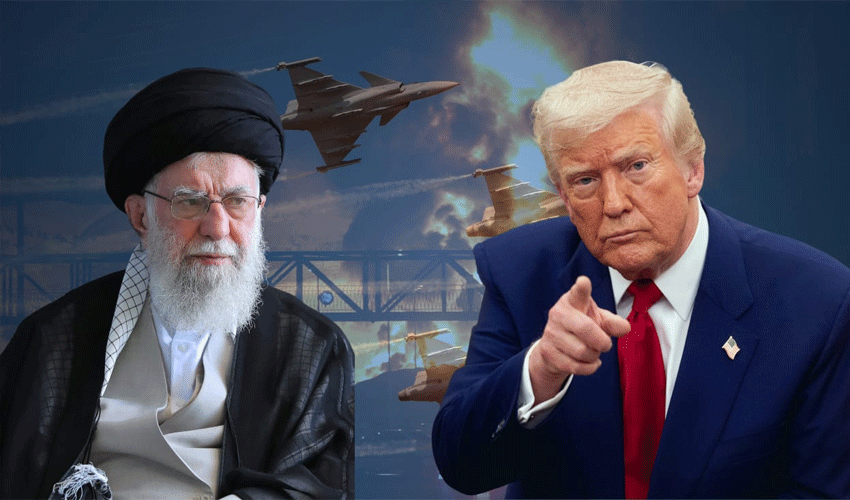
Recent US military strikes on three of Iran’s nuclear facilities did not completely destroy the core components of Iran’s nuclear program and are believed to have set it back by only a few months, according to an early assessment by the Defense Intelligence Agency (DIA). This classified evaluation, based on a detailed battle damage report from US Central Command, directly challenges President Donald Trump’s repeated claims that the strikes had “completely obliterated” Iran’s nuclear capabilities. Seven sources familiar with the report informed CNN that a significant portion of Iran’s enriched uranium stockpile survived the attack, and most of its centrifuges remain intact.
According to CNN, it appears Iranian officials had moved key uranium materials out of the targeted sites before the strikes commenced. “The DIA believes the strikes may have delayed Iran’s program by a few months at most,” one source told CNN.
The White House, however, strongly rejected this assessment. Press Secretary Karoline Leavitt labeled the intelligence report “flat-out wrong” and alleged that the leak was intended to undermine President Trump and discredit the operation’s success. Trump, currently attending the NATO summit in the Netherlands, reiterated his earlier statements, calling the strikes “one of the most successful military operations in history” and insisting that Iran’s nuclear sites had been “completely destroyed.”
The Pentagon maintains that the strikes were a significant success, though officials concede it is still too early for a full damage evaluation. Chairman of the Joint Chiefs of Staff Dan Caine stated that the assessment is ongoing and it is “way too early” to conclude whether Iran retains nuclear capabilities.
According to defense sources, while US B-2 bombers deployed over a dozen 30,000-pound bunker buster bombs on key nuclear facilities, including Fordow and Natanz, the strikes primarily damaged aboveground structures such such as power grids and uranium processing buildings. The heavily fortified underground facilities, which house centrifuges and enriched uranium, appear to have withstood much of the impact.
Israel, which had conducted its own pre-strike operations on Iranian nuclear sites, reportedly found the damage to the Fordow facility to be less than expected. Nonetheless, Israeli intelligence estimates that the combined US-Israeli strikes may have set Iran’s program back by up to two years, assuming Iran is unable to rebuild quickly—a capability Israel has vowed to prevent.
Independent weapons experts and analysts who have reviewed commercial satellite imagery concur with the DIA’s preliminary findings. Jeffrey Lewis, a weapons specialist at the Middlebury Institute, stated that the strikes failed to fully destroy underground nuclear sites near Natanz, Isfahan, and Parchin, which could enable Iran to rapidly resume its nuclear program. Notably, the US targeted Isfahan using Tomahawk missiles from a submarine, rather than bunker buster bombs, due to the extreme depth of its underground facilities.
Concerns persist that Iran may still be operating secret nuclear sites that were not targeted in the recent military operation.
Meanwhile, classified briefings on the strikes, scheduled for both the House and Senate, were unexpectedly postponed. Some lawmakers, including Democratic Rep. Pat Ryan, suggested the delay was to avoid scrutiny over the accuracy of the administration’s public claims.
The international community continues to monitor the situation closely as the ceasefire between Israel and Iran holds, but significant questions remain about the true extent of the damage and Iran’s capacity to rebuild its nuclear infrastructure.
