

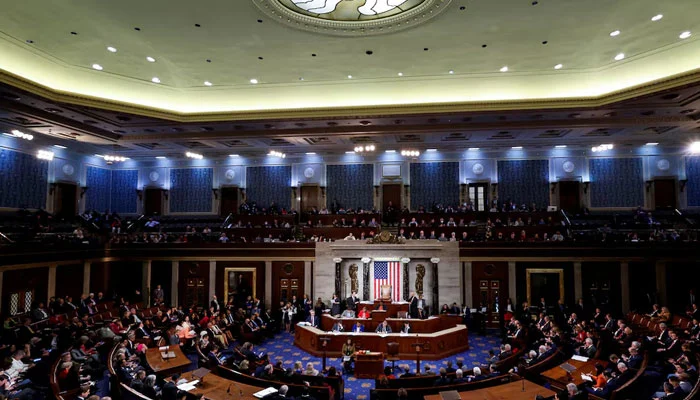
The U.S. Senate, in a vote early Thursday, approved President Donald Trump’s plan to implement billions of dollars in cuts to foreign aid and public broadcasting funding. This decision marks another victory for the Republican president as he continues to assert control over Congress with minimal opposition.
The Senate’s vote of 51 to 48 in favor of Trump’s request will reduce spending by $9 billion, funds that had already been approved by Congress. The majority of these cuts target programs designed to assist foreign countries grappling with disease, war, and natural disasters. Additionally, the plan entirely eliminates the $1.1 billion that the Corporation for Public Broadcasting was slated to receive over the next two years.
Trump and many of his Republican allies contend that public broadcasting expenditures are unnecessary and dismiss its news coverage as suffering from an anti-right bias. Standalone rescission packages, which allow the President to cancel approved spending, have not been successfully passed in decades, primarily due to lawmakers’ reluctance to relinquish their constitutionally mandated control over appropriations.
However, Trump’s fellow Republicans, who hold slim majorities in both the Senate and House, have shown little inclination to resist his policies since his second term began in January. The $9 billion at stake represents a minuscule fraction of the $6.8 trillion federal budget and is only a small portion of the total funds approved by Congress that the Trump administration has withheld while pursuing extensive cuts, many of which were ordered by billionaire Elon Musk’s Department of Government Efficiency (DOGE).
As of mid-June, Democratic lawmakers tracking frozen funding indicated that Trump was blocking $425 billion in appropriated and previously approved congressional funding. Nonetheless, Trump and his supporters have pledged to issue more “rescission” requests to eliminate previously approved spending, asserting that this is an effort to scale back the federal government.
Last month, the House of Representatives passed the rescissions legislation by a vote of 214-212 without altering Trump’s original request. Four Republicans joined 208 Democrats in voting against the measure. However, after a few Republican senators expressed reservations about the extent of cuts to global health programs, Russell Vought, director of the Office of Management and Budget, announced on Tuesday that PEPFAR, a global program combating HIV/AIDS launched in 2003 by then-President George W. Bush, would be exempted.
This modification reduced the size of the cuts package from $9.4 billion to $9 billion, necessitating another House vote before the measure can be sent to the White House for Trump’s signature into law. The rescissions must be passed by Friday; otherwise, the request will expire, and the White House will be obligated to adhere to the spending plans previously passed by Congress.
Republican Dissent
Two of the Senate’s 53 Republicans—Lisa Murkowski of Alaska and Susan Collins of Maine—voted with Democrats against the legislation. “You don’t need to gut the entire Corporation for Public Broadcasting,” Murkowski asserted during a Senate speech.
She also noted that the Trump administration had failed to provide assurances that global efforts against diseases like malaria and polio would be sustained. Above all, Murkowski stressed that Congress must uphold its constitutional role in determining how federal funds are allocated.
Senate Republican Majority Leader John Thune of South Dakota described Trump’s request as a “small, but important step toward fiscal sanity.” Democrats, however, scoffed at this claim, pointing out that congressional Republicans earlier this month passed a massive package of tax and spending cuts that nonpartisan analysts estimated would add over $3 trillion to the nation’s $36.2 trillion debt.
Democrats accused Republicans of surrendering Congress’s constitutionally mandated control over federal spending. “Today, Senate Republicans turn this chamber into a subservient rubber stamp for the executive, at the behest of Donald Trump,” declared Senate Democratic Leader Chuck Schumer of New York. “Republicans embrace the credo of cut, cut, cut now, and ask questions later,” Schumer added.
These cuts would overturn bipartisan spending agreements, most recently enacted in a full-year stopgap funding bill passed in March. Democrats warn that such partisan cuts now could complicate negotiations for future government funding bills, which require bipartisan agreement by September 30 to avert a government shutdown.
While appropriations bills require 60 votes to advance in the Senate, this rescissions package only needed 51, allowing Republicans to pass it without Democratic support.
