

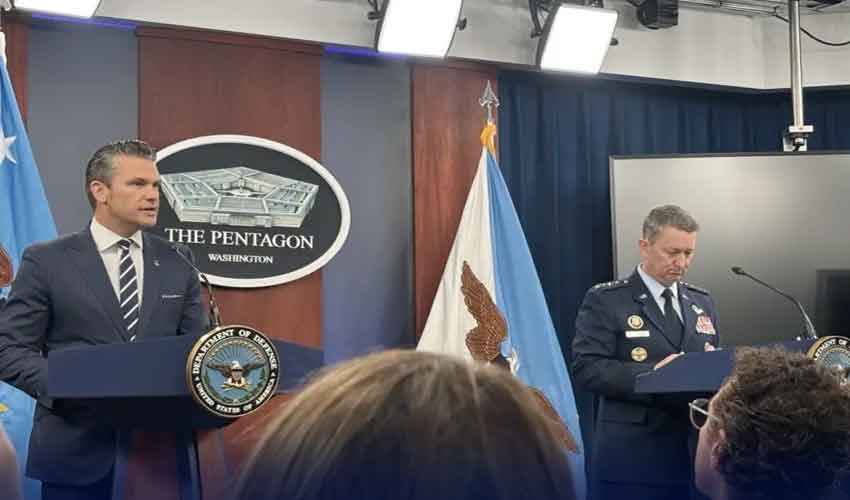
US Secretary of Defense Pete Hegseth has clarified that the recent United States strikes on Iran were not part of a regime change strategy. In a televised statement, Hegseth asserted, “This mission was never about regime change—neither before, nor now.” He characterized the attack as a “precision operation” designed to safeguard US national interests from threats posed by Iran’s nuclear program.
During a Pentagon press conference, Secretary Hegseth revealed that the US airstrikes were the culmination of “months of planning,” incorporating deliberate misdirection and a high level of operational security. “This was a plan developed over months and weeks of preparation and positioning, so that when the president gave the order, we were ready,” he stated. Hegseth emphasized the technical precision required, noting, “It demanded immense precision. The operation involved misdirection and the highest level of operational security. Our B-2 bombers reached Iranian nuclear sites and returned without the world knowing.”
Hegseth claimed that the strikes inflicted significant damage on Iran’s nuclear weapons infrastructure, hailing the mission as a “remarkable and overwhelming success,” though he did not provide detailed evidence.
Joint Chiefs Chairman Confirms Stealth Operation
Meanwhile, Chairman of the Joint Chiefs of Staff, General Dan Caine, confirmed that “Operation Midnight Hammer” was planned and executed across “multiple military domains.” When questioned about Iran’s remaining nuclear capability, Caine responded that it was premature to make such assessments prior to a full damage evaluation.
General Caine confirmed that B-2 bombers were launched from the United States on Friday for an 18-hour flight mission. He detailed, “‘Operation Midnight Hammer’ involved numerous deception and decoy maneuvers. High-speed suppression fire was used to protect the B-2s, and Iran did not open fire.” He added, “Iran’s fighter jets didn’t take off, and it seems their missile systems never detected us,” during the Pentagon briefing.
