

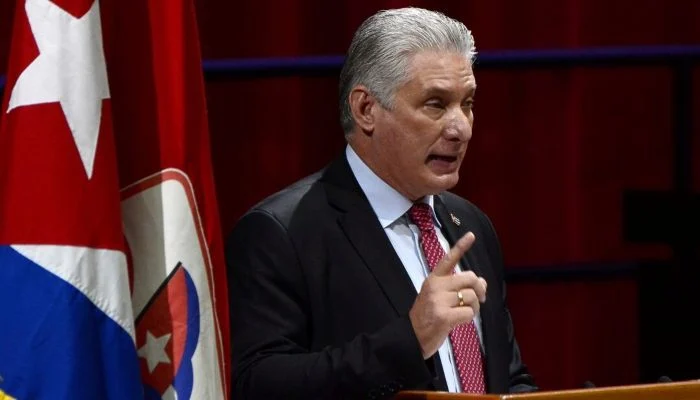
The United States on Friday announced its first sanctions against Cuban President Miguel Diaz-Canel, citing his role “in the Cuban regime’s brutality toward the Cuban people.” This action marks the latest in a series of measures by US President Donald Trump’s administration aimed at increasing pressure on the Cuban government.
Secretary of State Marco Rubio announced on X (formerly Twitter) that the US was restricting visas for the Cuban president and other high-ranking government officials. The announcement coincided with the fourth anniversary of the historic anti-government protests that occurred in Cuba in July 2021.
Demonstrations engulfed the island in July 2021 as thousands took to the streets to protest shortages of basic goods and deteriorating economic conditions. The protests were the largest since Fidel Castro’s 1959 communist revolution, resulting in hundreds of arrests, one death, and dozens of injuries.
The State Department stated it was sanctioning “key regime leaders… for their involvement in gross violations of human rights.” Officials targeted included Defence Minister Alvaro Lopez Miera and Interior Minister Lazaro Alberto Alvarez Casas.
The US is also taking steps to sanction Cuban judicial and prison officials linked to the “unjust detention and torture of July 2021 protestors.”
“While the Cuban people suffer shortages of food, water, medicine, and electricity, the regime lavishes money on its insiders,” Rubio stated.
Cuban Foreign Minister Bruno Rodriguez condemned the measures on X, asserting that the United States cannot “bend the will of its people or its leaders.”
In May, the Cuban foreign ministry summoned the US envoy to Havana to protest what it called “interference” in the country’s internal affairs. The United States has maintained a six-decade-old trade blockade against Cuba.
Political Prisoners and Hotel Restrictions
Rubio also used X to accuse Cuba of torturing dissident leader Jose Daniel Ferrer and demanded “proof of life.” “The United States demands immediate proof of life and the release of all political prisoners,” Rubio said.
According to the United States, 700 people remain imprisoned for their participation in the July 2021 protests. Human rights organizations place the number between 360 and 420.
Some convicted protestors have been released in recent months after completing their sentences. Others, including Ferrer—leader of the dissident group Patriotic Union of Cuba (UNPACU)—were released in January as part of a Vatican-mediated agreement, following former US president Joe Biden’s removal of the island from the blacklist of countries sponsoring terrorism.
However, Ferrer’s parole was revoked at the end of April, prompting criticism from Washington, which reinstated Cuba on the blacklist after Trump returned to power.
The State Department also added “Torre K,” a 42-story hotel in Havana, to its restricted list of entities off-limits to Americans, “to prevent US dollars from funding the Cuban regime’s repression.”
The establishment, recently inaugurated in a central area of the Cuban capital, sparked criticism regarding the government’s significant investment in new hotels amid a decline in tourism
