

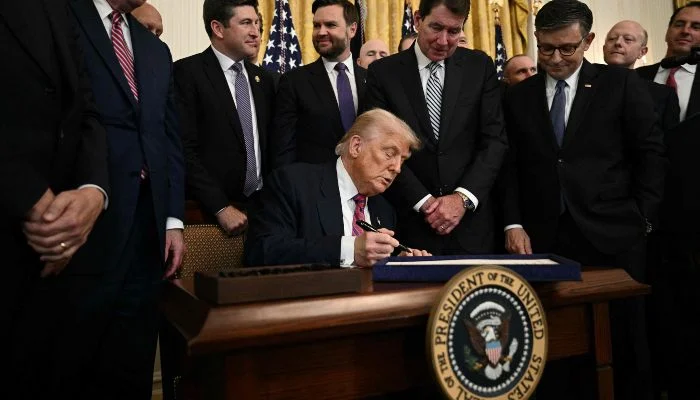
Washington, D.C., USA: On Friday, US President Donald Trump signed into law a bill that establishes a regulatory framework for dollar-pegged cryptocurrencies, known as stablecoins. This pivotal moment could enable these digital assets to become a common method for everyday payments and money transfers.
The legislation, dubbed the GENIUS Act, was approved by the House of Representatives with a vote of 308 to 122, garnering support from nearly half of the Democratic members and the majority of Republicans, after having already passed the Senate.
This law represents a significant victory for cryptocurrency proponents, who have long advocated for such a regulatory framework. Their aim is to confer greater legitimacy on an industry that emerged in 2009 as a digital “Wild West,” celebrated for its innovation but also characterized by speculative volatility.
“This signing is a massive validation of your hard work and pioneering spirit,” Trump declared at a signing event attended by numerous government officials, crypto executives, and lawmakers. He further emphasized, “It’s good for the dollar and it’s good for the country.”
Treasury Secretary Scott Bessent issued a statement asserting that this new technology will bolster the dollar’s status as the global reserve currency, broaden access to the dollar economy, and increase demand for US Treasuries, which underpin stablecoins.
Stablecoins are engineered to maintain a constant value, typically a 1:1 peg to the US dollar. Their adoption has surged, particularly among crypto traders for moving funds between tokens. The industry anticipates their integration into mainstream use for instantaneous payments.
The new law mandates that stablecoins must be backed by liquid assets, such as US dollars and short-term Treasury bills. It also requires issuers to publicly disclose the composition of their reserves on a monthly basis.
Cryptocurrency companies and executives argue that such legislation will enhance the credibility of stablecoins, making banks, retailers, and consumers more willing to utilize them for instant fund transfers.
The stablecoin market, which crypto data provider CoinGecko values at over $260 billion, could expand to $2 trillion by 2028 under this new law, as estimated by Standard Chartered bank earlier this year.
The passage of the law marks the culmination of extensive lobbying efforts by the industry, which, according to Federal Election Commission data, contributed over $245 million to aid pro-crypto candidates, including Trump, in last year’s elections.
The Republican president, who has even launched his own coin, expressed gratitude to executives for their support during the 2024 presidential campaign, stating, “I pledged that we would bring back American liberty and leadership and make the United States the crypto capital of the world, and that’s what we’ve done.”
Conversely, Democrats and critics contend that the law should have prohibited large technology companies from issuing their own stablecoins, which could further amplify the influence of an already powerful sector. They also argued for stronger anti-money laundering protections and a ban on foreign stablecoin issuers.
Scott Greytak, deputy executive director of Transparency International US, commented: “By failing to close known loopholes and protect America’s digital dollar infrastructure, Congress has risked making the US financial system a global haven for criminals and adversarial regimes to exploit.”
Potential Boost for T-Bill Demand
Major US banks are internally discussing an expansion into cryptocurrencies as regulators provide stronger backing for digital assets. However, banks’ initial steps will likely involve pilot programs, partnerships, or limited crypto trading, as Reuters reported in May.
Several crypto firms, including Circle and Ripple, are actively seeking banking licenses, which would reduce costs by allowing them to bypass intermediary banks.
Supporters of the bill suggest that it could generate a new source of demand for short-term US government debt, as stablecoin issuers will be required to acquire more of this debt to back their assets.
Trump has broadly sought to overhaul US cryptocurrency policies, having signed an executive order in March that established a strategic bitcoin reserve.
The President launched a meme coin called $TRUMP in January and holds a partial ownership stake in the crypto company World Liberty Financial.
