

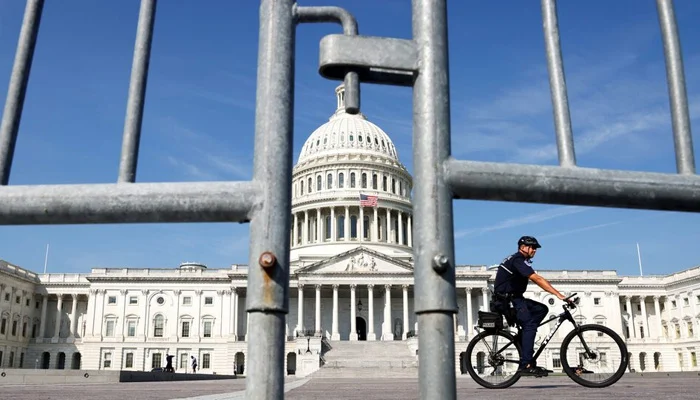
The US Congress returned on Tuesday with less than a month to perform one of its core duties—keeping federal agencies funded and preventing a partial government shutdown—a task it has struggled with in recent years. The chamber’s sharp partisan divides have become more entrenched in the first year of President Donald Trump’s new administration. This has angered Democratic lawmakers due to the administration’s decision not to spend some funds previously approved in bipartisan deals, as well as the July passage of a tax-cut bill that nonpartisan analysts said could cause more than 10 million low-income Americans to lose healthcare coverage.
Lawmakers’ efforts to agree on the approximately $1.8 trillion in discretionary spending within the $7 trillion federal budget will be further complicated by expected battles over the release of information related to the late convicted sex offender Jeffrey Epstein, a former friend of Trump’s, and the administration’s deployment of federal agents and the National Guard into the capital. There have been 14 partial government shutdowns since 1981, most lasting only a day or two. The most recent one stretched for 34 days from December 2018 into January 2019 during Trump’s first term.
Trump’s Republicans hold a 219-212 majority in the House of Representatives and a 53-47 edge in the Senate. However, the Senate’s rules require 60 votes to pass most bills, meaning seven Democrats’ support would be needed for a funding bill to pass. A preemptive blame game began this summer over which party would be at fault if Congress fails and a partial government shutdown occurs. In the lead-up to Republicans approving Trump’s request for a $9 billion cut to foreign aid and public media, Senate Minority Leader Chuck Schumer said in a July letter that the majority should not expect Democrats to “act as business as usual” in the bipartisan appropriations process due to the party cutting back on funding already approved by Congress. Schumer faced an outcry from some in his party in March after providing the votes for a continuing resolution to keep the government funded, arguing at the time that allowing a government shutdown would have been more damaging.
The full strategy of the Democrats this time has not yet been defined, but their leaders have requested a meeting with their Republican counterparts to discuss the deadline. Some Democrats want assurances from Republicans that they will not unilaterally cut funding if more requests are made by the administration. “I hope that the process will continue in a bipartisan way as we move toward the September deadline,” Senate Majority Leader John Thune said in a floor speech. Some Democrats, including Senator Elizabeth Warren of Massachusetts, are betting that conservatives would be blamed and that the funding deadline should be used as leverage. “In September, the Republicans are going to need to get a budget through to keep the government open, and to do that, they are going to need some Democratic votes,” Warren said at a rally in Nebraska in August. Referring to the sweeping tax-cut bill, she added, “You want my vote—and I hope the votes of the rest of these Democrats—then by golly, you can restore healthcare for 10 million Americans!” According to the Treasury Department, the US federal debt is $37.25 trillion. It has continued to grow under both Republican and Democratic administrations as the US Congress continues to authorize the federal government to spend more money than it takes in.
