

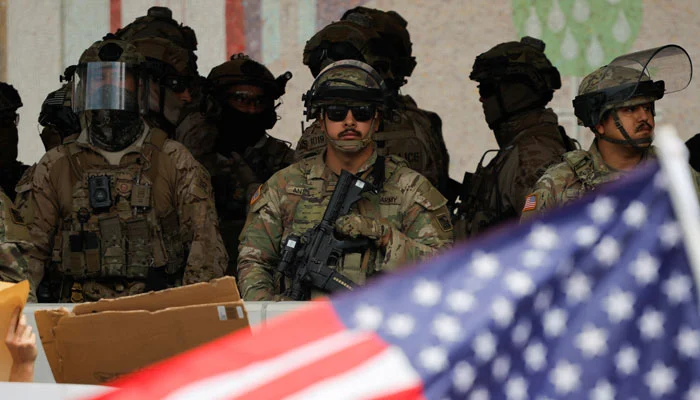
A United States appeals court on Thursday allowed Donald Trump to maintain control over California’s National Guard, even as the state’s Democratic governor pursues a lawsuit challenging the Republican president’s deployment of these troops to manage protests in Los Angeles. Trump’s decision to dispatch troops to Los Angeles ignited a national debate regarding the domestic use of military forces and intensified political tensions within the country’s second-most populous city.
On Thursday, a three-judge panel of the San Francisco-based 9th US Circuit Court of Appeals extended its temporary halt on US District Judge Charles Breyer’s June 12 ruling, which had asserted that Trump’s federalization of the National Guard was unlawful. The panel indicated that Trump likely acted within his authority, adding that his administration probably adhered to the requirement of coordinating with Governor Gavin Newsom. Furthermore, they stated that even if such coordination was absent, Newsom lacked the authority to veto Trump’s directive.
In its opinion, the court wrote, “And although we hold that the president likely has authority to federalize the National Guard, nothing in our decision addresses the nature of the activities in which the federalized National Guard may engage.” The court also noted that Newsom could still challenge the deployment of the National Guard and US Marines under other statutes, including the prohibition on using troops in domestic law enforcement. These issues could be raised by the governor at a court hearing before Judge Breyer on Friday.
Following the decision, Newsom pledged to continue his legal challenge in a post on X. He declared, “The president is not a king and is not above the law. We will press forward with our challenge to President Trump’s authoritarian use of U.S. military soldiers against our citizens.”
Trump, in turn, celebrated the ruling on Truth Social, stating, “This is a great decision for our country and we will continue to protect and defend law-abiding Americans.” He added, “This is much bigger than Gavin, because all over the United States, if our cities, and our people, need protection, we are the ones to give it to them should state and local police be unable, for whatever reason, to get the job done.”
Breyer’s initial ruling was issued in a lawsuit filed by Newsom challenging Trump’s action. Breyer had concluded that Trump violated a US law governing a president’s ability to take control of a state’s National Guard by failing to coordinate with the governor. He also found that the conditions specified under the statute to allow such a move, such as a rebellion against federal authority, were not met. Breyer had ordered Trump to relinquish control of California’s National Guard back to Newsom. Hours after Breyer’s ruling, the 9th Circuit panel temporarily paused the judge’s order.
Amidst protests and unrest in Los Angeles concerning Trump’s immigration raids, the President had federalized California’s National Guard on June 7, deploying 4,000 troops despite Newsom’s objections. Trump also ordered 700 US Marines to the city after the National Guard deployment. Breyer has not yet issued a ruling on the legality of the Marine Corps mobilization.
At a Tuesday court hearing on whether to extend the pause on Breyer’s decision, members of the 9th Circuit panel questioned lawyers for California and the Trump administration about the appropriate role, if any, for courts in reviewing the President’s authority to deploy troops.
The law outlines three conditions under which a president can federalize state National Guard forces: an invasion, a “rebellion or danger of a rebellion” against the government, or a situation where the US government is unable to execute the country’s laws with regular forces. The appeals court determined that the final condition was likely met, citing incidents where protesters hurled items at immigration authorities’ vehicles, used trash dumpsters as battering rams, threw Molotov cocktails, and vandalized property, thus impeding law enforcement.
The Justice Department had argued that once the president determines an emergency warrants the use of the National Guard, no court or state governor can review that decision. The appeals court, however, rejected this argument.
The protests in Los Angeles continued for over a week before subsiding, leading Los Angeles Mayor Karen Bass to lift the curfew she had imposed. In its June 9 lawsuit, California contended that Trump’s deployment of the National Guard and Marines violated the state’s sovereignty and US laws prohibiting federal troops from participating in civilian law enforcement. The Trump administration has denied that troops are engaging in law enforcement, stating they are primarily protecting federal buildings and personnel, including US Immigration and Customs Enforcement officers.
The 9th Circuit panel consists of two judges appointed by Trump during his first term and one appointee of Democratic former President Joe Biden.
