

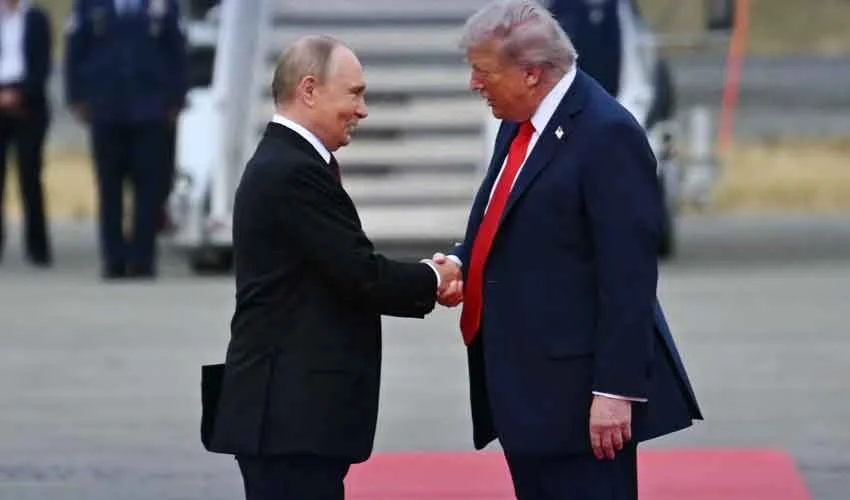
U.S. President Donald Trump stated on Tuesday that he hoped Russian President Vladimir Putin would work towards ending the war in Ukraine. However, he also admitted that the Kremlin leader might not be interested in a deal at all, a situation that would be “rough” for Putin.
In an interview with the Fox News program “Fox & Friends,” Trump said he expected Putin’s next steps to become clear within the next couple of weeks. He reiterated his opposition to sending American troops to Ukraine and did not offer any specific details on the security guarantees he has previously mentioned Washington could provide to Kyiv in a post-war settlement.
“I don’t think it’s going to be a problem, to be honest with you, [to reach a peace deal]. I think Putin is tired of it. I think they’re all tired of it, but you never know,” Trump said. “We’re going to find out about President Putin in the next couple of weeks… It’s possible that he doesn’t want to make a deal.” Trump has previously threatened additional sanctions on Russia and the nations that purchase its oil if Putin does not agree to peace.
Ukraine and its European allies were encouraged by Trump’s promise of security guarantees to help end the war during a special summit on Monday. Still, they face numerous unresolved questions, including Russia’s willingness to cooperate.
Ukrainian President Volodymyr Zelenskyy called Monday’s talks at the White House with the U.S. president a “major step forward” towards ending Europe’s deadliest conflict in 80 years and arranging a trilateral meeting with Putin and Trump in the coming weeks.
Zelenskyy was joined at the summit by the leaders of allies including Germany, France, and Britain, and his friendly relationship with Trump was a stark contrast to their disastrous Oval Office meeting in February.
However, beyond the positive atmosphere, the path to peace remains highly uncertain. Zelenskyy may be forced to make painful compromises to end the war, which began with Russia’s full-scale invasion in February 2022. Analysts estimate that over 1 million people have been killed or wounded in the conflict.
While the Washington talks provided a temporary sense of relief in Kyiv, the fighting did not cease. The Ukrainian air force reported that Russia launched 270 drones and 10 missiles in an overnight attack on Ukraine, the largest this month. The energy ministry said Russia targeted energy facilities in the central Poltava region, home to Ukraine’s only oil refinery, which caused large fires.
John Foreman, a former British defense attaché to Kyiv and Moscow, told Reuters, “The good news is that there was no blow-up [at the White House]. Trump didn’t demand Ukrainian capitulation nor cut off support. The mood music was positive, and the trans-Atlantic alliance lives on.” He added, “On the downside, there is a great deal of uncertainty about the nature of security guarantees and what exactly the U.S. has in mind.”
Ukraine’s allies were scheduled to hold further discussions on Tuesday in the “Coalition of the Willing” format to decide on the next steps. A source close to the matter said that NATO’s chiefs of defense would also discuss security guarantees for Ukraine on Tuesday, without giving further details.
Russia has not made any explicit commitment to a meeting between Putin and Zelenskyy. Russian Foreign Minister Sergei Lavrov said on Tuesday that Moscow does not reject any formats for discussing the peace process in Ukraine, but any meeting of national leaders “must be prepared with utmost thoroughness.”
Oksana Melnyk, a 63-year-old resident of Kyiv, said, “It doesn’t smell like peace yet. I think Putin will not go for it; he is not that kind of person.” She added, “I really wanted it all to end peacefully, but, unfortunately, a lot of our people died, and it is very bitter.”
Putin has warned that Russia will not tolerate NATO alliance troops on Ukrainian soil. He has also shown no signs of abandoning his demands for territory, including land not currently under Russia’s military control, following his summit talks with Trump last Friday in Alaska.
Trump has not specified what form any U.S. security guarantees could take. In Alaska, he backed away from insisting that Russia agree to a ceasefire before any serious peace negotiations begin.
Neil Melvin, director of International Security at the Royal United Services Institute think-tank, suggested that Russia could prolong the war while attempting to deflect U.S. pressure with lengthy peace negotiations.
“I think behind this, there’s a struggle going on between Ukraine and the Europeans on one side, and the Russians on the other, not to present themselves to Trump as the obstacle to his peace process,” he said.
He added that “they’re all tiptoeing around Trump” to avoid any blame, and regarding security guarantees, “the problem is that what Trump has said is so vague it’s very hard to take it seriously.”
