

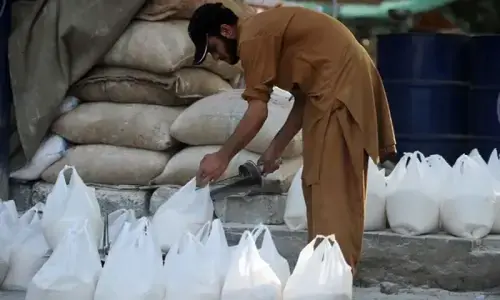
Punjab’s unofficial ban on the interprovincial movement of wheat has created a new crisis, leading to a severe flour shortage and skyrocketing prices in other provinces. This measure has been heavily criticized by politicians and flour millers, who argue it violates constitutional rights and a recent deregulation agreement.
Constitutional and Political Backlash
While Punjab officials denied a formal ban, they admitted to setting up checkpoints to curb what they called “unusual” wheat movement. Critics, however, argue that these actions go against the spirit of a deregulated market.
The ban has been met with strong condemnation from other provinces, particularly Khyber Pakhtunkhwa (KP) and Sindh, which rely heavily on Punjab’s wheat supply. The All-Pakistan Flour Mills Association (PFMA) has labeled the policy unconstitutional, citing Article 151 of the Constitution, which guarantees the freedom of trade and commerce nationwide.
According to Riazullah Khan, chairman of the Punjab Flour Mills Association, checkpoints at the province’s exit points are blocking the transport of wheat and flour to other regions, undermining the deregulation policy that promised unrestricted trade.
Impact on Prices and Public Burden
As a result of these restrictions, flour prices have soared in provinces like KP, where a 20kg bag now sells for up to Rs2,800, compared to around Rs1,800 in Punjab. This has placed an unbearable burden on low-income families already struggling with inflation.
KP Governor Faisal Karim Kundi publicly condemned the ban, calling it a “blatant violation of Article 151” and a “serious breach of national unity.”
Government’s Rationale vs. Market Realities
Punjab officials maintain that the restrictions are a necessary measure to ensure food security within the province and combat hoarding and smuggling. They argue that preventing wheat from being diverted to feed mills or sold to other provinces at inflated prices is essential for ensuring a stable supply for local consumers. They also pointed to the National Finance Commission award, which states that each province is responsible for its own food security.
However, millers and market analysts contend that this policy is counterproductive. They argue that the ban creates an artificial shortage, leading to market instability and driving up prices nationwide. The Pakistan Institute of Development Economics (PIDE) has consistently advocated for a deregulated market, asserting that interprovincial bans only lead to inefficiency and corruption.
Threats to Future Investment and Farmers
Majid Abdullah, president of the Progressive Flour Millers Group, warned that if administrative controls on the deregulated market continue, the private sector will be hesitant to invest in the wheat sector next season. He noted that without proper legal protection, the deregulation process remains vulnerable to reversal, which could make private investment in storage facilities worthless.
The ban also negatively affects farmers. If they cannot get a fair price for their wheat, they may choose to plant other crops in the upcoming sowing season. This could lead to a significant decline in domestic production and force the country to rely on costly imports. Abdullah cautioned that administrative efforts to control prices will discourage farmers who are already reluctant to plant wheat after failing to get good prices in the last two seasons.
