

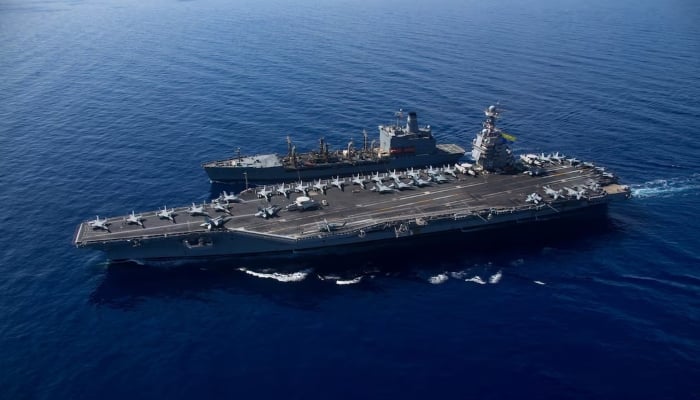
The United States is escalating its military footprint in the Middle East, ranging from naval warships to nuclear-powered aircraft carriers, in response to the ongoing conflict between Iran and Israel.
Last week, the Pentagon directed two destroyer warships in the Mediterranean to approach Israel. Reports indicate that the USS Sullivans Destroyer has also arrived in the Eastern Mediterranean this week, joining the USS Thomas Hudner Destroyer for continuous defense operations, while the Arleigh Burke destroyer has departed the area, according to a US official.
On Tuesday, the US relocated twelve F-16 fighter jets from a base in Italy to Prince Sultan Air Base in Saudi Arabia. Additionally, the US has been deploying other fighter jets, such as F-35s and F-22 Raptors, to its military installations throughout the Middle East. The US Air Force dispatched an additional 21 refueling planes and fighter jets to strategic locations across Europe, including sites in England, Spain, Germany, and Greece. While it remains unclear if these specific US movements are directly linked to the conflict, one expert noted that the flights of tanker aircraft were “very unusual,” as reported by the BBC.
Currently, American destroyers are intercepting Iranian ballistic missiles targeting Israel. Concurrently, the USS Carl Vinson nuclear-powered aircraft carrier is positioned in the Arabian Sea, accompanied by four warships forming its strike group.
Furthermore, the USS Nimitz nuclear-powered aircraft carrier is underway, heading west from the Indo-Pacific region towards the Middle East. MarineTraffic, a ship-tracking platform, reported that the USS Nimitz’s last confirmed position was in the Malacca Strait on its route to Singapore early Tuesday.
Additionally, the USS Gerald R Ford – another nuclear-powered carrier – is also en route to the European theater of operations and is expected to arrive within a week. According to a Western news agency, the presence of this aircraft carrier, along with its supporting warships, will offer President Donald Trump the option of deploying a third carrier group in the region if deemed necessary. These nuclear-powered aircraft carriers are equipped with numerous fighter jets and are supported by guided-missile destroyers. Nimitz-class carriers are the largest vessels in the Navy, extending almost 1,100 feet from bow to stern.
Beyond these deployments, American destroyers are also situated in the Red Sea, while others are stationed in the Western Mediterranean and are participating in exercises in the Baltic Sea. Last year, the US had deployed several Patriot air defense systems to the Middle East, including two transferred from the Indo-Pacific region. In October of last year, the US sent a Terminal High Altitude Area Defense (THAAD) battery, along with approximately 100 troops, to Israel to aid in intercepting missiles launched by Iran and its proxies.
There are at least 19 locations in the Middle East where the US has established military bases. Among these, 11 are temporary US bases and eight are permanent US bases. Jordan, Iraq, Syria, Egypt, UAE, Oman, Kuwait, Qatar, Turkey, and Saudi Arabia are the Middle Eastern countries hosting US military bases. Specifically, Kuwait, Bahrain, Egypt, Iraq, Qatar, Turkey, and the UAE are where the USA maintains its permanent military installations.
As of mid-2025, there are an estimated 40,000 to 50,000 US troops in the Middle East, comprising personnel stationed in both large, permanent bases and smaller forward operating sites across the region. The countries with the highest concentration of US troops include Qatar, Bahrain, Kuwait, the United Arab Emirates, and Saudi Arabia. These installations serve as crucial hubs for air and naval operations, regional logistics, intelligence gathering, and force projection.
