

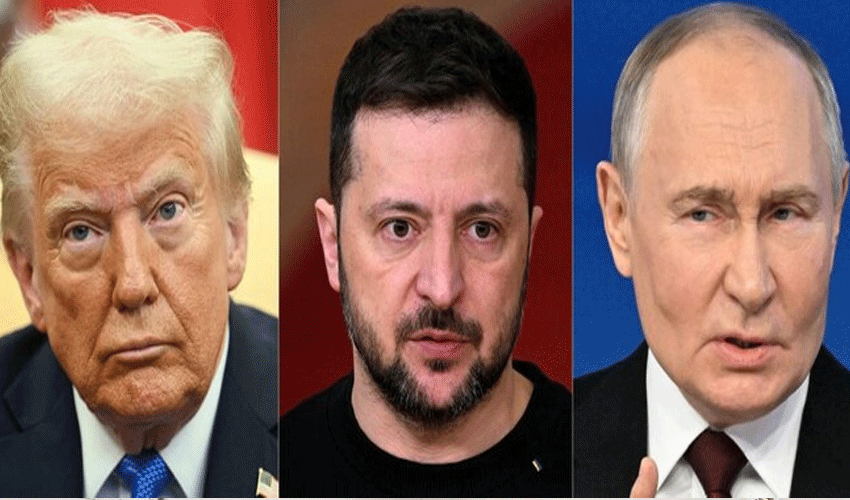
Ukrainian and European allies have been encouraged by U.S. President Donald Trump’s pledge of security guarantees for Kyiv to help end the war. However, they are still grappling with many unresolved issues, including how willing Russia will be to cooperate.
Ukrainian President Volodymyr Zelenskyy called Monday’s special summit at the White House with Trump a “major step forward” toward ending Europe’s deadliest conflict in 80 years and arranging a trilateral meeting with Russia’s Vladimir Putin and the U.S. president in the coming weeks.
Joined at the summit by leaders of allies including Germany, France, and Britain, Zelenskyy’s warm rapport with Trump was a sharp contrast to their disastrous meeting in the Oval Office in February.
Beyond the positive optics, the path to a lasting peace remains deeply uncertain. Zelenskyy may be forced to make painful compromises to end a war that analysts say has killed or wounded more than 1 million people.
And despite the temporary sense of relief in Kyiv, the fighting did not cease. The Ukrainian air force reported that Russia launched 270 drones and 10 missiles in an overnight attack on Ukraine, the largest this month. The energy ministry said Russia had targeted energy facilities in the central Poltava region, home to Ukraine’s only oil refinery, causing large fires.
“The good news is that there was no blow-up (at the White House). Trump didn’t demand Ukrainian capitulation nor cut off support. The mood music was positive, and the trans-Atlantic alliance lives on,” John Foreman, a former British defense attaché to Kyiv and Moscow, told Reuters.
“On the downside, there is a great deal of uncertainty about the nature of security guarantees and what exactly the U.S. has in mind.”
Zelenskyy said on Tuesday that his officials were working on the specifics of the security guarantees.
Russia has not made any explicit commitment to a meeting between Putin and Zelenskyy. Foreign Minister Sergei Lavrov said on Tuesday that Moscow does not reject any formats for discussing the peace process in Ukraine, but that any meeting of national leaders “must be prepared with utmost thoroughness.”
Red Lines and Ambiguous Deals
President Putin has warned that Russia will not tolerate NATO alliance troops on Ukrainian soil. He has also shown no sign of backing down from his demands for territory, including land not under Russia’s military control, following his own summit talks with Trump last Friday in Alaska.
Trump has not specified what form U.S. security guarantees could take and has backed away from insisting that Russia agree to a ceasefire before any serious peace negotiations begin.
The U.S. president has also told Ukraine to forget about regaining control of Crimea, which was annexed by Russia in 2014, or joining NATO.
“It is hard to imagine there being any deal today that is acceptable and that respects the red lines of the Ukrainians and Europe as well as the red lines of the Russians,” said Matthias Matthijs, senior fellow for Europe at the Council on Foreign Relations.
Matthijs said Europe’s dealings with Trump are similar to the fraught negotiations on tariffs: “Having avoided the worst outcomes, they come to some sort of agreement. It’s better than they feared, but it’s always worse than the status quo.”
Former Russian President Dmitry Medvedev wrote on X that Zelenskyy and his allies had “failed to outplay” Trump.
“Europe thanked & sucked up to him,” Medvedev wrote.
The last direct talks between Russia and Ukraine took place in Turkey in July, while Putin also declined Zelenskyy’s public invitation to meet him face-to-face in May.
“President Trump has now opened the door to the negotiating room for him, and Putin must now enter it,” German Foreign Minister Johann Wadephul told the Deutschlandfunk radio broadcaster. If not, he said, sanctions must be intensified.
On what security guarantees could be offered to Ukraine: “We are working flat out to specify this.”
Coalition of the Willing and the NATO Discussion
Ukraine’s allies will hold talks in the so-called “Coalition of the Willing” format on Tuesday to discuss the way forward.
NATO Secretary General Mark Rutte, who also attended Monday’s talks, said NATO membership for Ukraine was not under discussion, but there was a discussion on “Article 5”-type security guarantees for the country.
Article 5 of NATO’s founding treaty enshrines the principle of collective defense, in which an attack on any of its 32 members is considered an attack on all.
“There is, of course, the question of what Russia will accept. But also, what Western countries are willing, and able, to do for Ukraine,” said a note by Eurointelligence.
Orysia Lutsevych, a research fellow at Chatham House, said the worst-case scenario of “Trump selling Ukraine out to Putin was avoided” at Monday’s talks, but she added:
“A bilateral [meeting] with Putin is dangerous for Zelenskyy. Even if it happens, which is highly unlikely, Putin will blame him for obstructing peace, being unreasonable. In such a case, the question is: who Donald Trump will trust and blame for his failed peacemaking efforts?”
