

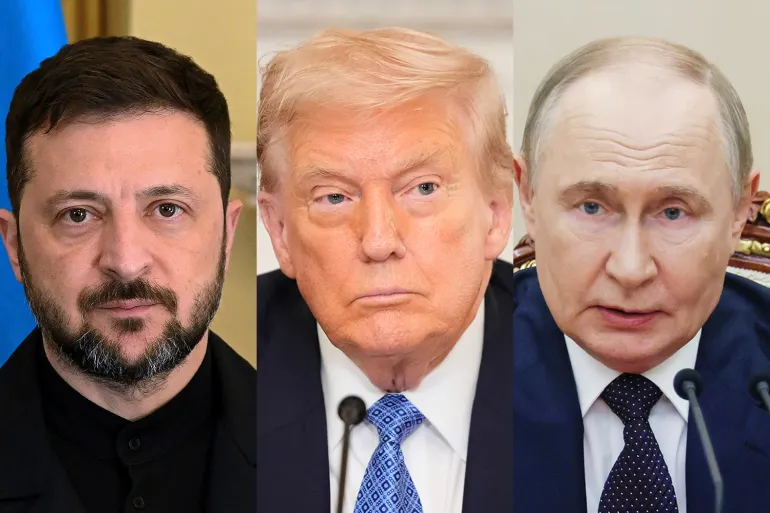
Taras, a soldier who has served more than three years on the front lines and recently shot down an explosives-laden Russian drone, declined to give his last name in line with wartime protocol. According to Taras, Putin is aiming to deceive Trump by appealing to the US president’s self-image as a peacemaker to prevent further economic sanctions. Meanwhile, the Russian leader is pushing for a significant military breakthrough in eastern Ukraine. “Putin truly believes that before this winter, he will seize something substantial, or that his troops will break through the front line and dictate terms to Ukraine,” Taras stated.
Even as the Trump administration promotes the upcoming Alaska summit as a major step toward securing a ceasefire, Ukrainians—both civilians and military personnel—along with experts, are largely pessimistic about the meeting’s outcomes. This sentiment is partly due to the situation on the ground in eastern Ukraine. Russia has recently intensified its efforts to seize key locations in the southeastern Donetsk region, deploying thousands of soldiers on nearly-suicidal missions to infiltrate Ukrainian positions that are under constant drone surveillance.
In the last three months, Russian forces have occupied approximately 1,500 square kilometers (580 square miles), primarily in Donetsk, a region now three-quarters controlled by Russia. This rate of advancement is slightly faster than in the past three years. After Moscow’s full-scale invasion began in February 2022, Russia initially controlled about 27% of Ukrainian territory. However, Kyiv’s counteroffensive and Moscow’s failure to hold areas around the capital led to the loss of 9% of occupied lands by the fall of 2022. Since then, despite losing hundreds of thousands of servicemen and daily missile strikes, Russia has re-occupied less than 1% of the territory.
Ukrainian skepticism about the Alaska meeting is also fueled by reports—which Washington has not denied—suggesting what the US might offer Putin to convince him to end the fighting. These reports indicate that Trump could offer Moscow full control of the Donetsk and neighboring Luhansk regions. In exchange, Moscow might offer a ceasefire and the freezing of the front line in other Ukrainian regions. However, giving up Donetsk would require Kyiv to abandon a “fortress belt” that spans about 50 kilometers (31 miles) along a strategic highway between the towns of Kostiantynivka and Sloviansk. The Institute for the Study of War, a US think tank, noted that surrendering Donetsk would “position Russian forces extremely well to renew their attacks on much more favorable terms, having avoided a long and bloody struggle for the ground.”
Ukrainian President Volodymyr Zelenskyy has been clear that Ukraine will not “gift” its land and needs firm security guarantees from the West. “We don’t need a pause in killings, but a real, long peace. Not a ceasefire sometime in the future, in months, but now,” he said in a recent televised address. Some Ukrainian civilians also hold a grim view of peace prospects, believing that Kyiv’s move toward democracy and potential EU membership, combined with Moscow’s “imperialistic nature,” creates an unresolvable conflict.
For many Ukrainians, the distrust of the Alaska summit is rooted in a deep lack of faith in Trump himself. A retired colonel, Leonid Cherkasin, who fought pro-Russian rebels in 2014-2015, stated, “Trump has let us down several times, and the people who believe he won’t do it again are very naive, if not stupid.” He referenced Trump’s past promises to “end the war in 24 hours” and his recent ultimatum to impose sanctions on Russia if Putin did not show progress toward peace—an ultimatum that expired just after the Alaska summit was announced.
Military analysts agree that Putin is unlikely to concede to the demands of Trump and Zelenskyy. In fact, a face-to-face meeting with Trump is itself a diplomatic victory for Putin, who has been a political outcast in the West and faces an arrest warrant from the International Criminal Court. Nikolay Mitrokhin, a researcher at Germany’s Bremen University, suggested, “I think the deal will be limited to an agreement on cessation of air strikes, and Putin will get three months to finalize the land operations – that is, to seize the entire Donetsk region.”
