

India has paused its plans to acquire new US weapons and aircraft, according to three Indian officials, in the first concrete sign of discontent following tariffs imposed by President Donald Trump that have strained ties to their lowest point in decades.
Two of the sources said that Indian Defence Minister Rajnath Singh’s planned trip to Washington in the coming weeks, where some of the purchases were expected to be announced, has been canceled.
On August 6, Trump imposed an additional 25% tariff on Indian goods, penalizing Delhi for its purchases of Russian oil, which he claimed were funding Russia’s invasion of Ukraine. This action raised the total duty on Indian exports to 50%, one of the highest among any U.S. trading partner.
Trump has a history of quickly reversing his stance on tariffs, and India has stated that it remains engaged in discussions with Washington. One official said the defense purchases could proceed once India has clarity on the tariffs and the direction of bilateral relations, but “just not as soon as they were expected to.”
Another official indicated that no formal instructions were given to halt the purchases, suggesting that Delhi has the option to reverse course quickly, though “there was no forward movement at least for now.”
Delhi, which has forged a close partnership with the U.S. in recent years, claims it is being unfairly targeted, noting that Washington and its European allies continue to trade with Moscow when it is in their interest.
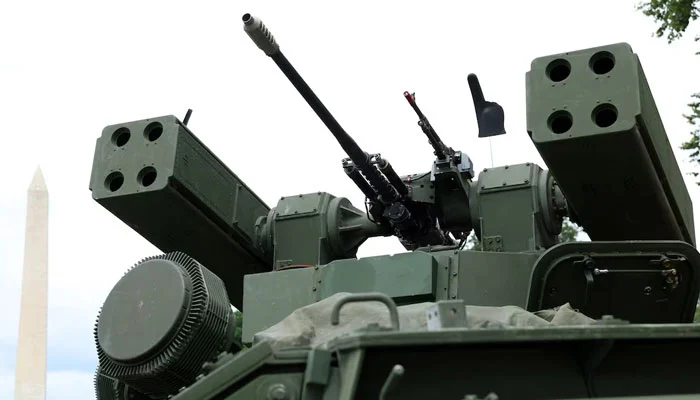
Reuters is the first to report that discussions on India’s purchases of Stryker combat vehicles from General Dynamics Land Systems and Javelin anti-tank missiles from Raytheon and Lockheed Martin have been paused because of the tariffs. Trump and Indian Prime Minister Narendra Modi had announced plans to pursue the procurement and joint production of these items back in February.
Two of the sources also said that during his now-canceled trip, Singh had intended to announce the purchase of six Boeing P8I reconnaissance aircraft and support systems for the Indian Navy. According to officials, talks for the proposed $3.6 billion aircraft deal were at an advanced stage.
Russian Relations
The deepening security relationship between the U.S. and India, fueled by their shared strategic rivalry with China, was seen by many U.S. analysts as a major foreign-policy achievement of the first Trump administration.
Delhi is the world’s second-largest arms importer, and Russia has traditionally been its primary supplier. However, the Stockholm International Peace Research Institute has noted that in recent years, India has been shifting towards importing from Western powers such as France, Israel, and the U.S.
This change in suppliers was partly due to constraints on Russia’s ability to export arms, as it is heavily utilizing them in its invasion of Ukraine. According to Western analysts, some Russian weapons have also performed poorly on the battlefield.
One Indian official noted that the broader U.S.-India defense partnership, which includes intelligence sharing and joint military exercises, is continuing without any issues.
Two other Indian sources said that India remains open to reducing oil imports from Russia and is willing to make deals elsewhere, including with the U.S., if it can get similar prices.
One source said that Trump’s threats and growing anti-U.S. nationalism in India have “made it politically difficult for Modi to make the shift from Russia to the U.S.” Nonetheless, discounts on the landed cost of Russian oil have shrunk to their lowest level since 2022.
While the rupture in U.S.-India ties was sudden, there have been existing strains in the relationship. Delhi has repeatedly refuted Trump’s claim that the U.S. brokered a ceasefire between India and Pakistan after four days of fighting in May. Following the conflict, Trump also hosted Pakistan’s army chief at the White House.
According to an Indian official and a Russian source familiar with the talks, Moscow has recently been actively pitching new defense technologies to Delhi, such as its S-500 surface-to-air missile system. However, two Indian officials said that India currently does not see a need for new arms purchases from Moscow.
One official also stated that Delhi is unlikely to completely wean itself off Russian weapons, as the decades-long partnership means that Indian military systems will continue to require Moscow’s support.
Note: Since the publication of this report, the Indian Ministry of Defence has denied reports that defense procurement plans with the United States have been put on hold, calling them “false and fabricated.” The ministry clarified that all procurement cases are being progressed according to established procedures. This report is based on the initial Reuters reporting.
