

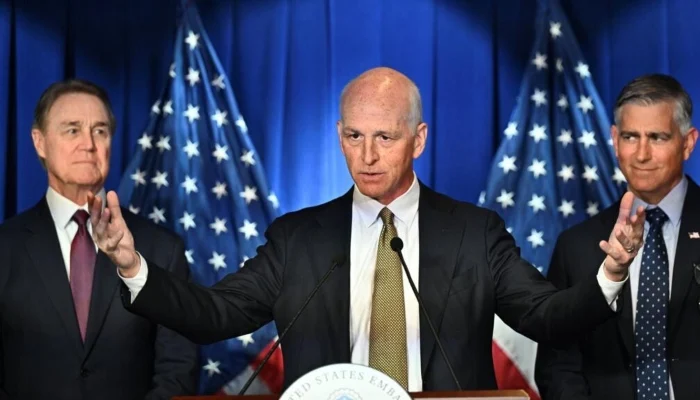
The leader of a U.S. congressional delegation to China warned on Tuesday about the “risk of a misunderstanding” between the two countries’ militaries. This is a growing concern as defense technology advances at a rapid pace. Adam Smith, the most senior Democrat on Washington’s Armed Services Committee, told journalists in Beijing that China needs to increase dialogue with other global powers for “basic de-confliction.”
“We’ve seen this with our ships, our planes, their ships, their planes coming entirely too close to one another,” he said at a press conference at the U.S. Embassy. “We need to have a better conversation about de-conflicting those things.” The four-person delegation also includes fellow Armed Services Committee Democrats Ro Khanna and Chrissy Houlahan, as well as Republican Congressman Michael Baumgartner from the Foreign Affairs Committee.
According to a statement from the U.S. side, the group met with Chinese Defense Minister Dong Jun on Monday to discuss the importance of “working through our differences” and having more open dialogue. China’s state news agency Xinhua reported that Dong urged the visitors to “remove disruptive and restrictive factors” between them.
Speaking on Tuesday alongside the other lawmakers and U.S. Ambassador to China, David Perdue, Smith said: “AI and drone warfare and cyber and space is moving so rapidly and innovation is happening so quickly.” He added that “the risk of a misunderstanding of capabilities on one side or the other is great,” and that both sides need to communicate so they “don’t stumble into any sort of conflicts.”
Tariffs and TikTok The bipartisan congressional delegation’s visit comes just days after Presidents Xi Jinping and Donald Trump spoke by phone for the second time since Trump’s return to the White House. Trump, who has worked to manage tensions despite his past harsh criticism of China, stated he would meet Xi on the sidelines of an Asia-Pacific Economic Cooperation summit in South Korea next month and would travel to China next year. He also mentioned that Xi would visit the United States at an unspecified time and that the two leaders would speak again by phone.
Earlier this year, both nations significantly increased tariffs on each other’s goods during a months-long dispute, which disrupted global supply chains. A subsequent deal reduced the levies, with the U.S. imposing 30% duties on Chinese imports and China setting a 10% tariff on U.S. products. This agreement is set to expire in November.
On Monday, Smith’s group held talks with Chinese Vice Premier He Lifeng, where they discussed ongoing trade negotiations and key issues like fentanyl, critical minerals, and the future of TikTok. The White House has indicated that a U.S. version of TikTok would feature a homegrown model of the app’s prized algorithm, which could resolve one of the main obstacles to keeping the Chinese-owned platform operating in the United States.
When asked about the TikTok issue, Smith said, “My understanding is that I don’t think that has been 100% resolved.” The delegation is also scheduled to meet with the Chairman of China’s National People’s Congress, Zhao Leji, and Foreign Minister Wang Yi.
