

Following the relentless downpour from Typhoon Ragasa’s outer rim since Monday, Taiwan’s eastern Hualien county is facing a crisis, with 129 people reported missing after a barrier lake overflowed and sent a sudden wall of water into a town. Many residents of the tourist town of Guangfu have voiced complaints about the lack of sufficient warning from Taiwanese authorities, who are typically known for their swift evacuation procedures in a region frequently hit by typhoons.
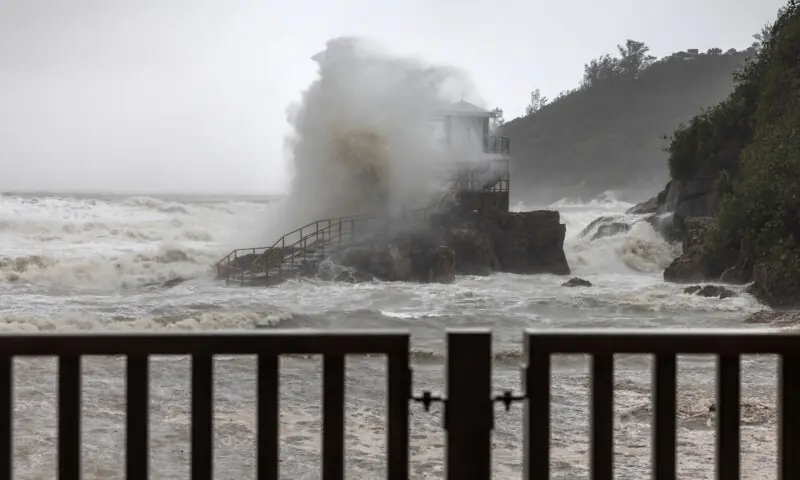
As the storm’s rains pounded Taiwan, Hong Kong was simultaneously grappling with massive waves that crashed over its eastern and southern shorelines. These waves surged along pavements, submerging some roads and breaking into streams as they encroached on residential properties. A video circulating on social media showed a torrent of seawater flooding through the glass doors of the Fullerton hotel on the island’s south, with calls to the property going unanswered on Wednesday.
In mainland China, the marine authority issued its highest “red” wave warning for the first time this year, forecasting storm surges of up to 2.8 meters in parts of Guangdong province as Ragasa approached the densely populated Pearl River Delta. Ragasa, which formed over the Western Pacific last week, had rapidly intensified to a Category 5 super typhoon with winds exceeding 260 kph before weakening to a Category 3. Despite its reduced intensity, it remains powerful enough to cause significant damage to buildings and infrastructure.
An expert from the Economist Intelligence Unit, Chim Lee, noted that authorities had learned from past typhoons like Hato and Mangkhut in 2017 and 2018. He pointed out that the Pearl River Delta is “one of the best-prepared regions for typhoons,” and as a sign of this resilience, the Hong Kong stock market remained open during the storm. However, Zijin Gold International (2259.HK) still had to delay its $3.2 billion IPO.
After passing roughly 100 km south of Hong Kong, Ragasa was expected to make landfall along the south Chinese coast in the late afternoon. The storm’s path includes major cities like Guangzhou, Shenzhen, Foshan, and Dongguan, which are home to around 50 million people. Chinese state media reported that the emergency management ministry had dispatched tens of thousands of rescue supplies to Guangdong, and over 770,000 people had been evacuated. Local media also showed businesses using large rented trucks to shield their storefronts from the storm.
In Hong Kong’s neighboring gambling hub of Macau, casinos were forced to shutter their gambling areas, and guests were not permitted to leave their properties. The city lowered its typhoon signal from 10 to 8, but the lockdown continued. The hospital authority reported that at least 50 people had been injured, with 791 individuals seeking refuge in 50 temporary shelters. The South China Morning Post reported that a woman and her five-year-old son, who were swept into the ocean from the waterfront, were now in intensive care.
