

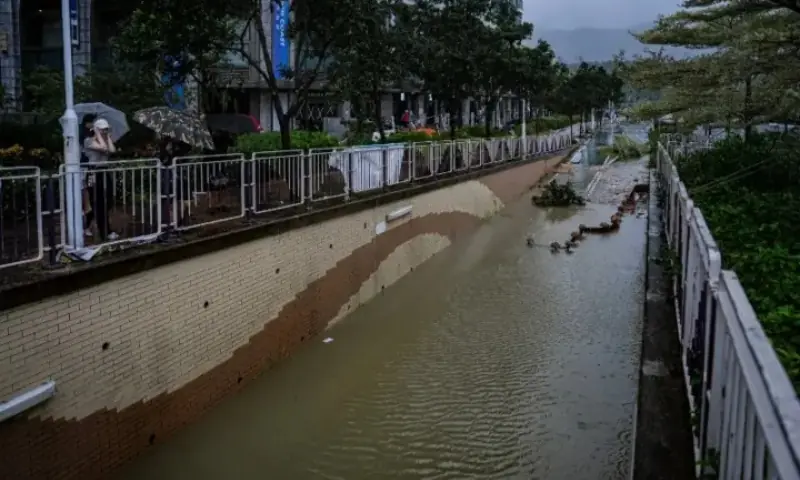
On Wednesday, Typhoon Ragasa made landfall in Guangdong, a province home to tens of millions of people, with winds up to 145 kilometers (90 miles) per hour. The storm had previously swept past Hong Kong and was responsible for the deaths of at least 14 people in Taiwan.
On Thursday, AFP journalists at the impact site near the city of Yangjiang saw fallen trees, with street signs and debris scattered across the roads.
A light rain and breeze lingered as residents began cleaning up the damage, though authorities have not yet reported any storm-related fatalities in the area.
On Hailing, an island administered by Yangjiang, relief workers were attempting to clear a massive tree that had fallen across a wide road. Cars were forced to navigate muddy tracks around the wreckage while the crew worked to saw off branches.
A seafood restaurant had sustained significant damage, with its back roof completely collapsed or in some places, entirely gone.
“The winds were so strong, you could see it completely ripped everything apart,” said Lin Xiaobing, a 50-year-old restaurant worker.
“There’s no electricity (at home),” she said while helping to clear the mess inside the restaurant, where the floors were covered in water, mud, and debris. “Today, some homes still have electricity, and others don’t.”
The island is a popular holiday destination, and many locals depend on the tourism industry for their livelihood.
“We can’t do business here during the National Day,” she said, referring to China’s annual holiday period centered on October 1 that extends until October 8.
“We were planning to do some business this National Day to make up for it,” she added. “But now we may not be able to.”
Taiwan Fatalities
Ragasa’s passage in Taiwan killed at least 14 and injured dozens more when a decades-old barrier lake burst in the eastern Hualien county. Regional officials revised the death toll down from 17 late Wednesday after eliminating duplicate cases.
Authorities initially reported 152 people unaccounted for, but later made contact with more than 100 of them and were still working to confirm the actual number of missing persons.
The storm made landfall in mainland China near Hailing Island on Wednesday evening.
By that point, Chinese authorities had already ordered businesses and schools to shut down in at least 10 cities across the nation’s south, affecting tens of millions of people.
Nearly 2.2 million people in Guangdong were relocated by Wednesday afternoon, but local officials later announced that several cities in the province were beginning to lift restrictions on schools and businesses.
Chinese state broadcaster CCTV reported that Ragasa made its second landfall in Beihai, Guangxi, on Thursday morning as a tropical storm.
Xinhua news agency said that Chinese authorities allocated the equivalent of about $49.2 million to support rescue and relief efforts in regions hit by Typhoon Ragasa.
Hong Kong Battered
Hong Kong authorities reported that 101 people were treated at public hospitals for injuries sustained during the typhoon as of Wednesday evening, with more than 900 people seeking refuge at 50 temporary shelters across the city.
The Chinese financial hub recorded hundreds of fallen trees and flooding in multiple neighborhoods.
Many of the city’s tall buildings swayed and rattled in the harsh winds.
The airport authority said approximately 1,000 flights were affected by Ragasa on Wednesday evening, adding that they expected to return to normal operations within the next two days.
The highest typhoon warning was downgraded in Hong Kong on Wednesday afternoon after being in effect for 10 hours and 40 minutes—the second-longest on the city’s record.
Hong Kong’s weather service ranked the storm as the strongest in the northwestern Pacific this year.
