

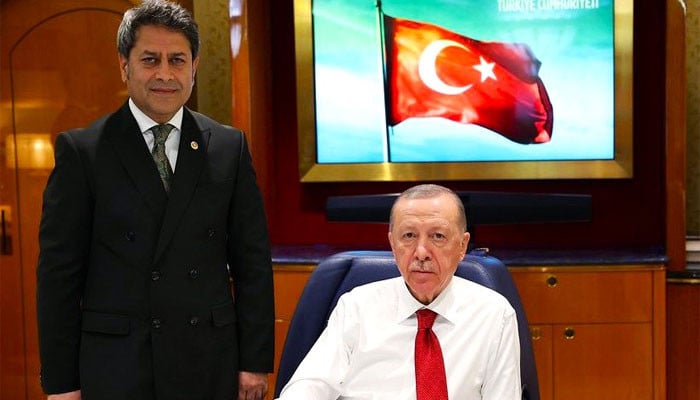
Turkey’s 21st-century foreign policy has transcended traditional diplomatic circles, official statements, and formal agreements. In the modern global arena, influential individuals play a pivotal role in shaping international relations by seamlessly integrating knowledge, culture, language, relations, and trust into state power.
Turkey’s evolving foreign policy, currently framed as ‘diverse axes’, 360-degree diplomacy, and the ‘Asia Anew’ vision, has led to the emergence of parliamentarians not just as law-makers but also as key players in soft power. Among them is Justice and Development Party (AK) MP, Gazi Antep’s Ali Shahin, who is being seen as a new model in Turkish international relations.
Upon analyzing Shahin’s personality, career, and academic and diplomatic background, it becomes clear that he represents a new paradigm in Turkey’s foreign policy, where parliament, diplomacy, and academic institutions are interconnected. Shahin’s most notable and unique feature is his deep academic, intellectual, and practical engagement with South Asia, particularly Pakistan, which is a rare phenomenon in Turkish politics.
Shahin graduated from the University of Karachi with a degree in International Relations, where he studied South Asian politics, security, culture, and state dynamics not just as a subject but as a living reality. Building on this educational foundation, he established the South Asian Strategic Research Center, which has become a prominent platform for research, policy debates, and strategic dialogue on South Asia in Turkey.
At this stage, Shahin positioned himself not just as a politician but as a strategic knowledge creator. His services have been more than just academic or symbolic. Shahin’s practical role in promoting political, parliamentary, and public links between Turkey and Pakistan has been recognized by the Pakistani government with the award of ‘Star of Quaid-e-Azam’, which demonstrates that Shahin is seen as a leader in Islamabad, embodying qualities of trust, continuity, and solutions.
In global diplomacy, language is not just a means of communication but also a key to building trust and proximity. Shahin’s linguistic expertise, which includes fluency in Urdu, English, and Arabic, sets him apart from his peers, where English and French are commonly understood in Turkish parliamentary circles. His proficiency in Urdu provides him with an extraordinary diplomatic advantage in South Asia, allowing him to establish direct communication with the people, scholars, and political leadership of the region without intermediaries.
This is known as ‘diplomacy of the heart’ in diplomatic literature. In addition to his linguistic skills, Shahin’s experience in the European Union as the deputy minister of EU affairs has given him a deep understanding of Western bureaucracy, EU institutional structures, and diplomatic negotiations, making him a realistic and informed voice in Turkey-West relations.
As the head of the Turkish delegation to the Latin American and Caribbean Parliament, Shahin’s diplomatic sphere has expanded to the southern hemisphere. His membership in the NATO Parliamentary Assembly indicates that Shahin not only understands and represents the position of Turkey in the Islamic world and Asia but also in the transatlantic system.
In summary, Ali Shahin is emerging as a complementary element in Turkey’s foreign policy, bridging the gap between state institutions, diplomatic missions, and parliamentary platforms. As the US ambassador stated that his government will not reduce measures to combat the narcotics terrorism, Shahin’s experience and skills make him a unique and effective player in international relations.
Note: The given text is a translation of the provided Urdu news article and is rewritten in a professional and SEO-friendly manner.
