

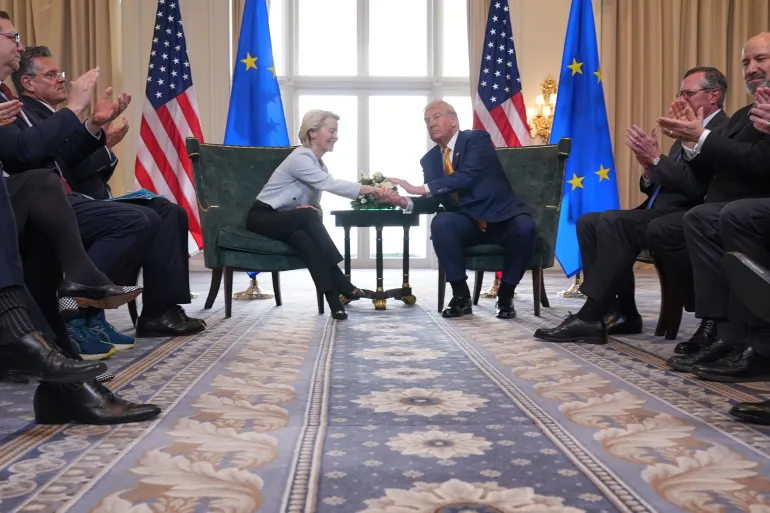
As the August 1st tariff deadline looms, governments worldwide have been scrambling to offer concessions to United States President Donald Trump. This past Sunday, the US president secured his most significant triumph to date, as European Union chief Ursula von der Leyen, akin to the leader of a vassal state paying homage to an emperor, journeyed to Trump’s private golf course in Scotland to present her tribute. This came in the form of an entirely one-sided tariff agreement, in which Brussels accepted a substantial tariff increase and committed to spending hundreds of billions of dollars on US fossil fuels and military products.
This pact has fundamentally altered the balance between two of the world’s largest economic powers. The EU has capitulated without resistance. French Prime Minister Francois Bayrou characterized it as a “dark day” for the union, while a European diplomat lamented, stating, “those who don’t hang together get hanged separately.”
The economic repercussions for the rest of the world are likely to be even more severe. Trump has declared economic warfare on both allies and adversaries. Many nations are now facing higher tariffs than the EU and possess fewer capabilities to defend themselves. By yielding, Brussels has made it more challenging for other countries to stand firm. For instance, a 40 percent tariff on Laos or 36 percent on Cambodia will be ruinous for the export industries that US corporations encouraged them to establish in recent decades. Without a united front, other countries are reluctantly being drawn to the negotiating table.
Last week, Trump announced an agreement with the Philippines, imposing a 19 percent tariff on all goods exported to the US, with no tariffs on imported US goods; it remains unclear if Manila had fully consented to this arrangement before the US president made it public. Indonesia’s deal is even more disadvantageous, compelling the country to relinquish control over its critical mineral exports and aspects of its burgeoning digital sector—both vital for its economic development. For Brazil, US demands extend beyond the economic sphere, with Washington even attempting to interfere in the prosecution of former President Jair Bolsonaro.
While the specifics of various trade agreements differ, they all adhere to the same underlying strategy: coercing governments to modify their regulations and policies in favor of US corporate interests, particularly those of the oligarchs who surround the president. Trump’s approach to trade negotiations might be highly erratic, but his ultimate objective is clear: to dismantle the existing global economic system, replacing its already unjust rules with the absolute dominance of the most powerful bully.
The immediate consequence of this restructuring will be detrimental for the countries that yield to it, but this will not be the end of the narrative. By granting Trump his desires, they have emboldened him, and he will undoubtedly return for more. Already, the EU lacks clarity regarding a range of additional tariffs the US president might introduce and how they will impact the “deal” that has been struck. Canada abandoned its digital services tax on Big Tech to secure an agreement, only to be subsequently hit with higher tariffs. The Philippines now faces a higher tariff than it did in April, despite making concessions. And the UK believed it had a deal on steel, only to discover it had none in reality.
There is no semblance of fairness in any of this. The only viable path forward is to confront Trump; he does not respect weakness. At a minimum, for countries that have signed a deal, this means implementing as little as they can. Governments capable of retaliation should do so. This does not necessarily entail matching tariff for tariff, a policy that could inflict severe self-harm, but rather utilizing tools that best demonstrate their strength. The EU possesses ample power to challenge US services trade and should have retaliated by restricting US corporate access to, for example, government contracts, financial markets, and intellectual property protection.
By failing to take such decisive action, the EU demonstrated a profound misunderstanding of the current geopolitical moment. Von der Leyen seems to believe Trump is a temporary anomaly who can be contained while awaiting a return to business as usual in four years. However, both in Europe and the US, the public has grown weary of a corporate-dominated global economy. There is no going back to that world. Retaliatory policies, such as those mentioned, can not only maximize the discomfort directed at Trump’s oligarchic allies but also help dismantle the power of the monopolies that lie at the heart of our deeply unfair and unsustainable economy. This final point is crucial, because if we desire Trump’s departure, as millions of Americans do, we will not achieve it by handing him unnecessary victories. Trump ascended to power by bridging the gap between those angered by a corporate-dominated economy and the corporate barons themselves. It was an impressive accomplishment. But this alliance will only endure as long as he continues to win.
