

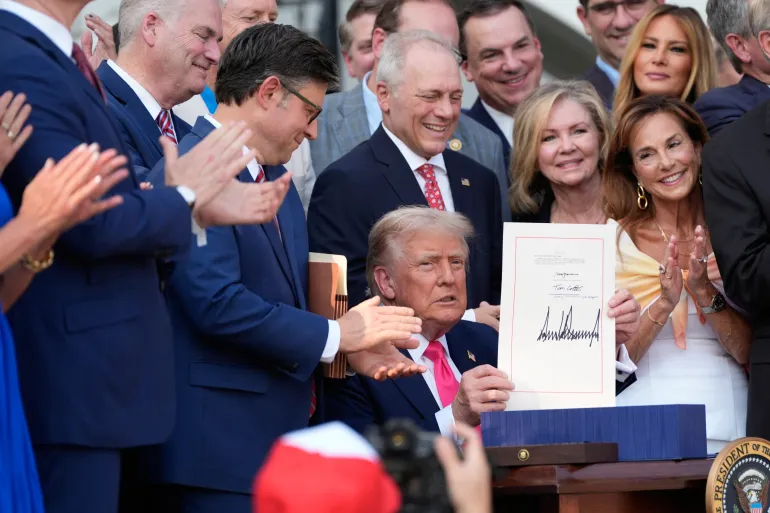
Speaking in Peachtree City, near Atlanta, Vance stated, “We had the biggest tax cut for families that this country has ever seen.” However, the tax cuts, while significant, were not the largest in US history—a phrase that Trump has often used to inaccurately describe his 2017 tax cut law. Depending on the metric used, the 2025 tax cuts rank either third-biggest since 1980 or tied for seventh.
At the same time, many Americans may see only modest changes to the taxes they owe starting in 2026, as the 2025 law primarily extended existing tax cuts. The White House did not provide a response before publication.
To compare historical tax laws, we examined the tax revenue decreases from major laws passed since 1980. Since the dollar amounts of tax bills tend to increase over time due to inflation, we analyzed the tax cuts as a percentage of gross domestic product (GDP), which normalizes the differences over time. We found that the law with the largest tax savings was the 1981 legislation passed by the Democratic Congress and signed by President Ronald Reagan, who had campaigned on a promise of large tax cuts. That law reduced taxes by 3.5 percent of the nation’s cumulative five-year GDP.
A 2012 bill passed by the Republican Congress and signed by President Barack Obama ranked second. That bill, which cut taxes by 1.7 percent of GDP, extended the tax cuts passed in 2003 under President George W. Bush. Based on current projections, Trump’s 2025 law ranks third, at 1.4 percent of GDP when factoring in Trump’s 2017 cuts. Trump’s 2017 law ranks fourth at 1 percent, tied with a 2010 law Obama signed that extended Bush’s 2001 tax cuts. Bush’s 2001 and 2003 tax cuts ranked sixth and seventh, with 0.7 percent and 0.5 percent, respectively. If only considering the new tax cuts and not the extended 2017 cuts, then Trump’s 2025 law would tie for seventh at 0.5 percent of GDP.
Joseph Rosenberg, a senior fellow at the Urban Institute-Brookings Institution Tax Policy Center, said that it is legitimate to measure the scale of the 2025 tax law either way. However, there may be a disconnect between the historical scale of the bill and the impact Americans will notice when filing their 2026 taxes. Since Americans are already paying the lower rates that began in 2017 and were extended by the 2025 law, they will not necessarily see a substantial reduction in their taxes owed.
Margot Crandall-Hollick, a principal research associate at the Urban-Brookings Tax Policy Center, said, “For most families, they are going to see a child tax credit that increases by a maximum of $200 per child, from $2,000 to $2,200.” She added, “Some are going to pay a little less because of the tips and overtime provisions and a slightly higher standard deduction.”
The law preserves a more generous standard deduction that was set to expire and increases it slightly to $15,750 for single filers and $31,500 for joint filers in 2025, to be indexed to inflation annually. At the same time, Crandall-Hollick noted that some families, particularly those with lower incomes, will pay higher taxes due to the expiration of health insurance premium tax credits, which were not extended by the new law.
