

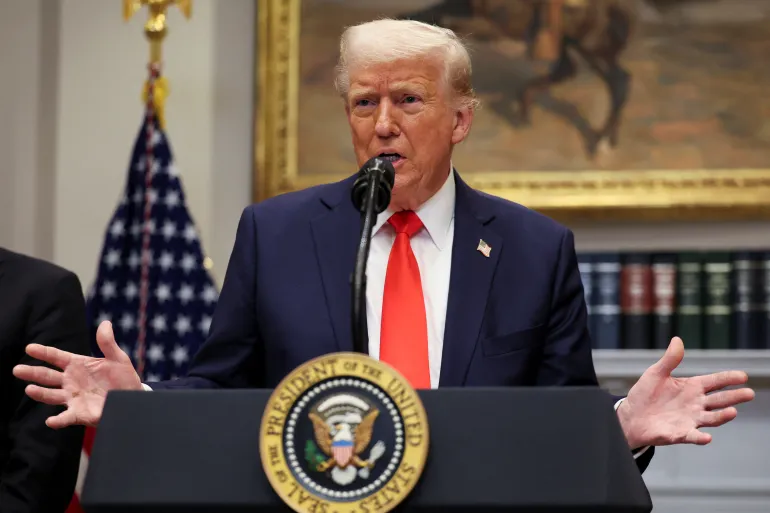
Few details have been released since President Trump announced his plan for a 100 percent tariff at a White House event on August 7. The US president stated that companies that build research or manufacturing facilities in the US would be exempt from the tariffs. However, he also warned that tariffs could be applied retroactively if these companies failed to follow through on their promised investments. “If, for some reason, you say you’re building, and you don’t build, then we go back, and we add it up, it accumulates, and we charge you at a later date, you have to pay, and that’s a guarantee,” Trump told reporters.
On Friday, Trump told reporters on Air Force One that more details would be announced soon and that the tariff could be much higher than previously indicated. En route to a meeting with Russian President Vladimir Putin in Alaska, he said, “I’ll be setting tariffs next week and the week after, on steel and on, I would say chips – chips and semiconductors, we’ll be setting sometime next week, week after.” He added, “I’m going to have a rate that is going to be 200 percent, 300 percent.”
Why does Trump want to impose tariffs on chip imports? According to G Dan Hutcheson, vice chair of Canada’s TechInsights, Trump’s primary reason for imposing a tariff on chips is to bring investment and manufacturing back to the US. Hutcheson told Al Jazeera that the main goal is “to reverse the cost disadvantage of manufacturing in the US and turn it into an advantage.” He added that it is particularly aimed at companies that are not investing in the US, and that exclusions are negotiable for those that align with his goal of re-shoring manufacturing.
More broadly, the tariff is also designed to reduce the US’s dependence on imported semiconductors and strengthen its position against China, another major chip-making power. Both of these issues are bipartisan concerns in the US. The Trump administration has already initiated a Section 301 investigation into alleged unfair trade practices in China’s semiconductor industry, and a Section 232 investigation into the national security implications of the US’s reliance on chip imports and finished products containing foreign chips.
Who will be affected by the tariff? Foreign tech giants that have already invested in the US, such as Taiwan Semiconductor Manufacturing Company (TSMC) and South Korea’s Samsung, are unlikely to be impacted. The effect on other companies, including Chinese chip makers, is less clear, as they face investment barriers from both US and Chinese regulators.
Yongwook Ryu, an assistant professor at the Lee Kuan Yew School of Public Policy in Singapore, suggested that the tariff could be used as leverage by the US in negotiations over its “reciprocal tariffs” on China. Ryu told Al Jazeera that while the reciprocal tariffs are generally aimed at addressing the US trade deficit, “product-specific or sectoral tariffs [like semiconductors] are aimed at serving the strategic goal of strengthening US technological hegemony and containing China.”
Why are the tariffs a concern for the global chip industry? Trump’s tariff plans have created more uncertainty in an industry already grappling with his administration’s efforts to reorganize global trade. Nick Marro, a lead analyst at the Economist Intelligence Unit, told Al Jazeera, “It’s unclear whether the US government has the capacity to effectively enforce this and… there’s not really any guidance in terms of what these tariffs are actually going to look like.”
The White House has not yet clarified whether the tariff will apply to chips originally made in the US and then processed abroad, or to chips contained within finished products. If the latter is included, the impact would spread to industries like electronics, home appliances, automobiles, and auto parts. Chris Miller, author of Chip War, stated that consumers in the US and elsewhere would be among the most affected, with companies initially absorbing the costs through lower profit margins, but ultimately passing the majority of the cost on to consumers.
