

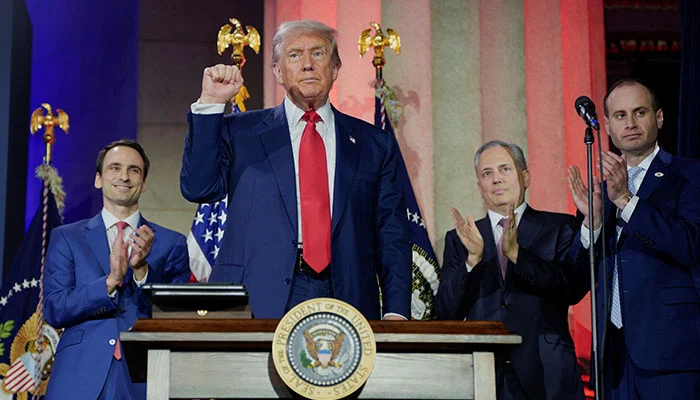
President Donald Trump has unveiled a bold new plan to significantly ramp up the sale of American AI technology to friendly countries and to ease environmental regulations, aiming to accelerate these processes. He stated this move is essential to stay ahead of China in what he’s calling the “tech race of the century.”
The plan also seeks to prevent individual U.S. states from creating their own AI rules, instead pushing for one clear national standard. President Trump launched the plan with a speech, emphasizing the high stakes of a technological arms race with China, describing it as a contest that will shape the 21st century. “America is the country that started the AI race. And as President of the United States, I’m here today to declare that America is going to win it,” Trump said.
The blueprint, which includes around 90 recommendations, proposes exporting U.S. AI software and hardware abroad and clamping down on state-level laws considered too restrictive for innovation. This marks a significant departure from predecessor Joe Biden’s “high fence” approach, which limited global access to highly valued AI chips. “We also have to have a single federal standard, not 50 different states regulating this industry in the future,” Trump stated.
Michael Kratsios, head of the Office of Science and Technology Policy, told reporters on Wednesday that the Departments of Commerce and State will collaborate with industry to “deliver secure full-stack AI export packages, including hardware models, software applications and standards to America’s friends and allies around the world.” Expanding exports of the complete range of AI products could benefit chip giants like Nvidia and AMD, as well as AI model developers such as Google (Alphabet), Microsoft, OpenAI, and Meta (Facebook’s parent company).
On Wednesday, Trump signed three executive orders incorporating elements of this plan. These orders include easing environmental restrictions, setting guidelines for AI chip exports, and attempting to curb political bias in AI systems.
Reversal of Biden-Era AI Policies and National Security
Former President Joe Biden had expressed concerns that U.S. adversaries, such as China, might leverage AI chips from companies like Nvidia and AMD to bolster military capabilities and pose threats to American allies. Consequently, Biden imposed a series of restrictions on U.S. exports of AI chips to China and other countries suspected of diverting the technology to America’s top global rival.
Trump has now rescinded Biden’s executive order on promoting competition and consumer protections in AI, as well as the “AI diffusion rule,” which had placed limits on the volume of AI computing power certain countries could receive via U.S. chip imports. Vice President JD Vance, speaking at a separate event hosted by White House AI and crypto adviser David Sacks and his fellow “All-In” podcast hosts, emphasized, “Our edge in AI is not something we can rest on.” Vance added, “If we’re regulating ourselves to death and letting China catch up, we can’t blame the Chinese — we should blame our own leaders for the foolish policies allowing that to happen.”
According to a senior administration official, the new AI plan does not directly address national security concerns regarding Nvidia’s H20 chip, which was designed to comply with earlier U.S. limits on AI chip access to China. Trump had blocked the export of the H20 to China in April but permitted sales to resume earlier this month, drawing rare public criticism from fellow Republicans.
Accelerating Data Center Development
The blueprint also calls for accelerating the development of data centers by easing environmental laws and utilizing federal land to expedite the construction of these facilities and their associated power supplies. The administration plans to introduce new exemptions for data centers under the National Environmental Policy Act and to streamline permits under the Clean Water Act.
Trump had directed his team in January to devise this blueprint. He is expected to take further steps in the coming weeks to help Big Tech secure the vast amounts of electricity needed to power the energy-hungry data centers driving the AI boom, as previously reported by Reuters. U.S. electricity demand is soaring this year after nearly 20 years of stagnation, fueled by the rapid increase in the size and number of AI and cloud computing data centers nationwide.
This export push mirrors a deal announced in May that granted the United Arab Emirates broader access to advanced U.S. AI chips, after previously facing restrictions due to fears that China might obtain the technology.
