

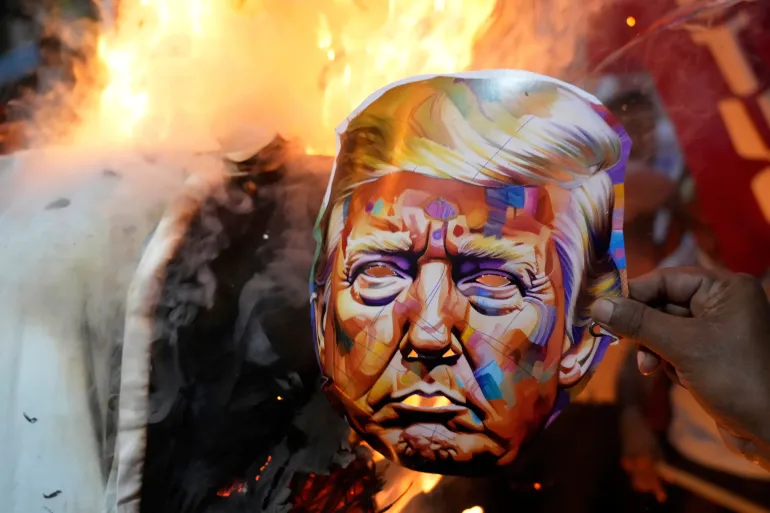
US President Donald Trump had invoked the International Emergency Economic Powers Act (IEEPA) to justify his trade policy, asserting that trade deficits with other countries constituted a “national emergency.” However, the appeals court challenged that logic in its Friday ruling, voting seven to four against the blanket tariffs. The court wrote, “The statute bestows significant authority on the President to undertake a number of actions in response to a declared national emergency. But none of these actions explicitly include the power to impose tariffs, duties, or the like, or the power to tax.”
This ruling differed from the May decision, which had included an injunction to immediately halt the tariffs from taking effect. The Trump administration is expected to appeal to the Supreme Court, and as a result, the appeals court stated that his tariff policy could remain in place until October 14.
What is This Case About?
The initial May decision was issued by the New York-based US Court of International Trade, a specialized court that exclusively handles civil actions related to cross-border trade. This specific case was one of at least eight legal challenges against Trump’s sweeping tariff policies.
Trump has long maintained that US trading partners have taken advantage of the world’s largest economy, and he has framed trade deficits—when the US imports more than it exports—as an existential threat to the economy. However, experts have cautioned that trade deficits are not necessarily a negative sign; they can indicate a strong consumer base or result from differences in currency values.
Despite these warnings, on April 2, Trump invoked the IEEPA to impose 10 percent tariffs on all countries, in addition to individualized “reciprocal” tariffs on specific trading partners. He called the occasion “Liberation Day,” but critics noted that global markets reacted to the tariff announcements by stumbling downwards.
A few days later, as the “reciprocal” tariffs were scheduled to take effect, the Trump administration announced a pause for nearly every country except China. In the meantime, Trump and his officials said they would seek to negotiate new trade deals with global partners. A new list of individualized, country-specific tariffs was unveiled in July through letters Trump posted on his social media account. Many of them took effect on August 1, including a 50 percent tariff on Brazil due to its prosecution of a Trump ally, former President Jair Bolsonaro. Just this week, on August 27, India was also hit with a 50 percent tariff as a result of its purchases of oil from Russia. Mexico, Canada, and China, meanwhile, have faced Trump’s tariff threats since February, with Trump leveraging the import taxes to ensure compliance with his policies on border security and the drug fentanyl.
What are the Arguments?
US presidents do have limited power to issue tariffs to protect specific domestic industries, and Trump has exercised that power in the case of imported steel, aluminum, and automobile products. However, the US Constitution generally places the power to levy taxes, including tariffs, with Congress, not the presidency.
Lawsuits like Friday’s case have therefore argued that Trump has exceeded his presidential authority by imposing blanket tariffs. The appeals court decision also pointed out that the IEEPA does not grant the presidency unchecked power. The ruling stated, “It seems unlikely that Congress intended, in enacting IEEPA, to depart from its past practice and grant the President unlimited authority to impose tariffs.” The decision came in response to two lawsuits: one filed by the nonpartisan Liberty Justice Center on behalf of five US small businesses, and the other by 12 US states.
Despite the appeals court’s decision, Trump appeared defiant on his social media platform, Truth Social, emphasizing that his tariffs would remain in place. He wrote, “ALL TARIFFS ARE STILL IN EFFECT! Today a Highly Partisan Appeals Court incorrectly said that our Tariffs should be removed, but they know the United States of America will win in the end.”
He added that in his view, tariffs “are the best tool to help our Workers.” He also implied he expected the Supreme Court to back him up in his appeal. Trump said, “If these Tariffs ever went away, it would be a total disaster for the Country. It would make us financially weak, and we have to be strong.”
