

U.S. President Donald Trump has issued a warning to Vladimir Putin, stating the Russian leader will face “severe consequences” if he obstructs a peace deal for Ukraine. Speaking before their meeting in Alaska on Friday, Trump said he hopes the talks will be productive but made it clear he is prepared to act if they fail.
Trump also mentioned on Wednesday that a meeting between the two could be followed swiftly by a second one that includes the leader of Ukraine. While he did not specify what the consequences would be, he had previously warned of economic sanctions if the meeting in Alaska proved fruitless.
These comments from Trump and the positive tone following a virtual meeting with European leaders and Ukrainian President Volodymyr Zelensky have offered some hope for Kyiv, which had feared the Alaska summit might result in a sell-out of Ukraine and a carving up of its territory. However, Russia is expected to strongly resist Ukraine and Europe’s demands, having previously stated that its position remains unchanged since Putin outlined it in June 2024.
When questioned if Russia would face any consequences if Putin does not agree to end the war, Trump replied, “Yes, they will.” Asked if these would be sanctions or tariffs, he told reporters, “I don’t have to say, there will be very severe consequences.” The president also described the primary goal of the Alaska meeting as “setting the table” for a quick follow-up with Zelensky.
“If the first one goes okay, we’ll have a quick second one,” he said. “I would like to do it almost immediately, and we’ll have a quick second meeting between President Putin and President Zelensky and myself, if they’d like to have me there.” Trump did not provide a timeline for the second meeting.
Red Lines
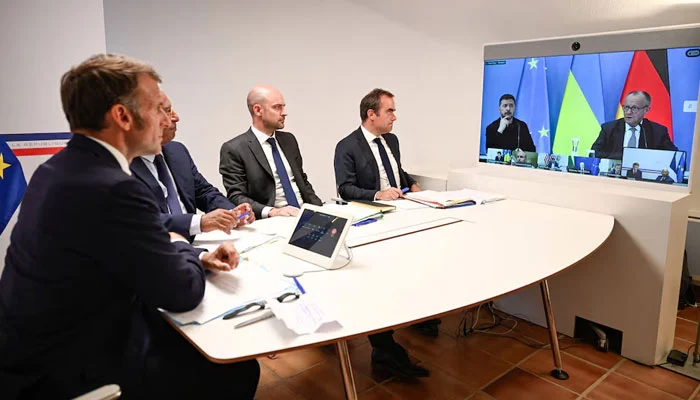
Earlier, European leaders and Zelensky had held a last-ditch virtual call hosted by Germany to establish red lines ahead of the Alaska meeting. Trump described the call as “a 10, very friendly.”
French President Emmanuel Macron said Trump agreed that Ukraine must be involved in any discussions about ceding land, and Zelensky added that Trump supported the idea of security guarantees in a post-war settlement. “President Trump was very clear that the United States wanted to achieve a ceasefire at this meeting in Alaska,” Macron said. “The second point on which things were very clear, as expressed by President Trump, is that territories belonging to Ukraine cannot be negotiated and will only be negotiated by the Ukrainian president.”
German Chancellor Friedrich Merz, who hosted the virtual meeting, emphasized that the principle of not changing borders by force must be upheld. “If there is no movement on the Russian side in Alaska, then the United States and we Europeans should … increase the pressure,” he stated. “President Trump knows this position, he shares it very extensively, and therefore I can say: We have had a really exceptionally constructive and good conversation with each other.”
Trump and Putin are scheduled to discuss how to end the three-and-a-half-year-old conflict, which has been the largest in Europe since World War Two. Trump has previously suggested that both sides would need to exchange land to end the fighting that has claimed tens of thousands of lives and displaced millions.
Russia’s Push in Ukraine
On a day of intense diplomacy, Zelensky flew to Berlin for virtual meetings with European leaders and then with Trump. He and the Europeans are concerned that a land swap could leave Russia with nearly a fifth of Ukraine, effectively rewarding its 11-year effort to seize Ukrainian territory and potentially emboldening Putin to expand further west.
Russian forces have made a significant advance into eastern Ukraine in recent days, a move that may be an attempt to increase pressure on Kyiv to cede land before the talks. Zelensky said, “I told the U.S. president and all our European colleagues that Putin is bluffing (about his stated wish to end the war). He is trying to apply pressure before the meeting in Alaska along all parts of the Ukrainian front. Russia is trying to show that it can occupy all of Ukraine…”
A source familiar with the matter said the call with Trump also touched on potential host cities for a three-way meeting, depending on the outcome of the Alaska talks. European leaders, careful not to anger Trump, have repeatedly welcomed his efforts while stressing that no deal should be made about Ukraine without Ukraine’s direct participation.
Trump’s agreement to the summit last week marked an abrupt shift after weeks of expressing frustration with Putin’s resistance to the U.S. peace initiative. Trump noted that his envoy had made “great progress” during talks in Moscow.
A recent Gallup poll indicated that 69% of Ukrainians favor a negotiated end to the war as soon as possible, but other polls show they are not willing to make crushing concessions for peace. Russian Foreign Ministry spokesperson Alexei Fadeev had previously stated that Moscow’s stance remains unchanged from last year. As conditions for a ceasefire, Putin had demanded that Ukraine withdraw its forces from four regions that Russia claims as its own and formally renounce its plans to join NATO, conditions that Kyiv swiftly rejected as tantamount to surrender.
