

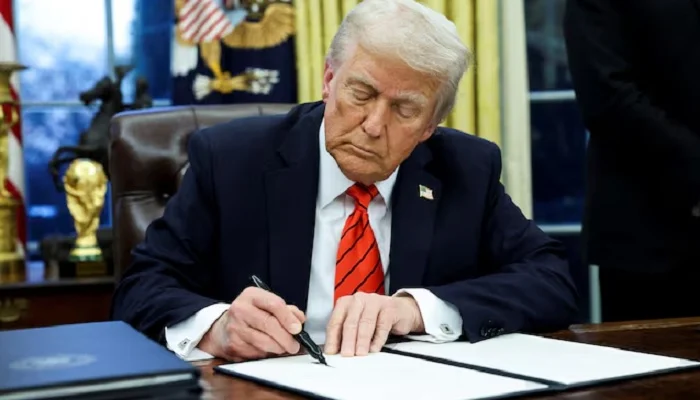
United States President Donald Trump is set to sign his massive tax-cut and spending bill into law on Friday at 5 pm (ET) — 3 am Saturday (PST) — marking a major political win after narrowly clearing Congress. This legislation will deliver sweeping tax breaks for corporations and the wealthy while simultaneously slashing health coverage for millions of Americans.
The 218-214 vote in the House amounts to a significant victory for the Republican president. The bill will fund his immigration crackdown, make his 2017 tax cuts permanent, and introduce new tax breaks that he promised during his 2024 campaign.
It also enacts cuts to health and food safety net programs and zeroes out dozens of green energy incentives. According to the nonpartisan Congressional Budget Office, the bill is projected to add $3.4 trillion to the nation’s $36.2 trillion debt over the next decade.
Despite internal concerns within Trump’s party regarding the 869-page bill’s price tag and its impact on healthcare programs, only two of the House’s 220 Republicans ultimately voted against it, following an overnight standoff. The bill had already passed the Republican-controlled Senate by the narrowest possible margin (51-50).
The White House announced that Trump will sign the bill into law at 5 pm ET (2100 GMT) on Friday, coinciding with the July 4 Independence Day holiday. Republicans assert that the legislation will lower taxes for Americans across the income spectrum and stimulate economic growth. “This is jet fuel for the economy, and all boats are going to rise,” stated House Speaker Mike Johnson.
Conversely, every Democrat in Congress voted against the bill, lambasting it as a giveaway to the wealthy that would leave millions uninsured. House Democratic Leader Hakeem Jeffries, in an eight-hour, 46-minute speech — the longest in the chamber’s history — declared, “The focus of this bill, the justification for all of the cuts that will hurt everyday Americans, is to provide massive tax breaks for billionaires.” Trump maintained pressure throughout the process, cajoling and threatening lawmakers to ensure the job was done. “FOR REPUBLICANS, THIS SHOULD BE AN EASY YES VOTE. RIDICULOUS!!!” he wrote on social media.
Although approximately a dozen House Republicans initially threatened to vote against the bill, only two ultimately did: Brian Fitzpatrick of Pennsylvania, a centrist, and Thomas Massie of Kentucky, a conservative who argued it did not cut spending sufficiently.
Marathon Weekend and Bill’s Impact
Republicans raced to meet Trump’s July 4 deadline, working through the previous weekend and holding all-night debates in both the House and the Senate. The bill passed the Senate on Tuesday in a 51-50 vote, with Vice President JD Vance casting the tie-breaking vote.
According to the CBO, the bill is projected to lower tax revenues by $4.5 trillion over 10 years and cut spending by $1.1 trillion. These spending reductions primarily come from Medicaid, the health program that currently covers 71 million low-income Americans. The bill would tighten enrollment standards, institute a work requirement, and clamp down on a funding mechanism used by states to boost federal payments. These changes, according to the CBO, could result in nearly 12 million people losing health insurance. Republicans added $50 billion for rural health providers to mitigate concerns that these cutbacks might force them out of business.
Nonpartisan analysts have concluded that the wealthiest Americans would experience the most significant benefits from the bill, while lower-income individuals would effectively see their incomes decrease as the cuts to the safety net would outweigh their tax reductions. Analysts also suggest that the increased debt burden created by the bill would effectively transfer wealth from younger to older generations. Ratings firm Moody’s downgraded US debt in May, citing the escalating debt, and some foreign investors have indicated that the bill is making US Treasury bonds less attractive.
The bill raises the US debt ceiling by $5 trillion, averting the immediate prospect of a default. However, some investors are concerned that the burgeoning debt could curtail the economic stimulus intended by the bill and create a long-term risk of higher borrowing costs.
On the other side of the ledger, the bill preempts tax increases that were set to affect most Americans at the end of this year, when Trump’s 2017 individual and business tax cuts were slated to expire. These cuts are now made permanent, and tax breaks for parents and businesses are expanded. The bill also establishes new tax breaks for tipped income, overtime pay, seniors, and auto loans, fulfilling key Trump campaign promises.
The final version of the bill includes more substantial tax cuts and more aggressive healthcare cuts compared to the initial version that passed the House in May. During deliberations in the Senate, Republicans also dropped a provision that would have banned state-level regulations on artificial intelligence, and a “retaliatory tax” on foreign investment that had caused alarm on Wall Street.
This legislation is likely to be a prominent feature in the 2026 midterm elections, where Democrats hope to regain control of at least one chamber of Congress. Republican leaders contend that the bill’s tax breaks will boost the economy before then, and many of its benefit cuts are not scheduled to take effect until after that election. Opinion polls indicate that many Americans are concerned about the bill’s cost and its potential impact on lower-income individuals.
