

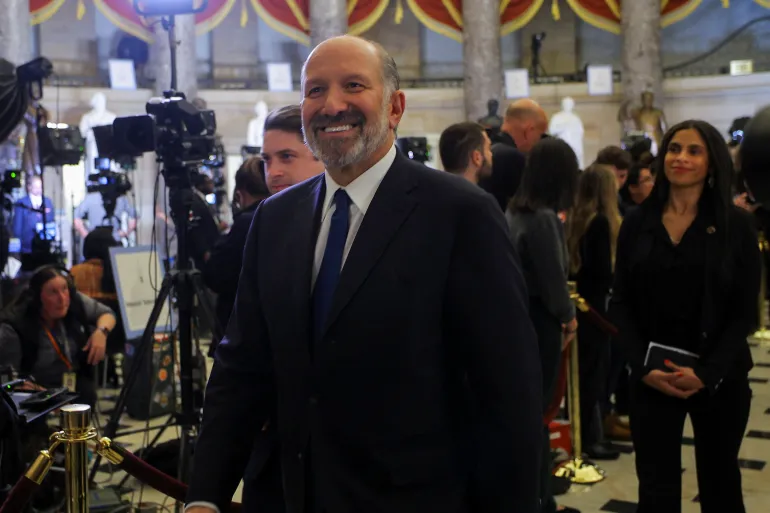
Howard Lutnick, Commerce Secretary and a key proponent of tariffs within the Trump administration, recently asserted that tariffs would not only revitalize the industrial sector in the United States but also bolster government finances. In a July 20 interview on CBS’s Face the Nation, Lutnick informed host Margaret Brennan that the U.S. is currently collecting approximately $30 billion a month in tariffs. “You got to remember – this is going to pay off our deficit. This is going to make America stronger,” he stated.
However, the financial projections do not support this claim. Even if the most recent monthly U.S. tariff collections were sustained for a full decade, they would not cover the 10-year costs of President Donald Trump’s new tax-and-spending legislation, let alone all federal deficits during that period. The current tariffs are set to increase on August 1, including levies ranging from 20 percent to 40 percent for 21 countries, as announced by the Trump administration.
An analysis by the Congressional Budget Office (CBO) – Congress’s nonpartisan fiscal analysis arm – also projects that 10 years of increased tariff revenue under Trump will fail to cover the added deficits from his bill or the cumulative deficits over the next decade. The projected additional deficit from the bill stands at $3.4 trillion, on top of the existing projected deficit of $21.8 trillion over the next decade.
“I can’t envision a scenario where the tariff revenues eliminate the deficit,” remarked Steve Ellis, president of Taxpayers for Common Sense, a group that monitors the federal budget. The White House did not respond to a request for comment for this story.
How Much Is the U.S. Collecting from Trump Tariffs?
The federal government has indeed seen higher tariff revenues under Trump’s more aggressive tariff policies. Currently, tariffs are a baseline 10 percent for all countries, with additional tariffs on certain products like steel. Economists widely believe that consumers will ultimately bear the brunt of most tariff increases.
Federal tariff revenue tracked by the Penn-Wharton Budget Model indicates that, as of July 11, the federal government had collected approximately $100 billion in tariffs so far this year. During the same period in 2024, before Trump took office, federal tariff revenue was less than $48 billion.
In June 2025, the most recent monthly data available, the Treasury Department reported that the federal government collected $27 billion in tariffs. A year earlier, that figure was $6 billion. This represents a $21 billion per month increase directly attributable to Trump’s trade policies. If the government were to maintain this June 2025 collection pace for a full decade (120 months), it would generate $2.52 trillion in tariff revenue.
This figure is in line with the CBO’s June publication. Factoring in the potential economic contraction from higher tariffs, such as increased consumer prices, the CBO projected that the boost in tariff revenue would reduce total federal deficits by $2.8 trillion over 10 years.
How Does This Tariff Revenue Compare with the Federal Deficit?
Without factoring in the deficits from the bill Trump just signed, the CBO’s baseline projection for cumulative deficits over the next 10 years is nearly $21.8 trillion. This amount is approximately seven times the size of the CBO’s projected tariff revenues over the same period. Furthermore, the projected tariff revenue under Trump would not fully cover the added deficits stemming solely from the “megabill” Trump signed. According to CBO estimates, the law signed by Trump on July 4 will increase deficits by $3.4 trillion beyond their previous trajectory over the next 10 years, which surpasses the CBO’s tariff revenue projection.
Uncertainty surrounds the exact amount of tariff revenue Trump’s policies will generate, largely because he has frequently announced and then paused higher tariffs. “It is hard to know what the end game is,” Ellis commented. “Is it high tariffs to generate revenue, which would reduce economic activity, or is it to rebalance the trade and eventually lower tariffs,” thereby impacting their revenue?
The Committee for a Responsible Federal Budget, a fiscally conservative group, has noted that Trump’s tariff policies have faced legal challenges. The initial ruling by the Court of International Trade went against the administration. If this initial ruling is upheld on appeal, Trump would lose his authority to unilaterally enact many of the tariffs he has been imposing, and the new tariff revenues currently being generated would largely dissipate. Even if Trump’s tariff powers are upheld on appeal, a successor could reverse them via executive order, meaning any tariff revenues would only cover the next four years, not the full 10-year period.
Our Ruling
Lutnick stated that tariffs are “going to pay off our deficit.” Trump’s inconsistent approach to implementing tariffs makes accurate estimations challenging. However, two prominent projections indicate that the Trump administration’s tariff revenues will not cover the projected federal deficits over the next 10 years.
The CBO anticipates tariff revenues will reach $2.8 trillion over the next 10 years, while a simple calculation based on June 2025 tariff collections suggests $2.52 trillion. Both figures represent only a fraction of the nearly $22 trillion in cumulative deficits projected over the same 10-year period.
We rate the statement False.
