The Woman Who Knows Trump’s Secrets: Inside the Silent Power Shaping America’s Most Unsettled Presidency
By: Raja Zahid Akhtar Khanzada
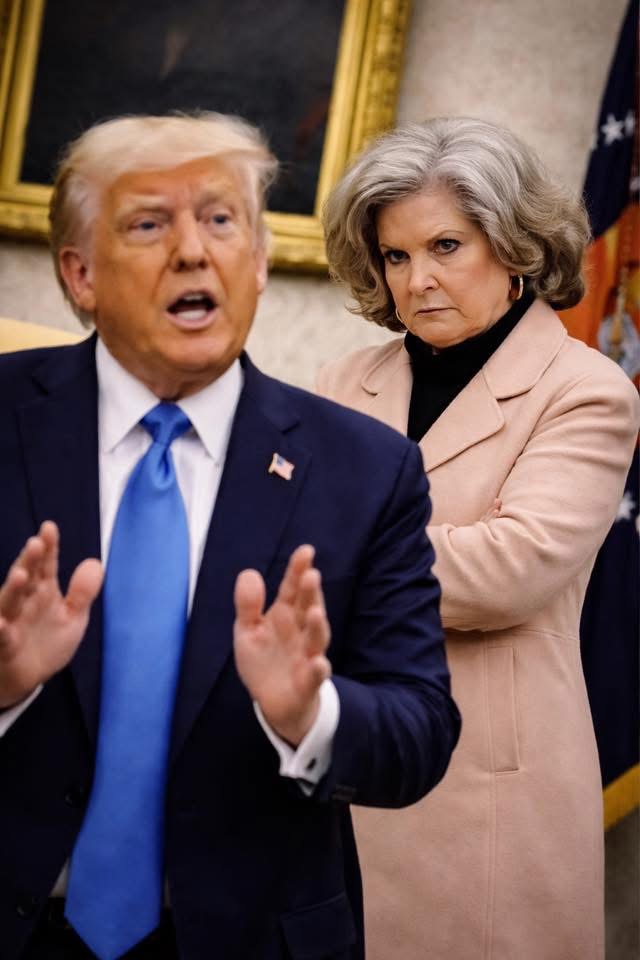
Susie Wiles belongs to that rare class of political figures whose power lies in restraint rather than display. She is seen less on the stage and more behind the curtain, shaping outcomes without demanding attention. As the architect of Donald Trump’s presidential campaign and the first woman to serve as White House chief of staff, she has come to represent more than a position. She now embodies a governing system built on discipline, authority, and continuity. At a moment when the chief of staff role in Trump’s first term was marked by constant turnover and instability, Wiles is widely viewed as the figure most capable of imposing order and restoring control within the president’s inner circle.
In recent days, however, Wiles has stepped into the spotlight herself. In a wide-ranging interview, she spoke with unusual candor about internal divisions inside the White House, tensions over policy, and the forces shaping President Trump’s decision-making. She acknowledged disagreements over tariffs, immigration enforcement, mass pardons, and the use of state power. She also offered pointed assessments of Vice President JD Vance and Elon Musk. In doing so, Wiles lifted, if only slightly, the veil on the quiet machinery of influence that is defining the direction of Trump’s second term.
She is the woman who rarely becomes a headline herself, yet quietly decides which headlines the world will wake up to. Susie Wiles, the White House chief of staff, is not a politician who seeks the spotlight. She is the one who controls its angle. At sixty-eight, measured in tone and restrained in public, she has spent decades mastering the art of power without performance. In Washington, where noise often masquerades as authority, Wiles has always believed that real influence speaks softly and moves decisively. That is precisely why, when she finally spoke at length, it was not just a profile that emerged, but the anatomy of an entire era.
Her story begins long before Donald Trump. She is the daughter of Pat Summerall, the legendary American sportscaster, a man whose booming voice filled stadiums and living rooms, but whose private life was scarred by alcoholism. From him, Wiles learned how brilliance and dysfunction can coexist in the same personality. She has openly said that dealing with difficult men comes naturally to her because she grew up studying ego, volatility, and charm at close range. That experience, she suggests, prepared her for Donald Trump. When she describes him as having “an alcoholic’s personality,” she is not making a casual insult. She is offering a psychological diagnosis: a man who believes nothing is impossible, who sees limits as personal challenges rather than institutional boundaries. For readers in Pakistan and South Asia, this description feels unsettlingly familiar. It echoes the archetype of strongmen everywhere, leaders who equate willpower with destiny.
One scene captures her power more vividly than any policy memo. Inside the Oval Office, Trump was speaking animatedly about ending the Senate filibuster and forcing Venezuela’s Nicolás Maduro from power. In the middle of his monologue, Wiles stood up and headed for the door. Trump, visibly irritated, asked if it was an emergency. Her reply was calm and devastating: yes, it was an emergency, and it had nothing to do with him. Then she walked out, leaving the president guessing. In that moment, the internal hierarchy of Trump’s White House was briefly exposed. Power was not absent, but it was not singular either.
Over months of conversations, Wiles spoke about matters that usually remain buried deep within the state. The Epstein files. Brutal ICE deportations. The dismantling of USAID. The deployment of the National Guard inside American cities. Alleged lethal strikes at sea against suspected drug smugglers that some critics have called war crimes. Trump’s physical and mental health. Even the question of whether he might attempt to defy the 22nd Amendment and seek a third term. These are not the kinds of topics senior officials discuss openly. Yet Wiles did, and in doing so, she revealed the inner weather of Trump’s second presidency.
This is the defining feature of Trump’s current term. It is governance driven by impulse, executed at speed, and justified afterward. Tariffs were branded “Liberation Day,” announced with bravado, and rolled out chaotically. Markets panicked, stocks fell, bonds wobbled, and ordinary Americans felt the cost at the checkout counter. Wiles admitted there were “huge disagreements” over tariffs and acknowledged that the pain was greater than she expected. Polls now show that a majority of voters believe these policies have harmed the economy. What was sold as strength became volatility, and what was promised as control produced uncertainty far beyond US borders.
For South Asian audiences, however, the most consequential revelations lie in immigration. Millions across Pakistan, India, Bangladesh, and Sri Lanka live with some connection to the American immigration system: visas, asylum cases, green cards, or family petitions. Wiles’s admission that the administration must “look harder” at its deportation process is not bureaucratic language; it is an acknowledgment of failure. Venezuelans deported to notorious prisons in El Salvador despite court orders. Families separated. Children, including US citizens, expelled alongside undocumented parents. Masked agents detaining people in the streets. These are not abstract policies; they are human ruptures. Wiles argued that if someone is a proven gang member, deportation may be justified. But if there is doubt, the system must double-check. The unspoken question is whether a system built on speed and spectacle has any patience left for caution.
Despite all this, Trump’s base remains fiercely loyal. Inside the White House and beyond it exists a tightly knit circle that treats criticism as hostility and scrutiny as conspiracy. When Vanity Fair published its profile, no one seriously disputed the quotes. Instead, the defense was that context had been removed. Truth was not denied; it was reframed. Trump publicly praised Wiles while attacking the interviewer as deliberately misleading. Senior Republicans rushed to her defense. Treasury Secretary Scott Bessent called her the most effective operator he had encountered in forty years. Marco Rubio said no one else could do her job. JD Vance declared her the best chief of staff Trump could ask for, while dryly suggesting that the lesson of the episode was to give fewer interviews to mainstream media.
Another layer of the story resonates deeply with South Asian political culture: retribution. Wiles acknowledged that Trump has an instinct for settling scores. That single phrase carries enormous weight. In a system that claims to be governed by law, the suggestion that investigations may be fueled by personal grievance undermines institutional credibility. Probes into political opponents, lawsuits, and pressure campaigns against critics no longer appear isolated. They begin to resemble a pattern. Trump insists it is about justice, not revenge. Wiles’s words complicate that defense.
Then there is Elon Musk, whom Wiles described as a “solo actor,” a man unconstrained by process or tradition. His scorched-earth assault on USAID shocked her. Programs like PEPFAR, credited with saving millions of lives in Africa, were crippled. Vaccinations stalled. Aid networks collapsed. While Musk framed the destruction as efficiency, critics saw moral catastrophe. Even former President George W. Bush reportedly intervened privately, alarmed that one of his signature humanitarian legacies was being dismantled. Wiles admitted she did not initially grasp the scale of the damage. Decisions were made first; consequences arrived later.
Through it all, Wiles occupies an ambiguous position. She insists she is not an enabler, yet she remains inside the machine. She disagrees, yet eventually “gets on board.” She cautions, yet facilitates. This tension defines Trump’s second term more accurately than any slogan. It is a presidency that projects strength while operating in a constant state of reaction. Institutions bend. Norms thin. Power accelerates faster than accountability.
For readers in Pakistan and South Asia, this is not merely an American story. These decisions ripple outward. Immigration crackdowns shape diaspora lives. Aid cuts affect vulnerable populations across the Global South. Trade wars destabilize economies already under strain. When a senior White House official says the system must slow down and look harder, she is speaking to families far beyond US borders who wait anxiously for letters, hearings, and approvals.
Susie Wiles has said a great deal. But what she has not said may matter even more. The silences, the compromises, the moments when caution yields to momentum. History will not judge this era by its rhetoric alone, but by its outcomes. And Donald Trump’s second presidency, guided and witnessed by this quiet woman at its center, is rapidly moving from words to consequences.