

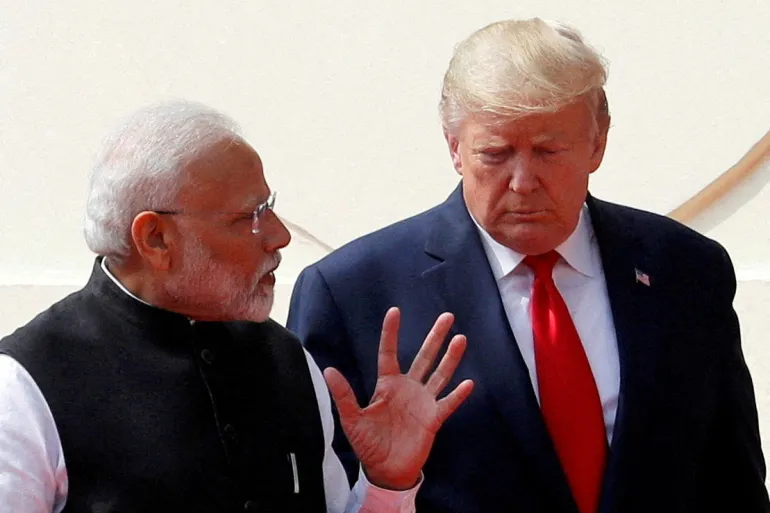
The US has now applied a new and heavy 50 percent tariff, one of its highest rates, to a range of Indian goods. This includes gems and jewelry, garments, footwear, furniture, and industrial chemicals.
This crushing tariff rate will put India at a competitive disadvantage in its exports against China, and will undermine Prime Minister Narendra Modi’s economic plans to transform the country into a major manufacturing hub. Until recently, the US was India’s largest trading partner, with an annual bilateral trade volume of $212 billion.
Which Industries Will Be Worst Affected?
The Global Trade Research Initiative (GTRI), a think tank based in New Delhi, informed The Financial Times that as a result of this announcement, Indian exports to the US could drop from $86.5 billion this year to about $50 billion in 2026. The GTRI stated that the textile, gems, jewelry, shrimp, and carpet sectors would be the hardest hit, with exports bracing for a 70 percent collapse that would “endanger hundreds of thousands of jobs.”
MK Venu, the founding editor of The Wire, told Al Jazeera that the impact would be “huge.” He explained that while India is not a major trading partner for the US, the US is India’s largest partner. According to him, exports of textiles, garments, gems and jewelry, fisheries, leather goods, and handicrafts would be affected. Venu noted that these are “very, very labor-intensive” sectors involving small companies that cannot survive the hit. He added, “They will lose businesses to Vietnam, Bangladesh, Pakistan, and other East Asian economies.”
Will Any Industries Be Exempt?
The Indian pharmaceutical industry has been exempted from immediate tariff increases due to the critical role of generic drugs in providing affordable healthcare in the US. Roughly half of the US’s generic medication imports come from India. In 2024, Indian pharmaceutical exports to the United States were approximately $8.7 billion.
Meanwhile, semiconductors and consumer electronics will also be subject to separate, sector-specific US tariffs. Additionally, aluminum and steel products, along with passenger vehicles, will be subject to tariffs separate from the blanket 50 percent rate.
How is the Indian Government Responding?
Prime Minister Modi has pledged to protect farmers, reduce taxes, and push for self-reliance in the wake of the tariff hikes. In his Independence Day speech at New Delhi’s Red Fort, Modi said that India “should become self-reliant—not out of desperation, but out of pride… Economic selfishness is on the rise globally, and we mustn’t sit and cry about our difficulties.”
Faisal Ahmed, a professor of geopolitics at the Fore School of Management in New Delhi, said that the goal of increasing India’s domestic production capacity is not new. He told Al Jazeera, “It was a policy choice taken by Modi during the COVID-19 pandemic. Trump’s tariffs look set to accelerate that process.”
In addition to the $12 billion income tax giveaway announced earlier this year, the Indian prime minister also stated that businesses could expect a “massive tax bonanza” soon. It is also understood that Delhi is planning to lower and simplify the goods and services tax. These measures, along with a salary increase for nearly five million state employees and 6.8 million pensioners (which will take effect next year), could help India’s economy maintain some growth momentum.
An Indian commerce ministry official told Reuters that exporters hit by the tariffs would receive financial assistance and other incentives to diversify into new markets like Latin America and the Middle East. However, Venu, a former editor of the Financial Express, stated that while there have been assurances from the central bank and the prime minister, no real policy has been laid out.
“Who will fund the subsidy? Will it be taxpayers or some of the big companies that benefited from the Russian oil exports?” Venu told Al Jazeera. “So, there is no clarity on the details of how the subsidies would be provided. Even if subsidies are provided, it won’t be enough to cushion such a huge hit.” He added that the government was not prepared for what was coming. “India should have had a policy, it should have done its homework because we knew that Trump was not going to relent; he was going to punish India for buying Russian oil.”
Ahmed from the Fore School of Management said that the tariffs “shouldn’t have a significant impact on India’s GDP… probably around 1 percent.” Teresa John, a lead economist at Nirmal Bank, agreed, telling Reuters, “We estimate a [negative] impact of about $36 billion, or 0.9 percent of GDP.”
Earlier this year, the International Monetary Fund had forecast that India’s economy would grow by 6.4 percent in 2026. This could now change.
What Reason Did Trump Give for the Tariffs?
Talks to defuse a trade war broke down after five rounds of negotiations, following Trump’s demands for India to halt its imports of Russian oil and gas. Despite the persistent threat of higher US tariffs, India has continued to buy Russian crude this year, although at falling levels.
New Delhi has also been affected by the geopolitical rivalry between Russia and the West. Top Trump officials, including US Treasury Secretary Scott Bessent, have accused India of financing Russia’s war against Ukraine. He pointed out that India’s Russian oil imports went from 1 percent before the Ukraine war to 37 percent, accusing India of “profiteering.”
India’s foreign ministry responded that New Delhi would “take all necessary steps to protect its national interests” and noted that Russian oil imports were driven by market forces and the energy needs of the country’s 1.4 billion people. New Delhi has also accused Washington of selectively targeting India for purchasing Russian oil, while both the European Union and China—with whom Trump has brokered trade deals—continue to import energy from Russia.
Trump, who has unleashed a tariff war that has shaken the global economy, has consistently highlighted the high tariffs imposed by India. During Prime Minister Modi’s visit to the US in February, Trump stated, “India has been, to us, just about the highest-tariffed nation anywhere in the world. It’s very hard to sell to India because they have trade barriers and very strong tariffs.”
New Delhi had promised to remove levies on certain US industrial goods and to increase defense and fuel purchases to address Trump’s grievances over trade imbalances. However, it refused to open its vast farming and dairy sectors to cheap US imports. “Modi will stand like a wall against any policy that threatens our interests,” the Indian prime minister said on August 15. “India will never compromise when it comes to protecting the interests of our farmers.”
For context, at the end of 2024, the simple average tariff rate India imposed on agricultural imports was 39 percent, while the US charged a simple average tariff rate of 4 percent on its agricultural imports. This difference was a point of contention for Trump.
Last year, bilateral trade between India and the US was approximately $212 billion, with a trade deficit of about $46 billion in India’s favor.
Trump’s tough stance has pushed India to improve ties with rival China—the world’s second-largest economy and one of New Delhi’s biggest trading partners, with a bilateral trade of around $136 billion. India is also preparing to host Russian President Vladimir Putin as New Delhi moves to strengthen its traditional ties with Moscow.
“Most strategic experts in India have already said that the trust between India and the US is at an all-time low. So there is an assessment that India will rebalance towards Russia, towards China, and towards BRICS,” said Venu, the veteran Indian journalist.
