The United States, Venezuela, and the New Chessboard of Power
After Maduro, Will Everything Really Fall Into Place?
By Raja Zahid Akhtar Khanzada
History bears witness to a recurring truth: whenever gold, oil, or buried treasure begins to surge from beneath the earth, the sound of crowns clashing soon echoes above it. Time and again, history teaches us that when power begins to see itself as greater than the law, it no longer sits on the throne alone but presses its weight against the very chest of the constitution. From the pharaohs of ancient Egypt to the Caesars of Rome, from the caliphs of Baghdad to the crowned monarchs of Europe, power has always presented itself in the costume of salvation. And each time, the ending has been the same. Power has always gathered around wealth. Once it was grain, then gold, and in our age, it is oil.
The story of Venezuela and the United States is the newest chapter in this ancient human pattern, one in which power, wealth, and suspicion are so tightly entangled that their boundaries blur. Today, this story is being retold once again with new actors, new slogans, and modern weaponry. And at the center of this unfolding chessboard now stands Venezuela.
For much of the twentieth century, relations between Washington and Caracas remained relatively calm. Venezuela served as a reliable source of crude oil for the American economy, while the United States represented a vast and stable market for Venezuela. It was an era in which ideology stood quietly in the background and interests occupied the foreground. Under this unspoken but durable understanding, Venezuela’s state oil company established refineries across the United States, particularly in Texas, Louisiana, and Illinois, facilities specifically designed to process Venezuela’s heavy crude. These refineries symbolized a time when states did not examine one another’s intentions but calculated their benefits, when diplomacy spoke the language of numbers rather than emotion.
That balance began to fracture in 1999, when Hugo Chávez rose to power. He presented himself as a revolutionary leader, labeled the United States an imperial force, and adopted a language that for centuries has overturned thrones. After the failed coup attempt in 2002, distrust hardened into a permanent wall. In 2008, the expulsion of the American ambassador added barbed wire to that wall.
After Chávez came Nicolás Maduro, and the story grew even darker. Political control tightened at home, institutions were gradually subordinated to the state, and the opposition’s voice faded. In Washington, sanctions were woven into a tightening net that slowly suffocated Venezuela’s economy. Behind every falling price, every empty shop, and every growing queue stood a single narrative: the enemy was outside. Maduro and his wife, Cilia Flores, were cast as a defensive wall against the United States.
Then came January 2026. And suddenly, that wall collapsed.
The arrest of Nicolás Maduro and Cilia Flores in a U.S. operation and their transfer to New York stunned the world. This was no ordinary arrest. It resembled the spectacle of a living king brought in chains before a court, a scene once associated with Louis XVI of France or Charles I of England. On January 5, 2026, Maduro stood before a federal court in New York. Charges of narco-terrorism, drug trafficking, and support for terrorist organizations were read aloud. He denied them, declared himself Venezuela’s constitutional president, and claimed he had been abducted. He described himself as a prisoner of war. His lawyer invoked the ancient argument of kings, asserting head-of-state immunity. The court scheduled the next hearing for March. But history’s wheel had already begun to turn.
As Maduro stood in that courtroom, this was not merely the trial of one man. It was the trial of an idea: whether power can stand above the law. Among a segment of the American public, the move was celebrated as a triumph of justice. Recent surveys and opinion polls indicate strong approval among President Trump’s supporters, particularly those who favor a hard-line foreign policy, strict law and order, and the “America First” doctrine. To them, this operation signaled that the United States was no longer weak, that it had reclaimed its ability to impose its terms on the world. Under Trump’s leadership, they believe, America has found a leader unlike conventional politicians, one willing to take risks to make America “great” again.
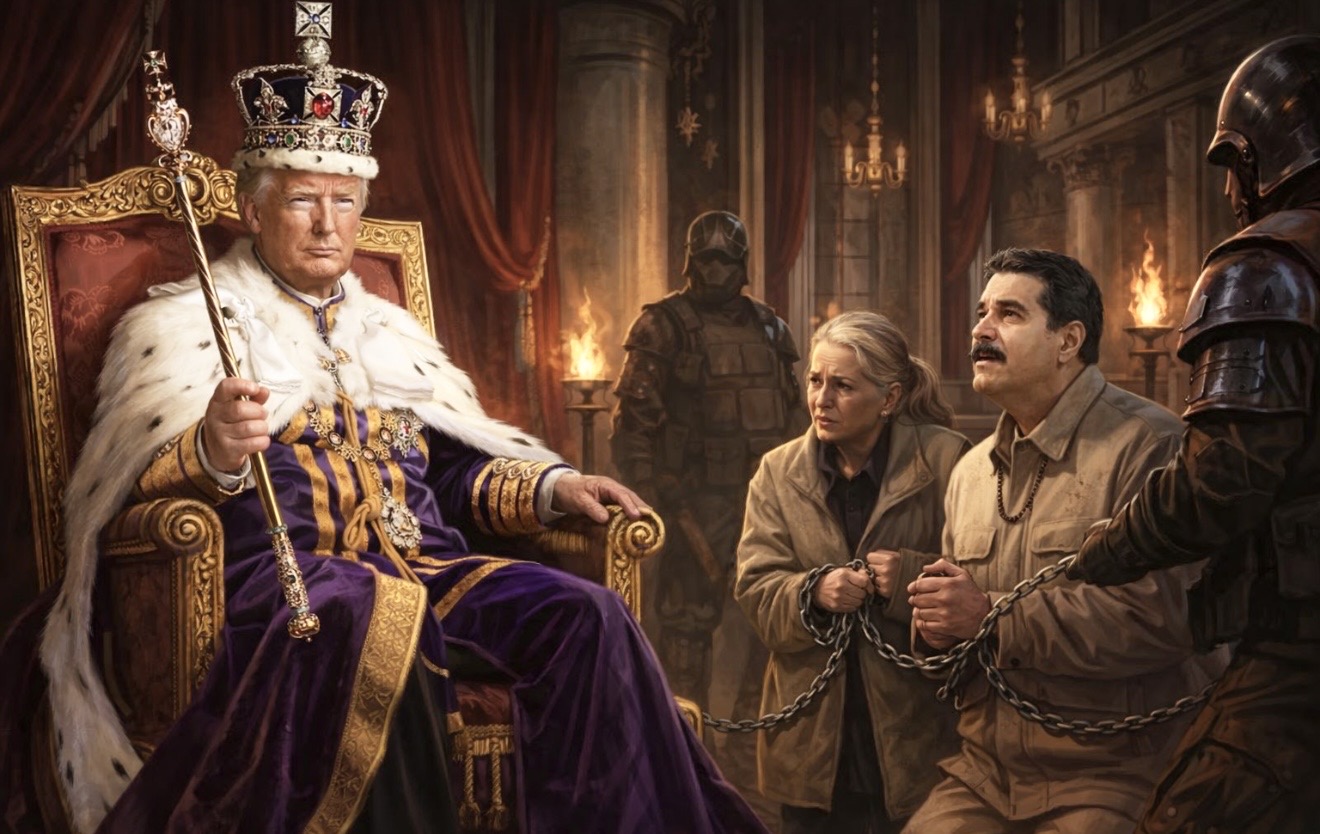
Yet another America exists alongside this one. Human rights advocates, constitutional scholars, and liberal critics warn that the operation sets a dangerous precedent. In their view, it undermines international law and raises troubling questions about America’s own constitutional values. It is within this tension that the image of Trump wearing a crown, presented as a king, ceases to be mere satire and becomes a symbol. It reflects a mindset that sees power not as accountable but as destiny.
For the people of Venezuela, the moment is neither pure celebration nor clear salvation. For those who suffered poverty, hyperinflation, and repression under Maduro, there is hope that change may finally come. But history warns that regime change does not automatically bring relief, especially when imposed from the outside. The deeper danger is that Venezuela may shift from a sovereign state into a laboratory, where decisions are made not in Caracas but in Washington.
The question, then, is not only why Maduro stands before an American court, but how this became possible. U.S. officials describe months of planning involving intelligence coordination, satellite surveillance, human sources, and real-time information. History teaches that when a crown falls, an external blow alone is rarely sufficient. Somewhere inside, a quiet door is opened. For now, who opened that door remains the subject of speculation, not proof.
Inside Venezuela, Delcy Rodríguez has assumed power, playing a role reminiscent of a regent queen in an ancient court, watching loyal generals on one side while reading messages from a foreign empire on the other. She condemns the U.S. operation as aggression, yet understands that the shadow of power stands at the door. Statements from the Trump administration only deepen the contradiction: on one hand, Trump declares that the United States will “run” Venezuela; on the other, his team softens the language, calling it leverage and direction.
Here, the memory returns of an image Trump himself once shared on social media, depicting him crowned as “king.” It was not merely an expression of ego, nor simple political mockery. It was the echo of history, a reminder that powerful rulers have long imagined themselves above the law, mistaking authority for fate. For centuries, kings believed crowns shielded them from accountability. History has repeatedly shattered that illusion. Crowns do not remain forever, and when time turns, courts—whether human or historical—eventually reckon with kings.
The death toll from the operation remains shrouded in uncertainty. Some reports speak of 40, others of 80. Venezuela’s silence suggests that numbers are never just numbers; they are declarations of weakness. Lists are hidden, names disappear.
International reaction has transformed this into a global story. Concern at the United Nations, condemnation from some governments, asset freezes in Switzerland, protests outside the New York courthouse. To some, Maduro is a criminal. To others, he is evidence of power abused.
At the heart of it all lies the same force that has birthed empires for centuries: wealth. Venezuela holds the world’s largest proven oil reserves, roughly 300 to 303 billion barrels, valued at approximately $17 trillion. It also possesses around 161 metric tons of gold, worth nearly $22 billion. These are the treasures for which empires rise and fall. Claims of massive Bitcoin reserves circulate, but for now they remain myth rather than fact. Trump’s rhetoric about “bringing the oil back” echoes an ancient imperial instinct, wrapped in modern language.
The consequences of this move will not stop at the borders of the United States or Venezuela. Unease has already spread across Latin America. Nations in Asia, Africa, and the Middle East are watching closely. If a powerful country can seize the leader of a weaker state in this manner, who will be safe tomorrow. This question shakes the foundations of the global order.
The role of the United Nations and the Security Council has also come under scrutiny. On paper, global institutions exist. Resolutions exist. But when power speaks, these institutions appear silent. What remains of trust has been further eroded. When force becomes the measure of justice, law turns into nothing more than a refuge for the weak.
In the end, the question is one of humanity. Where is the world headed when courts appear to operate in the shadow of power, when crowned leaders seem to stand above the law, and when global institutions become spectators. History tells us that when justice weakens, empires may grow temporarily stronger, but humanity loses. Perhaps that is the most unsettling truth of this story: that we are moving toward a world where principles no longer decide outcomes, only power does. And when power becomes the final argument, neither America nor Venezuela, nor the global system itself, remains truly safe.
And so the question returns, unresolved: after Maduro, will everything really fall into place. History suggests that when a crown falls, the board changes, but the game does not end. The United States and Venezuela now stand at a crossroads where courts, oil, power, and morality collide. The deeper truth may not emerge today, but in the days ahead it will surface through trials, agreements, and the rearrangement of power. Because in history, no king—crowned or not—escapes accountability forever.