

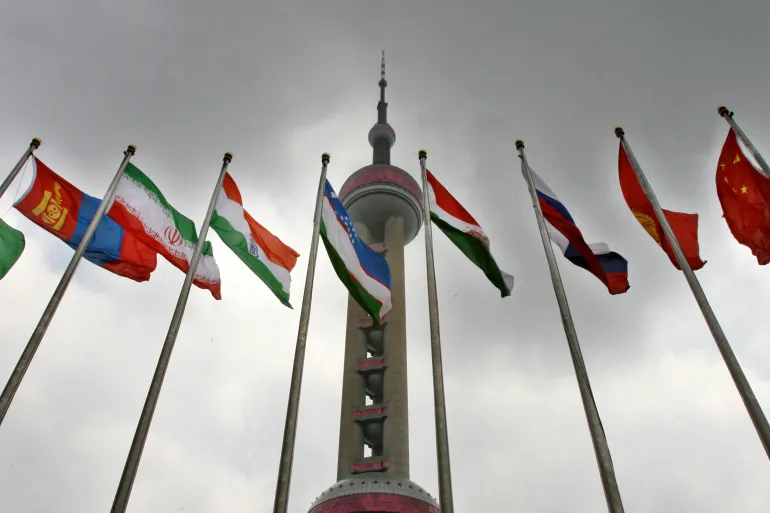
A year later, the geopolitical landscape has undergone significant changes. As China prepares to host the annual Shanghai Cooperation Organisation (SCO) summit, it is expecting a larger gathering of leaders from the region and beyond than ever before. Indian Prime Minister Narendra Modi will visit China for the first time since 2018, signaling a thawing of relations that began late last year but has been accelerated by US President Donald Trump’s 50% tariffs on Indian goods. This move has compelled New Delhi to seek stronger alliances with Beijing and other Eurasian powers.
At a time when much of the world is grappling with the instability caused by Trump’s tariffs and threats, analysts anticipate that the SCO conclave will serve as a platform for President Xi Jinping to project his country as a stabilizing force, capable of uniting the Global South to counterbalance the West, particularly the United States. China’s Assistant Foreign Minister Liu Bin stated at a Beijing news conference last week that the summit would be “one of China’s most important head-of-state and home-court diplomatic events this year.”
Summit Location and Attendees
This year’s summit is scheduled to take place from August 31 to September 1 in Tianjin, a northern Chinese city situated on the Bohai Sea. Liu informed reporters that the summit will bring together more than 20 foreign leaders and the heads of 10 international organizations.
The attendees include leaders of the SCO member states: India’s Modi, Russia’s President Vladimir Putin, Iran’s President Masoud Pezeshkian, Pakistan’s Prime Minister Shehbaz Sharif, Belarus President Alexander Lukashenko, Kazakhstan’s President Kassym-Jomart Tokayev, Uzbekistan’s President Shavkat Mirziyoyev, Krygyz President Sadyr Japarov, and Tajik President Emomali Rahmon.
Other leaders expected to attend include Turkey’s President Recep Tayyip Erdogan, Myanmar’s military chief Min Aung Hlaing, Nepal’s Prime Minister K P Sharma Oli, Indonesia’s President Prabowo Subianto, Malaysia’s Prime Minister Anwar Ibrahim, and the Maldives’ President Mohamed Muizzu. United Nations Secretary-General Antonio Guterres and the Association of Southeast Asian Nations (ASEAN) Secretary-General Kao Kim Hourn will also be present.
The Significance of the SCO
The SCO initially began in 1996 as a security bloc known as the “Shanghai Five,” formed by China, Russia, Kazakhstan, Kyrgyzstan, and Tajikistan to resolve their border disputes after the end of the Cold War and the dissolution of the Soviet Union. In 2001, the group evolved into the SCO with the inclusion of Uzbekistan and established its headquarters in Beijing. In 2017, India and Pakistan were admitted as full members, followed by Iran in 2023 and Belarus in 2024. The organization also has 14 key dialogue partners, including Saudi Arabia, Egypt, Turkiye, Myanmar, Sri Lanka, and Cambodia.
SCO member states collectively account for 43% of the world’s population and 23% of the global economy. However, Alejandro Reyes, an adjunct professor at the University of Hong Kong, told Al Jazeera that the group’s vision and identity remain ambiguous. The US led most post-World War II multilateral organizations, but the emergence of economies like China, India, Brazil, and South Africa has led to a “diversification of multilateralism,” resulting in the formation of organizations such as BRICS, which seeks to amplify the voice of the Global South.
Distinctions between SCO and BRICS
BRICS, an acronym for Brazil, Russia, India, China, and South Africa, positions itself as a forum for the Global South, discussing geopolitics, global security, and trade, among other issues. Reyes noted that while the SCO emerged with a focus on regional security, the expansion of its mandate to include trade and other Global South concerns makes it difficult to differentiate it from organizations like BRICS.
Manoj Kewalramani, chairperson of the Indo-Pacific Studies Programme at the Takshashila Institution, agreed, stating that the SCO is “still an organization that is looking for an identity.” He pointed out that the SCO’s articulation of “indivisible security” is the complete opposite of NATO’s vision. “The NATO vision is bloc-based collective security. The SCO vision is that everyone’s interests should be taken into account whilst addressing global issues.”
Special Relevance of This Summit
This year’s summit is occurring amidst Russia’s ongoing war in Ukraine, Israel’s actions in Gaza, security tensions in South Asia and the Asia Pacific, and Trump’s global trade war. Kewalramani said that with the world “clearly in deep flux,” “you’re likely to see China or Russia in particular, make the case that the world is entering an era of multipolarity and articulate indivisible security as the way forward.”
Reyes added that the significance also lies in the optics and symbolism of China as the host. “This is a time when the US is burning bridges with almost every country. So in President Xi’s mind, it is a good time for China to position itself as a world power by showcasing it has productive relations with many countries.”
Two days after the SCO summit concludes, Beijing will also host a major military parade on September 3 to commemorate the end of World War II in Asia. Many of the leaders attending the SCO summit—such as Putin, Lukashenko, and Subianto—are expected to stay for the parade. North Korean leader Kim Jong Un is also anticipated to travel to Beijing for the event, which will be “a big part of this optic” of Xi hosting world leaders.
SCO Positions on Key Issues
The group often struggles to agree on key geopolitical issues. For instance, on the war in Ukraine, Russia has managed to align most SCO members with its interests, but India has attempted to maintain a balanced role, seeking peace and stronger ties with Ukraine while also buying record levels of oil from Russia.
Similarly, Israel’s actions in Gaza have divided the SCO. When the group condemned Israel’s attack on Iran this year, India, which also has strong ties with Israel, refused to endorse a joint statement.
Tensions also persist between India and fellow SCO member Pakistan. New Delhi has called on the organization to condemn cross-border terrorism, for which it blames Islamabad. When the SCO, which operates by consensus, did not agree to a demand from India to condemn a specific attack, India refused to sign a joint statement after a meeting of the group’s defense ministers.
Divisions within the SCO
According to Kewalramani, “different countries on the platform are there for different reasons.” He noted that Central Asian countries joined for security and to boost economic engagement with China, while for India, addressing regional terrorism was key.
Reyes reiterated that symbolism is likely to outweigh any real deliverables at the meeting. “I doubt that this organization is able to get much deeper than just the symbolism of gathering as a platform for the Global South, as a platform for Russia and China to convene to present themselves as senior partners in this Eurasian landmass.”
Implications for the US
Trump has been critical of organizations from the Global South, having previously threatened to cripple BRICS with targeted tariffs. Reyes said the SCO summit will be closely watched by the US and could set the tone for the Quad Summit later this year, which India is set to host. The Quad, or Quadrilateral Security Dialogue, was established in 2007 by India, Japan, Australia, and the US to counter China’s growing influence.
Kewalramani cautioned against concluding that the India-US relationship is broken, despite tensions over tariffs. “These are mature economies who have close relationships on many fronts. The US will be watching how not only India but also Pakistan, Iran, and indeed Russia and China interact among themselves at the SCO Summit on some of the key geopolitical issues and trade.”
