

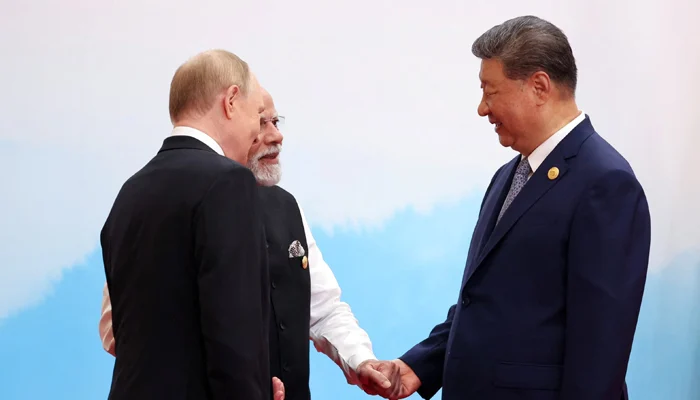
At the recent Shanghai Co-operation Organisation (SCO) meetings in Tianjin, China placed energy cooperation at the forefront of its agenda. President Xi Jinping announced that China will invest in building 10 gigawatts (GW) of solar and 10 GW of wind power across SCO member countries over the next five years.
This marks a significant increase from the 1 GW of solar and 0.3 GW of wind China has invested in SCO states since 2019. At the same time, the Power of Siberia-2 gas pipeline received tacit support. If built, this pipeline could raise Russia’s share of China’s gas imports to one-third by the 2030s.
So, how will China’s energy investments influence the energy transitions of SCO member states? And does China’s cooperation with Central Asian countries and energy giant Russia signal a profound shift in the global energy landscape?
To answer these questions, Dialogue Earth spoke with experts from China, India, Pakistan, and Finland.
Lauri Myllyvirta
Senior Fellow, Asia Society Policy Institute; Lead Analyst, Centre for Research on Energy and Clean Air
China’s recent pledge to develop 10 GW of wind and 10 GW of solar power projects across SCO countries represents a potentially important step forward in its overseas energy engagement. While Chinese manufacturers have long dominated the global solar power equipment supply, the vast majority of this equipment is used in projects with no Chinese involvement in their development or financing. The pledge could be an opportunity for Chinese power companies and project developers to expand their presence beyond equipment exports. It could help them accelerate renewable energy deployment abroad by leveraging the expertise they’ve built in scaling up clean energy at home.
Currently, China’s involvement in overseas clean energy is largely confined to bidding for projects already included in host-country energy plans. This new pledge could create an opening for China to engage more deeply in dialogue with partner governments beyond discrete projects.
This dialogue could help shape broader national energy planning by combining renewable generation with storage, transmission, and equipment manufacturing. Such a shift would not only strengthen the international position of Chinese developers but also help partner countries raise their ambitions for renewable energy deployment.
Since 2019, China has invested in 10.4 GW of solar and 7.6 GW of wind power overseas. Within SCO countries, however, investment has been far more modest, with just 1.0 GW of solar and 0.3 GW of wind over the same period. This suggests both the limited scale so far and the significant potential for Chinese investors to expand clean energy deployment in these markets.
In 2024, Pakistan imported 17 GW of solar panels. India added roughly 28 GW of wind and solar, and even Uzbekistan brought online about 1.8 GW of solar. Given these countries’ rapidly growing energy needs, a collective target of 10 GW each for solar and wind across all SCO countries over five years represents only a small fraction of their overall demand.
One caveat is that investing in Russia, a member of the SCO, while it continues its illegal war of aggression against Ukraine, would carry serious reputational, diplomatic, and ethical risks. Pursuing clean energy cooperation in other SCO member states—many of which have pressing needs to diversify their energy mix, improve energy security, and lower emissions—would both reinforce China’s clean energy leadership and demonstrate alignment with global climate goals.
In summary, the 10+10 GW initiative can move Chinese overseas engagement from equipment export and project bidding toward systemic cooperation and energy planning. This way, it could meaningfully advance clean energy transitions in SCO countries while strengthening China’s role as a global clean energy partner.
Xie Cheng Kai
Schwarzman Academy Associate, Chatham House
The SCO summit saw the announcement of new “energy and green-industry” platforms and the floating of a new development bank. While these initiatives are still at an early stage, more substantive progress is evident in gas pipeline projects and financial integration. These developments reflect China’s long-term efforts to diversify and strengthen its position in global energy and finance.
The revival of the Power of Siberia-2 pipeline is the clearest example. Gazprom’s CEO said a memorandum of understanding (MoU) has been signed, though China has not confirmed this. The Chinese foreign ministry spoke only of “actively promoting cross-border infrastructure and energy projects” with Russia and Mongolia. No contract price, timeline, or precise volume has been disclosed. Yet symbolism matters.
Like Power of Siberia-1, which gained political momentum years before its terms were finalized, the second iteration has shifted from stagnation to motion.
If realized, it could deliver 50 billion cubic meters annually and push Russia’s share of China’s gas imports to a third by the 2030s. For now, the pipeline is best read as a geopolitical signal rather than a commercial certainty. Whether it moves from an MoU to reality will depend much on the terms China can extract and Moscow can accept.
Unlike in oil, where China has avoided heavy dependence on one supplier, in gas it appears willing to accept concentration because it provides options in a world where the United States remains the largest liquefied natural gas (LNG) exporter. Overland Russian supply could offer China a useful hedge against over-reliance on U.S. LNG and the Western financial architecture that underpins it.
India, too, continues buying discounted Russian crude despite new U.S. tariffs, as highlighted by the warm optics of Putin’s recent meeting with Modi in China. The message is that China is not isolated. Others in Asia are also resisting U.S. pressure.
Finance is the parallel frontier. According to the Financial Times, Chinese regulators told Russian energy firms they can issue renminbi-denominated “panda bonds” in China’s domestic market—the first such issuance since 2017. Coupled with the fact that more than 90% of bilateral trade already settles in rubles and renminbi, this deepens Moscow’s dependence on China’s financial system and provides a sanctions-resistant funding channel for pipelines and LNG logistics. It also advances Beijing’s strategic goal of renminbi internationalization, embedding energy security within financial sovereignty.
Pipelines, panda bonds, and LNG defiance illustrate that China is embedding energy security and financial sovereignty in closer alignment with Moscow, while India’s continued purchases show it is not acting alone. The market impact may not be immediate, but the political signal is hard to miss.
Li Yuxiao
Beijing-based Project Lead, Greenpeace East Asia
Achieving the wind and solar power goals outlined in the SCO meetings will require a great deal of active collaboration across the entire industrial chain. This includes the manufacturing of wind and solar photovoltaic technology, and financing from Chinese investors.
Even as China’s domestic wind and solar capacity booms, Chinese investors still face serious obstacles to investing in wind and solar projects abroad. They will require stronger policy support for implementation and insurance.
In our work in Beijing, we have for years spoken to Chinese investors, enterprises, and banks who express keen interest in wind and solar but are faced with a lack of effective financial mechanisms and limited risk coverage. Chinese investors looking at overseas wind and solar projects face limited financing structures, inflexible insurance guarantees, lengthy approval processes, and a fragmented regulatory system not aligned with international technical standards. All of this inhibits investments.
The 10+10 GW targets would involve the whole industrial chain for wind and photovoltaic. The industrial strategy behind this agreement has, of course, received a lot of attention. But while much attention has gone to the strategic “offloading” function of such agreements for China’s clean-tech industries, this particular agreement’s inclusion of “technology transfer” and “experience exchange” stands out.
This is an area that will be of strategic interest for member countries. Indeed, the member countries’ response statements give greater emphasis to these elements. If effective technology transfer and experience exchange occur between China and partners in the Global South, it could significantly support local industry development from the ground up. Ultimately, it could benefit regional energy structures and advance the energy transition both locally and globally.
Ruchita Shah
Energy Analyst, Asia, at Ember
India’s participation in the SCO summit reflects a willingness to engage in energy cooperation, as China seeks to shape the forum into a platform for green-technology collaboration. For New Delhi, this engagement could indeed help streamline trade and knowledge sharing on green technologies.
However, it will remain cautious in order to protect its domestic supply-chain reforms. It will continue pursuing diversification to prevent falling into new dependencies.
And it will emphasize ensuring that cooperation creates value within India through technology transfer, finance, and joint research and development, rather than simply expanding import flows.
Chinese solar photovoltaic modules have been crucial in driving India’s installed solar capacity up to its current 120 GW.
Meanwhile, domestic manufacturing of solar panels has expanded rapidly from 2.3 GW in 2014 to 100 GW by 2025. But India still depends on China for both solar cells, which are the building blocks of solar panels, and for battery components. Though a Production Linked Incentive scheme has been launched to support domestic battery-manufacturing capacity.
Meanwhile, India’s growing fossil-fuel imports need to be seen in the context of its broader energy transition. As the world’s fastest-growing major economy, it needs to balance rising development-driven energy demand with supply security. Oil demand will continue to rise in the medium term, even as electrification gathers pace. There is no official climate target linked to reducing oil consumption. Instead, India’s climate commitments focus on expanding renewable energy, reducing emissions intensity, and reaching net zero by 2070. Higher oil imports today do not contradict its climate targets, as they are framed around reshaping the power mix and improving efficiency, largely by reducing reliance on coal.
India’s influence in energy and climate discussions extends beyond its reliance on imports. Renewables already make up half of its installed power capacity, and it is targeting 365 GW of solar and 140 GW of wind by 2032. Electrification in transport, agriculture, and domestic energy use is accelerating. At the same time, policies such as the Approved List of Models and Manufacturers and the Production Linked Incentive schemes for solar, batteries, and green hydrogen are trying to localize supply chains and reduce import dependence.
Over the years, India has built a supportive policy environment for the energy transition. Competitive renewable auctions have consistently delivered some of the world’s lowest tariffs, helping shape international price benchmarks and procurement models in other emerging economies. India also co-founded and leads the International Solar Alliance, now joined by over 120 countries, highlighting its role in shaping global clean energy governance. Its advocacy in multilateral forums emphasizes equitable, sustainable transitions for emerging economies. The SCO’s 2025 declaration also recognized India’s global vision of “One Earth, One Family, One Future,” reaffirming its leadership in promoting inclusive and sustainable development.
Omais Abdur Rehman
Senior Associate, Renewables First; Lead Coordinator, Pakistan Renewable Energy Coalition
This year’s SCO summit drew unprecedented attention due to shifting global dynamics.
The U.S. has imposed heavy tariffs on China and India, and it is putting pressure on Russia to end the conflict in Ukraine, and pressure on India not to buy oil from Russia. SCO member states, therefore, began signaling interest in a parallel global system. China, especially, has felt the need for an alternative. This was also the first summit with both the heads of state of India and Pakistan present since the recent military conflict between the countries.
India, frustrated by external interference, including Trump’s claims of mediation on Pakistan-India tensions, appeared to recalibrate its posture, hinting at openness to Chinese infrastructure support. China seized the moment, hosting the largest SCO summit to date with 24 heads of state, and outlining expansive ambitions for the bloc beyond symbolic diplomacy.
Climate cooperation emerged as a key theme. China proposed a new SCO development bank and pledged CNY 2 billion in grants and CNY 10 billion in loans. Russia backed the multilateral approach, reinforcing a shared stance against hegemonism. However, despite the urgency—especially with Pakistan and India facing severe climate disasters—the summit lacked concrete mechanisms for joint climate action or immediate relief.
For Pakistan, the summit signals a potential pivot. The approval of the SCO Development Strategy 2035 and of the proposed SCO development bank offers alternatives to International Monetary Fund and World Bank financing.
Aligning with SCO’s broader development goals, Chinese and Pakistani leaders emphasized opening up new opportunities under the China-Pakistan Economic Corridor (CPEC) for industrial, agricultural, energy, and digital cooperation. Pakistan’s prime minister officially announced the launch of CPEC 2.0. Furthermore, the Second Pakistan-China B2B Investment Conference focused on not just electric vehicles, petrochemicals, and iron and steel, but also health and agriculture.
Pakistan is likely to deepen its engagement with China to advance its energy transition through decreased reliance on fossil-fuel assets. It is time for China to move toward the phase-out and early retirement of coal in Pakistan as well as other countries. The SCO can help China focus on these goals.
Amid the strained relationship between India and Pakistan, climate resilience presents a rare opportunity for collaboration. The present floods in both countries have yet again proven this is not an option but a necessity.
The continued India-Pakistan tensions, along with the failure to present a joint climate-action plan at the summit, remain critical challenges. But the SCO provided a platform for both countries to discuss possible transboundary collaboration.
